
Original briefings. Zero spin.
Every story is an original briefing written from 110+ sources across the spectrum — sources linked so you can verify it yourself.
 tech
Notable (6/10)
Event date: August 12, 2026
tech
Notable (6/10)
Event date: August 12, 2026
CoreWeave's Quarterly Interest Bill Hits $640 Million, Up 140% as Total Debt Tops $35 Billion
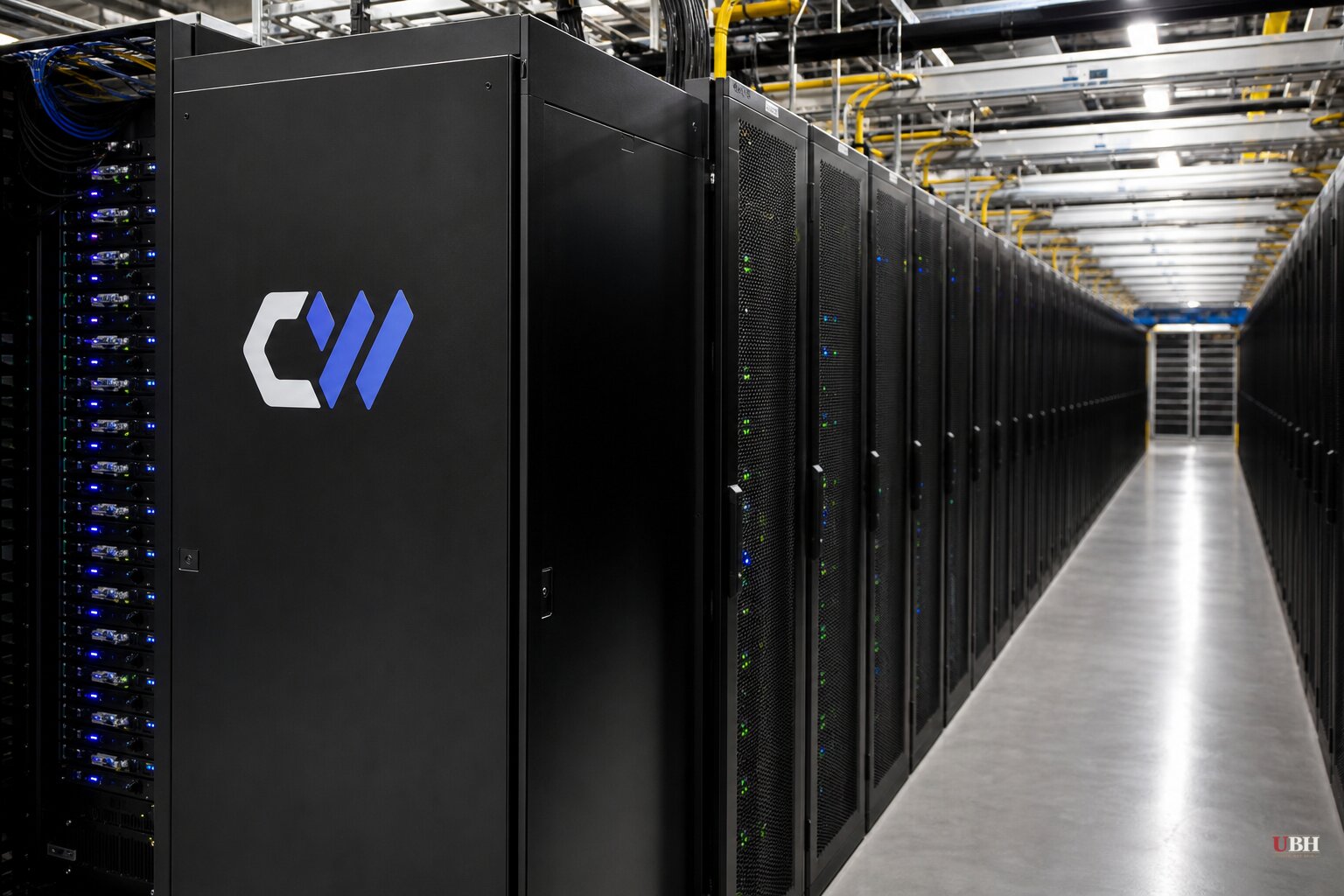
CoreWeave's second-quarter numbers, reported in mid-August, show contrasting financial pictures.
One side shows strong growth: revenue of $2.575 billion, up 112% from $1.212 billion a year earlier, according to the company's earnings release cited by Crypto Briefing and The Register. Revenue backlog hit $104 billion, up 246% year-over-year. Full-year 2026 revenue guidance was raised to $12.4 billion to $13.2 billion, according to trendspider.
The other shows mounting financing costs. Interest expense hit $640 million for the quarter, 2.4 times the $267 million CoreWeave paid a year ago, according to both Crypto Briefing and The Motley Fool. GAAP net loss widened to $626 million, up from $290 million in Q2 2025.
The debt keeps growing faster than the rate falls
Total debt reached roughly $35 billion to $35.6 billion as of June 30, according to The Motley Fool and The Register, up from about $21 billion at the end of 2025. CoreWeave raised more than $10 billion in new debt and capital during the quarter alone, including a $3.1 billion term loan and a $1 billion investment from Jane Street, according to Crypto Briefing.
CFO Nitin Agrawal told analysts on the earnings call that CoreWeave has cut its weighted average cost of debt by nearly 300 basis points over the past year, worth roughly $1.1 billion in annualized savings on the current balance, as reported by The Motley Fool. The weighted average interest rate across CoreWeave's borrowings stands at 8.4%, according to The Motley Fool, ranging from 2% on convertible notes up to 15% on its oldest term loan. New notes priced in April and June came in at 9.75% and 9.625%.
CoreWeave now guides for Q3 interest expense of $860 million to $940 million, a roughly 40% jump in a single quarter, according to Crypto Briefing.
What credit markets did in mid-July
In mid-July, CoreWeave went to the leveraged-loan market for a $2.6 billion delayed-draw term loan, its fifth-and-a-half such facility. MarketWise, drawing on loan-market reporting from LSEG and Octus, reported the deal launched July 16 at a spread of SOFR plus 425 to 450 basis points, offered at 99 cents on the dollar, then stalled until CoreWeave agreed to terms more favorable to lenders. The deal closed around August 10, described by the company as "meaningfully oversubscribed."
Fitch rated the loan BB+ and Moody's rated it Ba2, both below investment grade. MarketWise argued that lenders demanding tighter terms before committing capital is a more honest signal about a company's risk than its stock price. The sub-investment-grade ratings are a matter of record.
The bull case is real too
CoreWeave's defenders have plenty to point to. CEO Michael Intrator told analysts that AI compute is shifting from a one-time training cost to "a single continuous loop" of training, inference, and redeployment, which he argues creates recurring rather than one-off demand. The company says near-term capacity is effectively sold out and pushed through a roughly 25% price increase across SKUs in July without losing customers, according to trendspider.
Adjusted EBITDA hit $1.51 billion at a 59% margin, and operating cash flow turned positive at $679 million, according to 24/7 Wall St. Gartner named CoreWeave a visionary in its 2026 Magic Quadrant for Cloud AI Infrastructure, and the company was added to the Nasdaq-100. Wall Street's consensus price target sits at $144.46 across 37 analysts, with 26 rating it Buy or Strong Buy versus one Sell, according to 24/7 Wall St.
Shares nonetheless have traded in the low-to-mid $80s as of early September, down roughly 47% from a 52-week high of $153.20 hit in May, according to The Motley Fool and 24/7 Wall St.
The concentration risk nobody's spinning away
The Register's review of CoreWeave's Form 10-Q filed with the SEC found that 93% of the quarter's revenue increase came from existing customers rather than new ones, and that just three customers accounted for 36%, 26%, and 10% of quarterly revenue, 72% combined. CoreWeave itself warned in the filing that it "cannot predict whether we will maintain this level of growth or when we will achieve positive net income."
Total liabilities stood at $72.05 billion against just $5.02 billion in equity, according to 24/7 Wall St, and analysts cut fiscal 2026 EPS estimates seven times against one upward revision over the trailing 30 days.
CoreWeave's full-year 2026 capital expenditure guidance now stands at $35 billion to $39 billion, mostly for Nvidia GPU-heavy data centers, per Crypto Briefing. Q2 free cash flow ran negative $5.74 billion, according to 24/7 Wall St. Whether the $104 billion backlog converts into cash fast enough to keep servicing a debt load that's compounding quarter over quarter is the question CoreWeave's next earnings report, expected around November, will start to answer.
Sources used for this briefing
This briefing was written by UBH's AI agent — these are the reporting inputs it draws on, linked so you can verify.


