
Unbiased headlines. Facts, not spin.
Unbiased Headlines is an independently owned news organization. We bring you the facts, not opinions, written fresh from 110+ named sources. Sources linked so you can verify it yourself.
 energy
Notable (5/10)
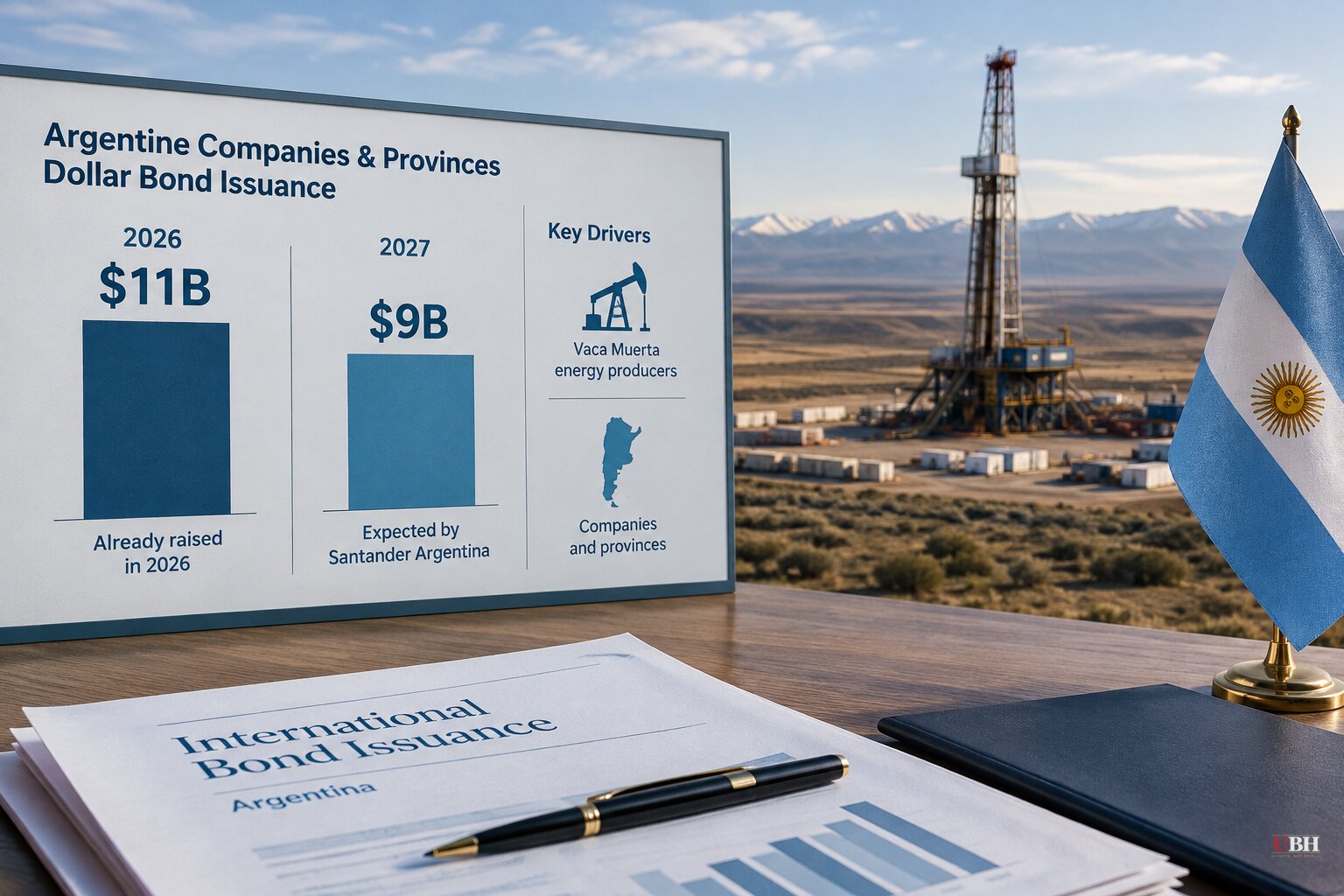
Argentine Firms Have Raised $11 Billion in Dollar Bonds in 2026. Santander Expects $9 Billion More in 2027
Argentina's energy companies are borrowing in dollars at a pace the country has not seen in years, and the bankers arranging the deals say it will not stop soon.
Companies and provinces had raised more than $11 billion in dollar bonds in 2026 as of Nov. 17, according to Bloomberg data. Mariano Urquiola, head of Corporate and Investment Banking at Santander Argentina, expects about $9 billion more in 2027. Borrowers are expected to crowd into the first half to get ahead of the October presidential election.
Energy leads the borrowing
Santander is the top underwriter of these deals. It has arranged nearly $7 billion in Argentine bond sales since the start of 2024, including more than $3 billion this year. JPMorgan ranks second and Citigroup third.
Urquiola said energy issuers have "fundamentals so strong that they're less vulnerable to these shocks," and that some can still borrow at single-digit yields. Strong balance sheets and growing shipments have made the sector's debt a favorite of international investors.
The money is headed mainly to Vaca Muerta, the shale formation in northern Patagonia. In August it produced 670,000 barrels of oil and 95 million cubic metres of natural gas per day. That was 72% of Argentina's oil output and 62% of its gas.
State-run YPF projects Vaca Muerta will generate $50 billion in annual export dollars by 2031, which would put it in range of the agricultural sector. TotalEnergies pledged $10 billion in October, according to energy-sector reporting.
What the export numbers show
The national statistics agency INDEC reported $12.452 billion in energy exports from January through September 2026, up 53.6%. September alone came in at $1.781 billion, up 89.1% from a year earlier.
Higher global prices tied to the war in Iran have helped. But the larger driver is volume. Argentina set an oil production record earlier this year, and its trade surplus in energy has grown since 2022 as domestic output replaced imports.
The central bank, the BCRA, said private external debt in oil and gas extraction rose $1.301 billion in the second quarter. Debt securities made up 80% of that increase. The proceeds were intended to finance repatriations of foreign direct investment.
Different from the last boom
Corporate and provincial borrowers have raised almost $30 billion since the start of 2024. In the 2016-2017 boom under Mauricio Macri, the total was nearly $60 billion, and the federal government was the dominant borrower. A financial crisis and an IMF bailout followed, and issuance stayed low through the 2020-2023 Peronist administration.
This time the federal government is not the one issuing. President Javier Milei's administration relies on local debt sales and other funding sources. The company and provincial deals still bring in foreign currency, which supports the central bank's effort to build reserves.
Sovereign foreign-currency debt repayments are projected at about $25 billion next year. Argentina's Ministry of Economy puts 2027 Treasury foreign-currency financing needs at $24.9 billion.
The election clock
Not everyone sees the early rush as pure upside. Pampa Energía CFO Adolfo Zuberbuhler urged issuers to arrange financing early. He also warned that a stampede of borrowers before the vote could make it harder for other companies to get into the market.
Sovereign debt has been shakier than corporate debt. Fernando Losada, a managing director at Oppenheimer & Co., said Argentina has underperformed "because of the perception that political risk ahead of next year's election is — and will continue to be — elevated." Bloomberg has tied investor concern to Milei's re-election prospects, citing his declining popularity and slowing economic growth.
David Austerweil, a portfolio manager at VanEck, called Argentina "a crowded long" that "lacks positive catalysts." Santander's argument is that energy credits are a different animal from the sovereign and from weaker issuers.
The energy trade is real money. Exports are up more than half this year and the production base is growing. But the 2027 financing calendar depends on a market that is pricing election risk into the sovereign while energy borrowers still get single-digit rates.
Whether that gap holds is uncertain. Santander is betting borrowers get their deals done in the first half of 2027. The vote in October, and the roughly $25 billion in sovereign payments due before and around it, will test that bet.
Sources used for this briefing
7 links from 6 independent newsrooms (syndicated copies of the same report count once)
These are the sources it draws on, linked so you can verify.


