
Original briefings. Zero spin.
Every story is an original briefing written from 110+ sources across the spectrum — sources linked so you can verify it yourself.
 tech
Notable (6/10)
September 1, 2026 at 08:14 AM
tech
Notable (6/10)
September 1, 2026 at 08:14 AM
Apple Says Ex-Engineer's MacBook Backs Claim That Stolen Circuit Files Were Used at OpenAI
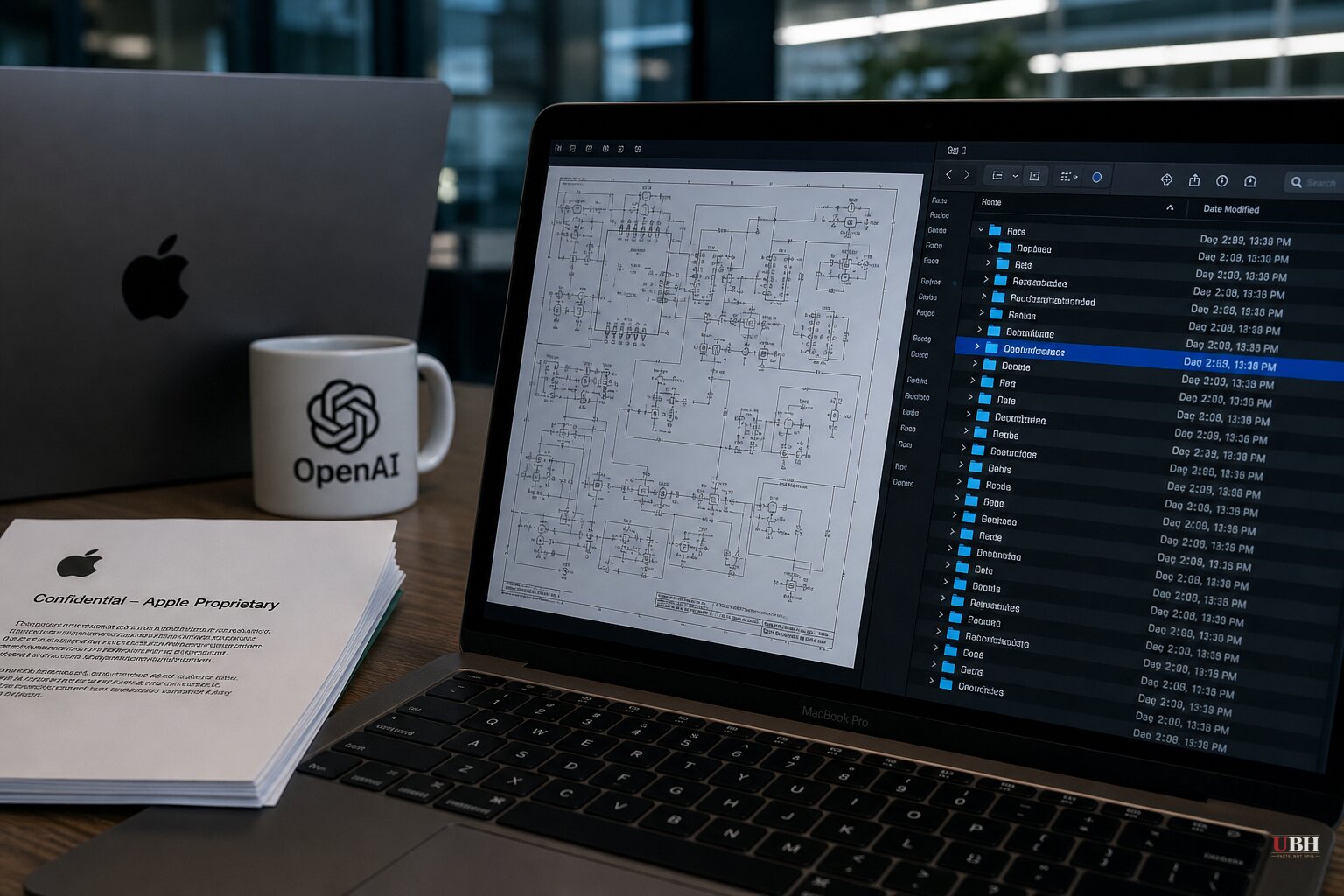
Apple's trade-secrets lawsuit against OpenAI just got a lot more specific.
In a filing submitted August 31, 2026 in the U.S. District Court for the Northern District of California, Apple says a forensic review of a laptop belonging to former engineer Chang Liu backs up its claim that Liu stole confidential hardware files and put them to use at OpenAI. Apple's lawyers called the findings "shocking evidence" and are using them to push for expedited discovery, according to filings reported by 9to5Mac, MacRumors, and The Straits Times.
What Apple says the laptop shows
Liu, a former senior systems electrical engineer at Apple, left for OpenAI in January 2026. Apple's lawsuit, filed July 10, 2026 and naming OpenAI, its hardware subsidiary io Products, Liu, and fellow ex-Apple engineer Tang Yew Tan, alleges Liu downloaded a confidential Apple circuit schematic in March, two months after his departure.
According to the filing, Liu ran that schematic through LTspice, an electrical engineering simulation tool, and told a colleague in a message he was working on power conversion development. Apple also says Liu bragged in messages about training an AI agent to run LTspice on its own, writing that his "agent learned how to run LTspice, look at result, tune compensation parameter," per excerpts published by MacRumors. Apple argues that once trade secret data gets fed into a learning AI system, the exposure becomes irreversible.
Apple also claims Liu used a tool bearing the same name as an internal Apple engineering application, and that he accessed the schematic on a Mac mini that later synced to the MacBook he'd kept from Apple, which is how Apple says it found out. Apple now wants access to that Mac mini too.
The filing further alleges that once Liu learned Apple was investigating him in June, he asked an OpenAI colleague, identified in filings as Yu-Ting Peng, to "restore" his Apple-issued devices, an act Apple's lawyers characterize as evidence destruction. Apple says the laptop itself only arrived after "weeks of delay" from Liu's legal counsel.
Apple's initial complaint alleges Liu also exploited what it calls a "rare, previously unknown authentication bug" to retain access to Apple's third-party cloud storage after he left the company. Apple's broader suit alleges more than 400 former Apple employees now work at OpenAI, and it has separately widened its claims to cover 11 former employees it says shared trade secrets, according to Engadget.
OpenAI's defense: blame Apple's own security practices
OpenAI isn't conceding the point. In a filing lodged the same evening, per Reuters as reported by The Next Web, OpenAI told the court: "This dispute is a mess of Apple's own making, and it is trying to blame everyone else."
OpenAI's core argument, laid out in both its August motion to dismiss and Monday's response, is that Apple itself created the conditions for any crossover of information. The company argues Apple encouraged employees to use personal iCloud accounts for work tasks and monitored personal messages on company devices, blurring the line between corporate and personal data. "Apple cannot transform the foreseeable consequences of its own systems and policies into evidence of theft," OpenAI wrote, according to The Next Web.
On Liu specifically, OpenAI has said he accessed Apple files only after leaving the company, to help former colleagues who asked for his assistance, and that any continued access reflects Apple's own failure to properly cut off departing employees rather than intentional theft, per a company blog post cited by TechCrunch. OpenAI has called Apple's overall case "careless, aggressive and oddly personal" and asked the court to dismiss it outright, arguing the accusations are "meritless."
If Apple's own IT policies routinely left former employees with residual cloud access, and it happened to other people too, that would undercut the idea that Liu's continued access was some unique, deliberate breach rather than a known company-wide gap. Whether the record supports that broader claim, or whether Liu's alleged use of an undisclosed "authentication bug" and subsequent instructions to erase device data go well beyond ordinary residual access, is exactly what discovery is supposed to establish.
What's actually proven versus alleged
None of Apple's newest claims have been tested in court. They're allegations in a legal filing, redacted in part from public view, and OpenAI disputes the characterization of nearly every fact Apple cites. No charges have been filed against Liu; this is a civil trade-secrets case, not a criminal one.
The case also sits against the backdrop of OpenAI's push into hardware. The company acquired io Products, the startup co-founded by former Apple design chief Jony Ive, who left Apple in 2019, and OpenAI president Greg Brockman has confirmed the company is developing a family of physical devices. Apple named io Products as a co-defendant, arguing the acquisition is a vehicle for its alleged trade secrets, not just a competitive hire.
Judge Edward J. Davila is scheduled to hear arguments on Apple's request for a preliminary injunction and expedited discovery on October 1, 2026. That hearing will determine whether Apple gets fast-tracked access to OpenAI's internal records and depositions before the underlying trade-secrets claims are even resolved.
Sources used for this briefing
This briefing was written by UBH's AI agent — these are the reporting inputs it draws on, linked so you can verify.


