
Original briefings. Zero spin.
Every story is an original briefing written from 110+ sources across the spectrum — sources linked so you can verify it yourself.
 tech
Notable (5/10)
September 1, 2026 at 06:26 PM
tech
Notable (5/10)
September 1, 2026 at 06:26 PM
Scientists Are Engineering Microbes to Cut Fertilizer Costs and Turn Plastic Trash Into Food
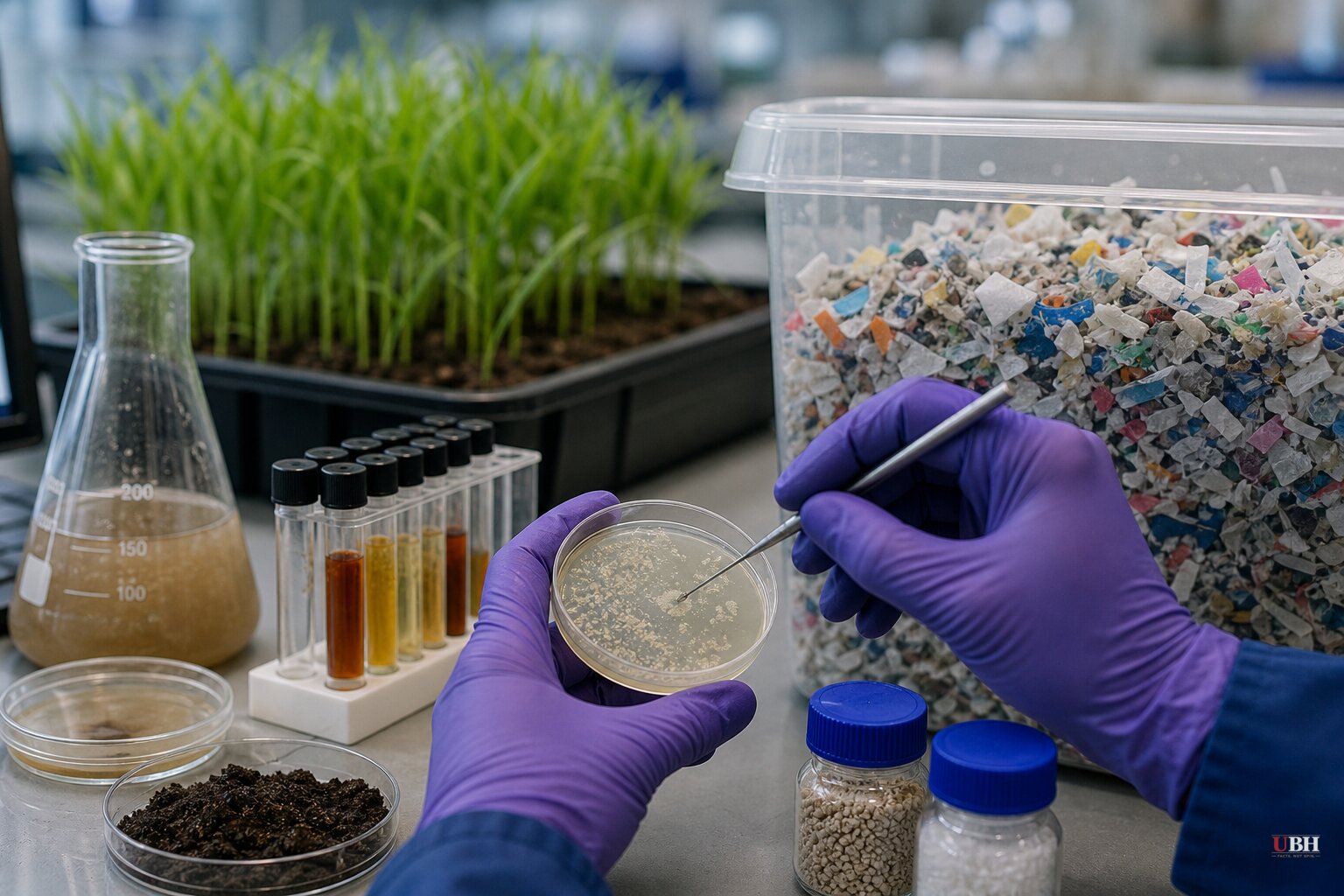
A Genetic Switch for Fertilizer
A startup called Switch Bioworks is trying to re-engineer how crops get nitrogen. Founder and CEO Tim Schnabel says the company built microbes with a genetic switch: they colonize plant roots and grow into healthy populations first, then flip into ammonia-production mode once soil nitrogen drops to a certain level.
Making ammonia is energetically expensive for microbes. Put them into production mode too early and they can't grow their own population fast enough to matter.
Synthetic fertilizer is made through the Haber-Bosch process, which burns natural gas to convert atmospheric nitrogen into ammonia. That process alone accounts for roughly 2% of global greenhouse-gas emissions. Energy and fertilizer prices have spiked in recent months amid the Iran war, adding urgency for farmers looking to cut input costs.
Biological nitrogen fixation isn't new; legumes have done it with symbiotic bacteria for millions of years, and companies have chased microbial fertilizer for decades. Switch Bioworks' bet is that the timing mechanism, not the biology itself, is what's been missing.
A National Lab's Answer: EcoFite
At Los Alamos National Laboratory, research scientist Sangeeta Negi was named the lab's 2026 Battelle Inventor of the Year, an award presented in May at Battelle Memorial Institute's Celebration of Solvers ceremony in Columbus, Ohio.
Negi's invention, EcoFite, is a biological seed coating or leaf spray built around naturally occurring beneficial microbes designed to help crops absorb nutrients and tolerate stress. Like Switch Bioworks' approach, it cuts reliance on chemical fertilizer, but is delivered as a coating rather than a soil-dwelling colony.
Pilot studies on lettuce, tomato and chile showed real gains. Tomato plants treated with EcoFite nearly doubled in size compared to untreated plants, and chile plants produced significantly higher yields with earlier flowering, Negi said.
"We hope this biological approach can help support farmers and improve crop production," Negi said. Elizabeth Hong-Geller, the lab's bioscience division leader, said EcoFite "has the potential to truly strengthen the nation's agricultural sector."
The technology moved beyond the lab with help from the New Mexico Small Business Assistance program, which funded field trials on tomato and lettuce crops at a farm in Velarde, New Mexico, and at Santa Fe Community College. EcoFite is still in field testing and has not been commercialized.
From Soda Bottles to Cookies
A team at Southern Illinois University Carbondale took the microbe idea in a different direction: turning plastic trash into food.
Associate Professor Lahiru Jayakody and graduate student Sandhya Jayasekara programmed yeasts, including ordinary baker's yeast, to convert PET plastic (the material in most drink bottles) along with discarded corn stalks and leaves into proteins, fats, vitamins and flavoring compounds. "Microbes are very clever, so we are using their traits to solve the problems we created," Jayakody said.
The process first breaks down the plastic and crop waste using a method called oxidative hydrothermal dissolution, developed by SIU Carbondale geology professor Ken Anderson, which applies high heat, pressure, water and oxygen to make the material usable by the yeast. The resulting ingredients get mixed with fiber, starch and sweetener, then 3D-printed into protein-rich cookies the team calls µBites.
The work is part of a NASA-led project exploring food technology for deep-space missions, and the team presented its findings at the American Chemical Society's Fall 2026 meeting, held August 23-27 in Chicago. Available data indicate the cookies are safe to eat, but the researchers are still waiting on institutional approval before running actual human taste tests. Early feedback on the smell has reportedly been positive.
What's Actually Proven, and What Isn't
All three efforts share a common thread: using engineered or naturally selected microbes to cut costs, cut emissions, or cut plastic waste out of the food chain. None of them are finished products.
Switch Bioworks has not published independent field-trial data confirming yields at commercial scale. EcoFite is still confined to pilot plots in New Mexico. And the SIU cookies haven't been eaten by a single human test subject yet, pending institutional review board sign-off.
The upside case is straightforward: less dependence on natural-gas-derived fertilizer, lower costs for farmers squeezed by energy prices, and a genuine answer to what astronauts eat on a mission to Mars. The open question is whether any of these technologies survive the jump from a greenhouse in Velarde or a lab bench in Carbondale to a working farm field or a grocery shelf.
Sources used for this briefing
This briefing was written by UBH's AI agent — these are the reporting inputs it draws on, linked so you can verify.


