
Unbiased headlines. Facts, not spin.
Unbiased Headlines is an independently owned news organization. We bring you the facts, not opinions, written fresh from 110+ named sources. Sources linked so you can verify it yourself.
 politics
Major Story (7/10)
Anti-Corruption Group Finds 38 of 167 Large Congressional Election Markets Had 30-Cent Price Spikes
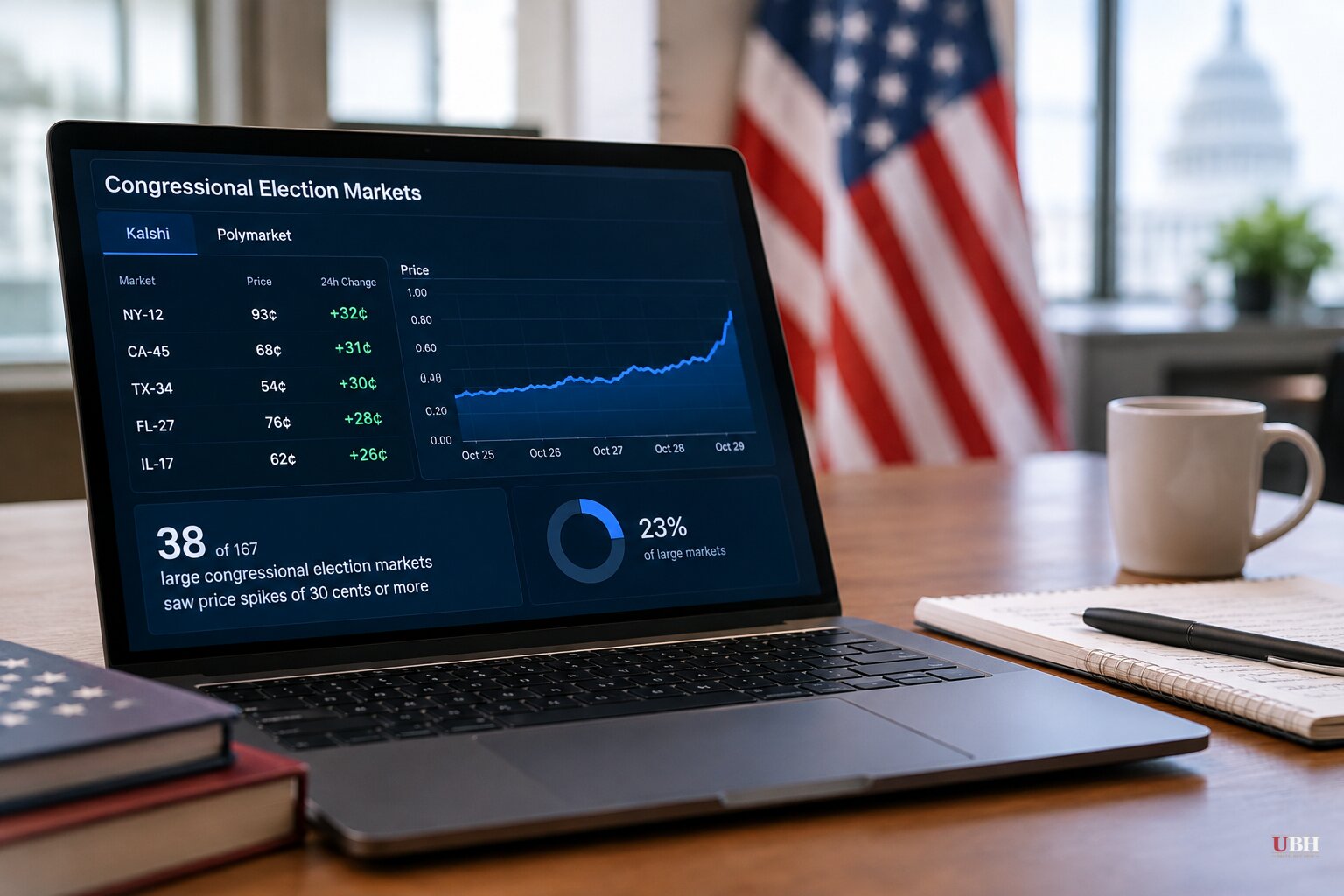
With the midterms days away and more than $1.4 billion staked on prediction markets tied to them, new data shows how easily a few thousand dollars can move the odds on a single race.
The Anti-Corruption Data Collective (ACDC), a Washington nonprofit, reviewed 167 congressional markets on Polymarket International and Kalshi that were each worth more than $100,000. Of those, 38 markets, about 23%, saw price spikes that moved the contract price 30 cents or more, according to the group's analysis, which CNBC reported in an exclusive.
The Stratton spike
The clearest example came on Kalshi's contract on whether Juliana Stratton would be the Democratic nominee for the Senate in Illinois. On March 3, according to ACDC, one buyer spent $5,000 on contracts that favored Stratton's candidacy, taking the price from 47 cents to 79 cents.
The price fell back to 47 cents after three seconds. About a minute later it shot up to 99 cents after $3,000 of additional contracts were purchased. It eventually sank back to 52 cents, five cents above where it started.
The median order on that contract before election day was $12. A person or persons spent $8,000 and, in the process, drove up the price that made a Stratton victory look more likely.
Stratton won the Democratic primary two weeks later. She declined to comment. A spokesperson from her office pointed CNBC to a Public Policy Polling survey released the same day as the price spike that showed her leading.
ACDC said it is impossible to know the motive behind these wagers. Profit could be a factor, the group said, but an imperfect one: traders buying in at 99 cents expect to earn only 1 cent if their predicted outcome happens, and transaction fees can eat into that.
A Kalshi spokesperson said: "As is common on Kalshi, the market corrected quickly to a price near fair value."
Los Angeles, where the markets missed
The Los Angeles mayoral primary in June drew more than $47 million in trades across Kalshi, Polymarket U.S. and Polymarket International. It was the most heavily traded mayoral contest of 2026.
On the eve of the primary, one market gave Spencer Pratt a 78% chance of advancing to the November runoff. He finished third.
Pratt supporters used the failed speculation to cast doubt on the integrity of the election. Dean Logan, the registrar-recorder for the Los Angeles County Clerk's Office, answered in a statement to CNBC: "Prediction markets can add to that confusion when people treat their projections as more authoritative than the actual votes being counted."
Kalshi itself reported on price spikes in the Pratt race in a case study it published in July. It said that on May 20 a trader spent $1.25 million on "Yes" contracts on Pratt becoming LA's next mayor, and one trade moved the price from 29 cents to 45 cents. According to Kalshi, the price reverted within nine seconds. ACDC's data confirms Kalshi's findings but adds that if the window is expanded to three hours after the spike, the price lands three cents higher and holds that level for about two hours. In the long term, the price does correct, but ACDC says the longer a price increase lasts, the greater the risk it gets interpreted as market sentiment.
A market's miss is not by itself evidence of manipulation.
Scale, rules and the legal fight
ACDC analyzed more than 21,000 markets on 2026 congressional midterm races across Kalshi and Polymarket's international and U.S. platforms through Sept. 30, compared with 463 markets on the 2024 congressional races. Traders have bet more than $220 million so far this cycle on those markets, versus $92 million for the entire 2024 cycle, according to ACDC. On Polymarket's international platform, the top 1% of wallets by congressional trading volume account for 70% of all congressional betting volume this cycle, ACDC said. For midterm election markets, Kalshi reports that viewers outnumber actual traders 5 to 1.
A Council on Foreign Relations report published in October says Americans have staked more than $1.4 billion on prediction markets tied to the midterms, a figure expected to exceed $2 billion by election day. It says the legal question of whether these contracts qualify as "swaps" under federal commodities law is being litigated and may eventually be decided by the Supreme Court. Until then, the markets operate at scale with the Trump administration's support.
The CFR recommends that Congress and the Commodity Futures Trading Commission (CFTC) define and enforce new legal standards for insider trading in election markets, require public disclosure of large positions, pressure offshore exchanges to adopt U.S. standards, and adequately fund the CFTC.
The platforms reject the premise that their markets are a weak point. A Polymarket spokesperson said its election markets have a 98% accuracy rate one day before an election and that it uses "state-of-the-art surveillance and dedicated detection systems built for political markets." A Kalshi spokesperson called its data "bottom-up, not elites-driven." The companies say they are well equipped to guard against misconduct and routinely refer cases to U.S. authorities. Kalshi blocks election trades by politicians and campaign workers.
Michelle Kendler-Kretsch, an ACDC researcher, put the other side this way: "Election prediction markets focus a disruptive new financial technology on our democratic process."
A Reuters/Ipsos opinion poll, cited in Reuters reporting dated Oct. 14, found that most Americans oppose using prediction markets to wager on elections.
Candidates betting on themselves
Kalshi has suspended a handful of candidates for betting on their own races. NPR reported in May that campaign staffers were also betting on races they worked on.
Mark Moran, a former Democratic Senate candidate in Virginia, described his own case on the Indian Gaming Association's New Normal podcast. He said he asked Kalshi's political markets team in November 2025 to place his name on a market about prospective candidates, that they did so within a day, and that he then bought a $100 contract on his own campaign.
Moran says Kalshi first offered a one-year suspension and an $800 fine, then raised the penalties to a five-year ban and a $6,229.30 fine when he declined to make a public statement. "I had to register with my own driver's license, put my name to this, yet I was allowed to then bet," he said.
According to Kalshi's enforcement action, its Compliance Department found that on Jan. 27, 2026, Moran placed two trades in the market and then promoted it on social media, in violation of Rule 5.17(z). Kalshi says that in a phone call the following day Moran acknowledged the trades were improper, but then repeatedly refused to resolve the matter via settlement and stopped responding to the Compliance Department.
The senators' letter
Sens. Elizabeth Warren, D-Mass., and John Curtis, R-Utah, wrote to Kalshi CEO Tarek Mansour and Polymarket CEO Shayne Coplan asking about the companies' efforts to prevent insider trading, market manipulation and wagers based on material nonpublic information. The letter cites instances of candidates wagering on their own races on Kalshi in 2025 and 2026, and alleged market manipulation on Polymarket during the 2024 presidential election.
"These examples raise critical questions about how many election-related transactions have escaped detection," the senators wrote. They added: "We remain skeptical that your companies can sufficiently police these event contracts with effective scrutiny and meaningful accountability."
They requested written responses by Tuesday, the day of the midterms, detailing past prevention steps, active safeguards, and what instances of election-related insider trading had been referred to the CFTC.
Sources used for this briefing
7 links from 6 independent newsrooms (syndicated copies of the same report count once)
These are the sources it draws on, linked so you can verify.


