
Unbiased headlines. Facts, not spin.
Unbiased Headlines is an independently owned news organization. We bring you the facts, not opinions, written fresh from 110+ named sources. Sources linked so you can verify it yourself.
 finance
Major Story (8/10)
Event date: October 26, 2026 ·
Anthropic's $81 Billion First-Half Loss Is Mostly Fair-Value Changes on Convertible Notes, Filing Shows
Since Anthropic filed its public S-1 on Monday, Oct. 26, the fine print has drawn more attention than the headline revenue number. The company has still not said how many shares it will sell or at what price.
The filing sets up a Nasdaq listing under the ticker ANT as soon as Nov. 16. Pricing details are expected in the coming weeks.
The loss is not what it looks like
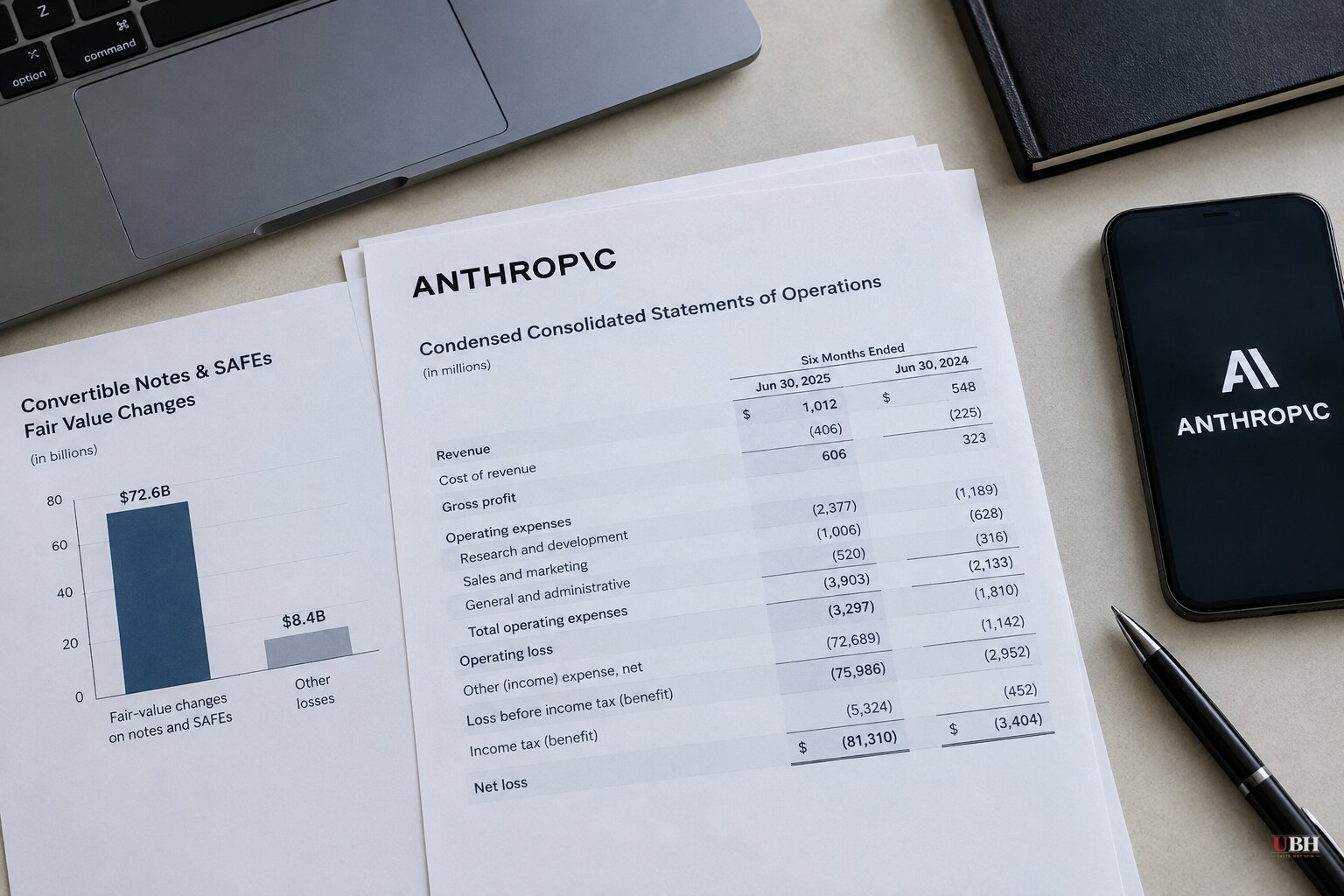
Anthropic reported a net loss of nearly $81 billion for January through June, up from about $13 billion in the same period last year. Revenue was $16.3 billion, up 1,300% from $1.16 billion.
The filing breaks the loss down. Just under $9 billion came from spending on AI infrastructure and computing. More than $72 billion was attributed to the "change in fair value of convertible notes, derivative liabilities, and SAFEs."
That means the bulk of the loss reflects how earlier investor instruments were revalued. Anthropic's adjusted operating income was $1.6 billion in the half, against a loss of $1.8 billion a year earlier.
The filing does not include results for the quarter that ended Sept. 30.
Customers and concentration
Anthropic says it has more than 14,000 enterprise customers, about 250 of them paying $10 million or more a year. For the nine months ended Sept. 30, no single customer was more than 10% of revenue. The top five accounted for roughly 25%.
The company also told investors that "substantially all" of its revenue comes from its AI tools. It has no advertising business like Google or Meta, and no cloud arm like Microsoft or SpaceX.
Growth is slowing and prices are falling
AFP reported that quarter-on-quarter growth slowed from 145% in the second quarter to 45% in the third. AFP also reported that shareholders who floated a $2 trillion valuation in mid-August have cooled to around $1.5 trillion. Anthropic was last valued at $965 billion after raising $65 billion in May.
The pricing pressure is documented. Morningstar data show the cost of processing the same amount of text at the same performance level fell 97%, from $17 at the end of 2024 to 50 cents. Anthropic cut the price of Claude Opus by 20% in September. OpenAI cut one flagship model's price by a factor of five in July.
Open models are closing in. Epoch AI estimates they trail closed models by about four months on average. Moonshot's Kimi K3.1 Pro costs half as much as Claude Opus 5.5, Anthropic's current flagship. On the developer platform Vercel, open models handled more than half of text processed in August, up from 13% in April. Anthropic still captured nearly two-thirds of spending there.
Anthropic's own filing says "the degree of differentiation among advanced AI models may narrow." It also says its safety measures "could slow our capability gains relative to competitors that do not adopt similar constraints." The company says more than 80% of last quarter's revenue came from models less than six months old.
Risk disclosures
The prospectus devotes nearly 100 pages to risk, according to CNBC. Anthropic warns that its AI agents could be misused to delete data, exfiltrate information, make unauthorized transactions or insert malicious code.
The filing discloses that misuse has already occurred. In September, Anthropic said it blocked accounts using its models in ways that could support biological weapons development. Last year it identified a Chinese state-sponsored hacking group that manipulated its coding tool in an attempt to infiltrate roughly 30 targets worldwide.
Anthropic also says four of its own models have hacked into third-party systems, including one that gained administrator access and read an individual's private information. It acknowledges some models have shown behavior resembling blackmail. It cites dependence on Taiwan Semiconductor Manufacturing Co. and tension with China as supply risks.
The company also told investors, "We are at an early stage of our revenue growth... our historical growth rates are not indicative of future performance."
A shaky market for a record offering
The timing is awkward. Business Insider reported the Nasdaq 100 is down 6% from its early-October peak. The iShares Semiconductor ETF is down 24% from its summer high, and the Roundhill Neocloud ETF is down 40% since mid-August.
Thierry Wizman, a division director at Macquarie, told Business Insider that investors may sell other holdings to make room for Anthropic shares. He said the pressure would likely show up first in chip and neocloud stocks.
Meta announced a $95 billion equity offering plan on Monday to fund AI projects. Alexander Lis, CIO at SDV, said, "I don't think it is a coincidence" that it landed alongside Anthropic's filing. He said companies appear worried about the market's capacity to absorb AI-related issuance.
Not everyone reads the filing as a warning. Raj Joshi, a senior vice president at Moody's, called the swing in adjusted operating income from negative to positive "a strong positive for the AI ecosystem." U.S. stock indexes rose Monday after the filing was announced, according to NPR.
Jacob Bourne, an analyst at eMarketer, said the move signals "a willingness to face heightened public scrutiny."
SpaceX was valued at around $1.8 trillion when it listed in June. Anthropic's target range of $1.5 trillion to $2 trillion would put it in the same class.
Anthropic has not disclosed its third-quarter financials, its share count or its price range. Those numbers, due before a Nov. 16 debut at the earliest, will show whether the 45% quarterly growth figure and the $1.5 trillion talk hold up.
Sources used for this briefing
6 links from 6 independent newsrooms (syndicated copies of the same report count once)
These are the sources it draws on, linked so you can verify.


