
Unbiased headlines. Facts, not spin.
Unbiased Headlines is an independently owned news organization. We bring you the facts, not opinions, written fresh from 110+ named sources. Sources linked so you can verify it yourself.
 finance
Notable (6/10)
Event date: October 19, 2026 ·
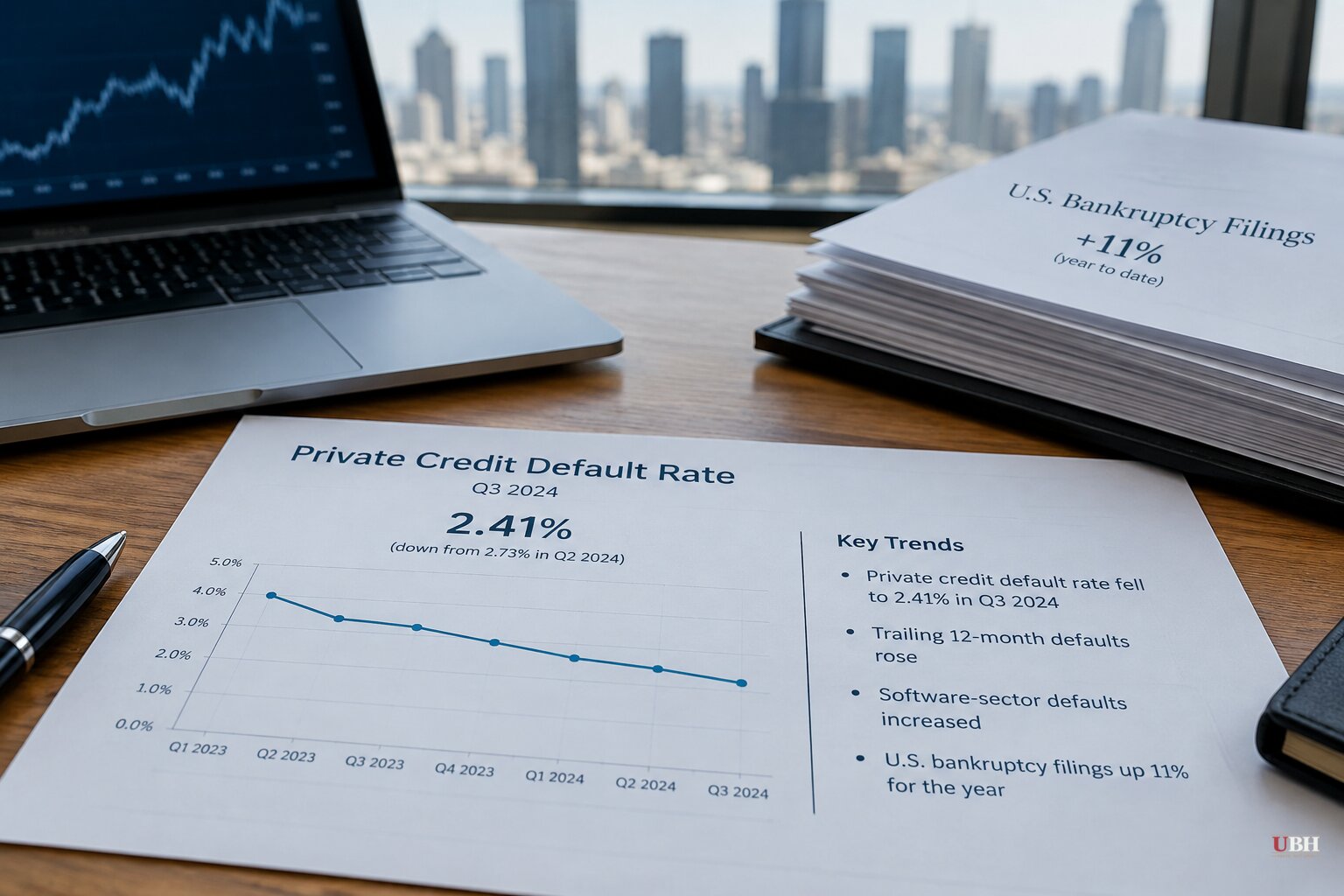
Private Credit Default Rate Slips to 2.41% in Third Quarter as US Bankruptcy Filings Rise 11% for the Year
Since the U.S.–Iran war began in late February, inflation has spiked and borrowing costs have stayed high. Thursday, Oct. 29, brought a fresh round of attention to credit risk as software stocks sold off. The latest hard numbers on debt stress point in two directions at once.
Private credit defaults dip, with soft spots underneath
Proskauer's Private Credit Default Index put the third-quarter default rate at 2.41%, down from 2.51% in the second quarter. It is the second straight quarterly decline. The index tracks senior-secured and unitranche loans: 746 loans, $205.7 billion in original principal.
The split by borrower size is uneven. Companies with EBITDA under $25 million saw defaults rise from 1.9% to 2.2%. Mid-sized borrowers with EBITDA between $25 million and $49.9 million slipped from 3.4% to 3.3%. Larger borrowers with EBITDA of at least $50 million fell from 2.4% to 1.7%.
Stephen Boyko, partner and co-founder of Proskauer's private credit group, said the two-quarter decline "points to continued resilience of the private credit market." He added that "the headline number doesn't tell the whole story." Trailing 12-month defaults rose, he said, and so did defaults among software and technology borrowers.
The bearish case
Bret Jensen, an investing group leader writing on Seeking Alpha, argues the opposite: that private credit is deteriorating quickly and that 2027 will be worse. In his opinion piece he says default rates are at record highs and that fund valuations "marked to model" can diverge sharply from market prices in stress. He also says Blue Owl and Apollo have gated redemptions for three quarters.
Jensen points to heavy lending to software and technology companies facing pressure from artificial intelligence. He also says 10-year and 30-year Treasury yields hit their highest levels since 2002 earlier this month before easing. Those are his claims. Proskauer's index, which covers a defined set of loans, shows a falling headline default rate.
Bankruptcies keep climbing
The American Bankruptcy Institute said Oct. 8 that 469,719 bankruptcy filings were made in the first nine months of 2026, up 11% from the same period last year. Individuals filed 444,252. Businesses filed 25,467, up 7%.
Small-business Subchapter V filings hit 2,442, up 46%.
Michael Hunter of bankruptcy data provider Epiq AACER said the increase "reflects the strain of higher borrowing costs, rising household expenses, growing consumer delinquencies, and a softer job market." The 30-year fixed mortgage rate is at its highest weekly average in roughly three years. Credit card rates have been above 20% for more than three years.
Joelle Scally, an economic policy adviser at the New York Fed, said in an Aug. 11 statement that new consumer delinquencies on credit cards and auto loans "remain at elevated levels." The U.S. also added fewer jobs than expected in September.
Bureau of Labor Statistics data show 12-month inflation peaked at 4.2% in May and fell to 3.4% in August. February's rate, before the war, was 2.4%.
Large corporate failures above average
Cornerstone Research said Oct. 8 that 100 large companies filed for bankruptcy between July 2025 and June 2026, which is 22% above the 2005–2025 average. Twenty-eight of those filings involved reported assets above $1 billion.
Matt Osborn, a principal at Cornerstone and report coauthor, said the pace reflects "persistent challenges of the broader economic environment for companies that rely on debt financing."
Amy Quackenboss, the ABI's executive director, said the rise in filings, especially among small businesses, shows how many debtors face "persistent inflationary pressures, elevated borrowing costs, and economic uncertainty." She said passage of the Bankruptcy Threshold Adjustment Act would expand access to bankruptcy relief for struggling businesses and families.
The retirement-plan proposal
The Center for American Progress, a left-leaning think tank, says investors in private credit funds continue to ask for their money back and that the Financial Stability Board has raised concerns about transparency and risks to the financial system. The group says the Trump administration has proposed a rule that, if finalized, would give retirement plan fiduciaries a liability safe harbor for offering private credit and other non-publicly traded investments to plan participants.
CAP argues this ignores the role shadow banking played in the 2007–09 financial crisis. It also points to links between private credit funds, deposit-taking banks and insurers that administer retirement annuities. The group has published the first piece of a three-part series and says later installments will analyze the risks and offer recommendations.
The administration's stated rationale for the proposal does not appear in the CAP analysis.
For savers, the picture is straightforward. Defaults in the tracked loan pool are down two quarters running, while small borrowers and software companies are showing more strain. The proposed retirement-plan rule is not final, and it is unresolved whether the next Proskauer reading continues the decline or the software and small-company defaults pull the headline number back up.
Sources used for this briefing
4 links from 4 independent newsrooms (syndicated copies of the same report count once)
These are the sources it draws on, linked so you can verify.


