
Unbiased headlines. Facts, not spin.
Unbiased Headlines is an independently owned news organization. We bring you the facts, not opinions, written fresh from 110+ named sources. Sources linked so you can verify it yourself.
 finance
Breaking / Critical (9/10)
Alphabet Shares Fall Up to 13.5% Thursday, Heading Toward a Record Market-Value Loss Near $500 Billion
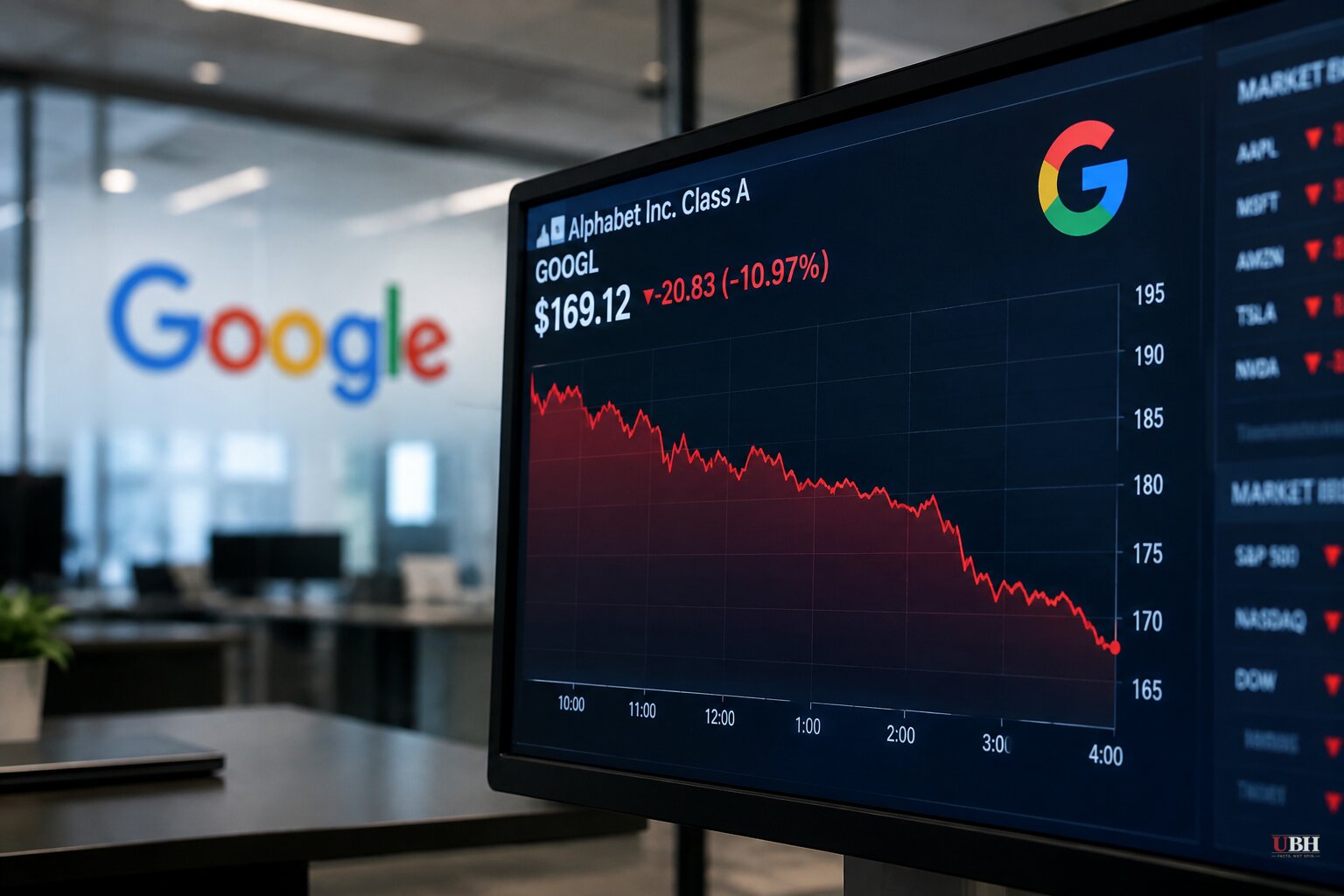
Alphabet's post-earnings slide has deepened into one of the largest single-day wipeouts in market history. Shares were down between roughly 11% and 13.5% in Thursday trading, Oct. 29, taking the company's market value from about $3.9 trillion to about $3.4 trillion.
The session is not over. Where the stock closes will decide whether the records below actually fall.
The size of the drop
A loss of $500 billion or more in a day would be the second largest of any stock. Only Nvidia has lost more, shedding roughly $589 billion on Jan. 27, 2025, when fears about China's DeepSeek hit the chip maker.
On a percentage basis, a close lower than 9.77% would be Alphabet's worst post-earnings reaction since it went public in 2004. Dow Jones Market Data put the day's potential market-cap erosion at $507 billion.
Alphabet alone accounts for most of the more than $693 billion the Nasdaq-100 was set to lose if morning losses held.
What the numbers showed
Third-quarter revenue was $127.6 billion, short of analyst estimates of roughly $128 billion. Earnings per share missed the $3.02 consensus. Alphabet attributed an $8.6 billion paper loss on equity stakes to its SpaceX investment, which hit the bottom line.
The services segment, which includes Search, brought in $96.3 billion against estimates of $98.5 billion. Search revenue growth slowed to 12% from 17% in the second quarter and 19% in the first.
Google Cloud was the bright spot. Revenue rose 103% to $30.71 billion, well above the $28.8 billion analysts expected.
The cash picture is what spooked investors. Alphabet spent $51.4 billion on AI infrastructure in the quarter and posted negative free cash flow of $9.07 billion. Wall Street had expected it to land near break-even. The second quarter's negative $5.9 billion was the first time since the 2004 IPO that free cash flow fell below zero.
Alphabet also kept its full-year capital spending forecast at $195 billion to $205 billion. Chief Financial Officer Anat Ashkenazi said capital expenditures will rise significantly next year, driven largely by AI.
Why Search is the pressure point
Search revenue of about $63 billion was virtually flat from the prior quarter, according to Business Insider's tally of the results. It was a shock because Search had beaten estimates in each of the previous four quarters.
Philipp Schindler, Google's chief business officer, tied the shortfall to AI Mode. He said strong query growth there had an impact "because of the lower monetization we were seeing in AI Mode." He added that Google is rolling out ads in AI Mode to more users, including in international markets.
"This may be the quarter we feared," said Gil Luria, head of technology research at D.A. Davidson, pointing to worries that AI agents will take business from traditional search.
Ryan Lee of Direxion called the results a "bad combination," saying the cash burn "gets harder to justify without monetization or the core business growing to compensate for it." JPMorgan analysts led by Doug Anmuth said the move shows "the margin for error" for a hyperscaler spending at this scale.
Alphabet's defense
Management argues the usage numbers are strong. CEO Sundar Pichai said on the earnings call that AI helped search queries grow at their fastest year-over-year pace in five years. "Just like our shift to mobile over a decade ago, we are focused on building the best Search user experience, followed by monetization," he said.
Bernstein's Mark Shmulik gave a more qualified view in a note: "Is Google an AI winner? Probably, but not today."
Broader market
At 9:56 a.m. ET, the Nasdaq Composite was down 1.64% at 26,117.47, the S&P 500 was off 0.51% at 7,704.55, and the Dow was down 0.31% at 52,311.92. Later in the morning the Nasdaq's loss had widened to about 1.8%.
The damage spread beyond Alphabet. Fortinet fell 21.7% after its third-quarter report. ServiceNow dropped 23.3% after missing profit estimates. The Philadelphia semiconductor index was down 1.8%. Caterpillar fell about 8% after holding its annual sales forecast, which raised questions about how long data-center demand can lift power-generation equipment sales.
Microsoft is the contrast, though its move was mixed. It posted a big cash-flow beat, with free cash flow down 27% to $18.63 billion but still positive. Capital expenditures were $45.2 billion, against expectations of $50.67 billion, and the company lowered its full-year spending forecast to $170 billion. Its shares edged 0.5% lower at one point after media reports that it plans to raise at least $25 billion in its first U.S. investment-grade bond sale in more than nine years.
On the macro side, the Personal Consumption Expenditures price index rose in line with economists' estimates, and the economy grew faster than expected in the third quarter. The Federal Reserve held rates steady Wednesday. Angelo Kourkafas of Edward Jones said that combination reinforces the expectation that October was "a skip rather than a hold" for the Fed.
What comes next
Anders Bylund of The Motley Fool framed the stakes for the whole group: "The positive AI effects must stay intact for years to come, or investors in Alphabet (and other hyperscalers) will eventually re-rate the multiples as the bottom-line profits fade."
Alphabet has guided to higher spending next year with free cash flow already negative. The open question is whether AI Mode ads and Cloud growth can close that gap before borrowing costs, which Reuters notes have tempered enthusiasm for debt-funded AI buildouts this month, force a harder look from investors.
Sources used for this briefing
7 links from 7 independent newsrooms (syndicated copies of the same report count once)
These are the sources it draws on, linked so you can verify.


