
Unbiased headlines. Facts, not spin.
Unbiased Headlines is an independently owned news organization. We bring you the facts, not opinions, written fresh from 110+ named sources. Sources linked so you can verify it yourself.
 tech
Notable (6/10)
Event date: July 20, 2026 ·
tech
Notable (6/10)
Event date: July 20, 2026 ·
Anthropic's $1.5 Billion Author Settlement Hits Snag: Publishers and Agents Claim Payments Authors Say Are Theirs
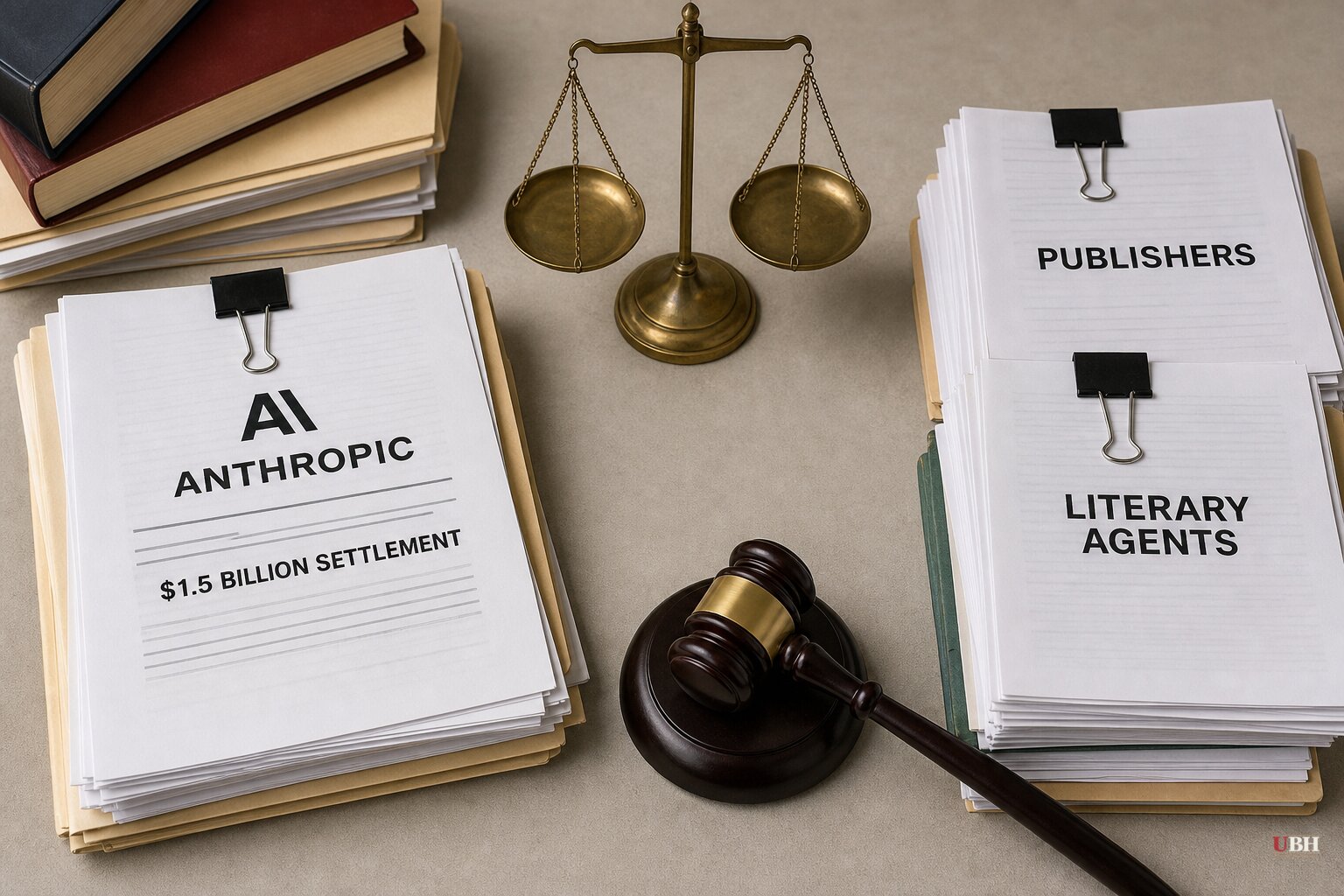
Since Judge Araceli Martínez-Olguín granted final approval to Anthropic's $1.5 billion book piracy settlement on July 20, 2026, the machinery to actually pay nearly 500,000 authors has started grinding forward.
A status report filed by class counsel says the first round of payments will go out between November 1 and November 15, according to Publishers Lunch. But that schedule only applies to titles where every rightsholder, author, publisher, co-author, agrees on the split. Where they don't, the money sits until the dispute clears.
The math behind the fight
The settlement covers roughly 482,000 titles Anthropic pulled from pirate libraries like LibGen and PiLiMi while building Claude, according to The Next Web. The headline number is $3,000 a book. But the first check will be smaller, about $2,203.56 per title, because Anthropic has only deposited $1.05 billion of the total so far, which has earned close to $25 million in interest, per Publishers Lunch. A further $450 million payment is due in September 2027, which should eventually push the total above $3,000 per work, according to Startup Fortune.
Under the terms, a book still in print with a traditional publisher splits its payout 50-50 between author and publisher. If the book was self-published, or if rights reverted to the author before August 10, 2022, the author is entitled to the whole amount. Class counsel set those percentages with input from the Authors Guild and publishers, according to The Next Web, but nobody negotiated title by title.
Where disputes are arising
Mystery novelist April Henry found HarperCollins listed as a part-owner of her 1999 book "Circles of Confusion," even though the rights reverted to her in 2007. She posted about it publicly, writing "WTF is HarperCollins playing at?" After her agent supplied a reversion letter and she uploaded it to the settlement portal, the claim was corrected to pay her the full $3,000, she told The New York Times. HarperCollins declined to comment to the Times.
Amy Lupold Bair has a different problem. Her publisher isn't disputing that she owns the rights to her guidebooks, it's disputing how much of the payout she gets. "They only want me, the author whose entire work was stolen, to get 10%," she wrote, according to The Next Web. Her website credits John Wiley & Sons for two of the disputed titles. Wiley told the Times it filed claims for all Wiley-published works and that allocations for educational titles follow individual contracts, without clarifying whether the specific books in question count as educational.
Authors Guild CEO Mary Rasenberger told the Times that textbook authors are faring worst, with contracts entitling some to as little as 10 to 15 percent of the total payout. "It's the textbooks where there are a lot of unhappy authors right now," she said.
Victoria Strauss of Writer Beware has logged a wave of similar complaints and named HarperCollins, Penguin Random House, Simon & Schuster, Macmillan, Bloomsbury, Kensington and Baen among publishers involved in rights-reversion disputes, according to Startup Fortune. A separate problem involves literary agents filing claims on books despite having no ownership stake in the underlying rights, which Strauss called surprising given that agents aren't rightsholders at all.
The source of the confusion
Strauss and Rasenberger both say they're reluctant to call this deliberate. "I don't see this as a grab by the publishers," Rasenberger told the Times, arguing publishers likely never updated their catalogues after rights reverted and are now claiming books by default, not by design. Strauss made a similar point on her blog, writing she's "reluctant to attribute to malice what can be plausibly explained by poor recordkeeping," and noted some publishers have already told the settlement administrator they mistakenly selected a 100 percent allocation instead of the correct default and are getting it fixed.
But Strauss also flagged that the volume and repetition of complaints she's received over a short window struck her as more than routine noise. "The unusually large number of reports I've received over the last two days, as well as the fact that authors are reporting the exact same errors over and over, suggest to me that these aren't the kind of routine glitches you might expect from such a large operation, but something much more widespread and systemic," she wrote.
For now, the fix is procedural. Authors who believe a claim against their book is wrong can dispute it in the portal and upload contracts or rights-reversion letters, per Superpower Daily. The settlement administrator treats a flagged allocation difference as a disagreement to resolve, not an automatic ruling for either side. The real test comes in November, when the first checks go out only for titles where the paperwork actually lines up.
Sources used for this briefing
7 links from 5 independent newsrooms (syndicated copies of the same report count once)
These are the sources it draws on, linked so you can verify.


