
Unbiased headlines. Facts, not spin.
Unbiased Headlines is an independently owned news organization. We bring you the facts, not opinions, written fresh from 110+ named sources. Sources linked so you can verify it yourself.
 tech
Major Story (7/10)
Event date: October 17, 2026 ·
Google Privacy Policy Now Allows Gmail, Drive and Photos Data to Inform Ads When Users Connect Them to Search
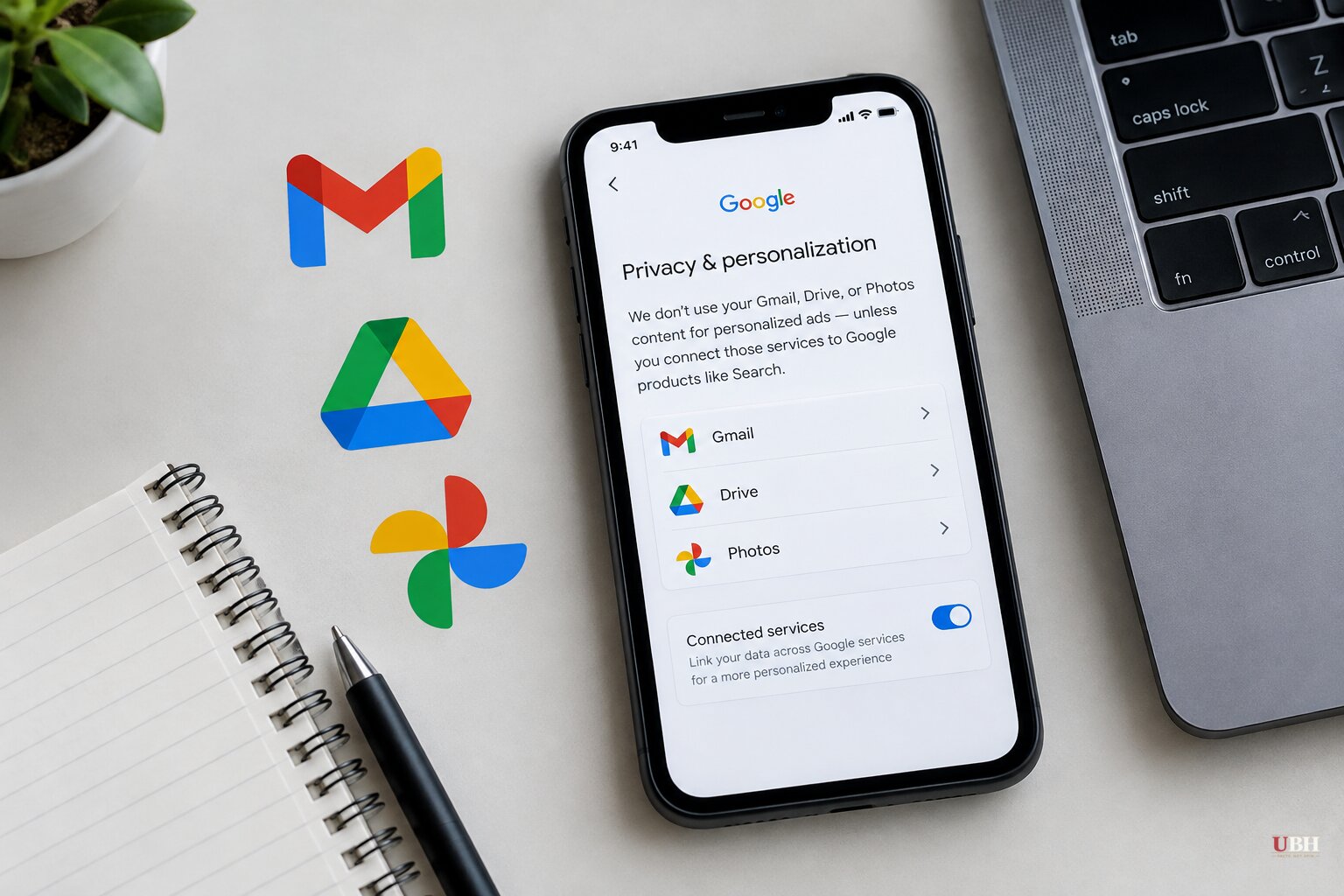
Google quietly changed one of its longest-standing privacy promises a week ago, and the change is only now getting attention.
On Oct. 16, Google updated its privacy policy. The old ad-personalization language was blunt: "We don't show you personalized ads based on your content from Drive, Gmail, or Photos." The new version adds a condition: "unless you choose to make data from these services available to other Google services that support personalized ads."
Android Authority spotted the edit.
What the policy now says
The default has not flipped. Google still does not use Gmail, Drive or Photos content for ad targeting out of the box. The exception applies to people who link those apps to other Google services.
The policy says users may let services such as Search or Gemini Apps access data from Photos and Workspace apps like Gmail and Drive for a "more personalized experience." It then adds: "For example, Search may process some of the data that you allow Search to access to personalize content, including ads."
The mechanism is Personal Intelligence, which Google released in early 2026. It lets users hand data from multiple apps to Google's AI products so answers draw on their own context. It connects to the Gemini app and to AI Mode in Search.
The Gemini app does not currently carry ads, according to Ars Technica. AI search tools can show sponsored content. That is where connected data and ad personalization meet.
Google's position
Google's defense is that nothing here happens without a user's say-so. In a statement, the company said: "Connecting your apps is entirely opt-in. Ads will continue to be relevant to things like your query, the context of the response and your interests. Ads will not be based directly on your Gmail inbox or Photos library, and as always, sensitive information will not be used to tailor ads."
A Google spokesperson told Ars Technica the clarification does not change how the company handles data with its advertising partners. The company is not scanning entire inboxes to build ad profiles, the spokesperson said, and is not giving this data to third parties.
Advertisers do not get access to the contents of Drive, Gmail or Photos, or to identifying details like a name or email address. Google says it will not target ads using sensitive categories such as race, sexual orientation, religion or health.
Where the friction is
The word "directly" in Google's statement carries much of the weight. According to Techlicious, Google's own materials say Search may still reference summaries, excerpts and inferences drawn from connected Gmail and Photos content. When an email is short or highly relevant to a request, the summary may be the entire email.
Google's example: AI Mode scans emails and photos for a hotel reservation, a flight itinerary and restaurants from past trips, then recommends places near the hotel. Useful. But Android Authority drew a distinction between using personal information to answer a question and using it to decide which ads to show, noting that users comfortable with the first "might not be happy about the latter."
There is also a data-handling layer. Techlicious reports Google says Search does not train its generative AI directly on a user's inbox or on the images and audio in a Photos library, but does train on summaries, excerpts, generated media and inferences drawn from them. A subset of data processed through connected apps may be reviewed by Google employees and outside service providers to debug, secure and improve services. Google says reviewers generally do not view underlying photos or videos unless addressing abuse or harm or responding to user feedback, and that it disconnects interactions from the account and reduces personal information before review.
How to shut it off
Users can disconnect individual apps from Search's Personal Intelligence features, or disable Personalized Recommendations entirely on the Search Services Personalization settings page.
Turning off personalized advertising in My Ad Center is a separate control. According to Techlicious, that does not necessarily stop connected-app information from being processed for AI personalization and model improvement.
Disconnecting also does not wipe the slate. Android Authority cautioned that information saved earlier may remain in Search Services History after the apps are disconnected.
It is especially relevant to anyone who connected Gmail or Photos early in the year, when Personal Intelligence launched, before the policy spelled out the ad link. The change took effect Oct. 16, and users who enabled the feature before then did so under the older wording.
What is unresolved
Google has not said how much connected-app data a user's Search Services History holds, or how long it persists after a user disconnects the app. Nor has it said whether the "not based directly" standard is measured by what inputs reach the ad system or by what the ad is ultimately shown against.
No regulator has announced an investigation or action over the policy change. For now, the only safeguard is a settings page, and the burden of finding it sits with the user.
Sources used for this briefing
8 links from 8 independent newsrooms (syndicated copies of the same report count once)
These are the sources it draws on, linked so you can verify.


