
Unbiased headlines. Facts, not spin.
Unbiased Headlines is an independently owned news organization. We bring you the facts, not opinions, written fresh from 110+ named sources. Sources linked so you can verify it yourself.
 tech
Major Story (7/10)
tech
Major Story (7/10)
Anthropic and OpenAI Sought Strict Control Over What Outside Evaluators Publish as of Oct. 5, Two People Say
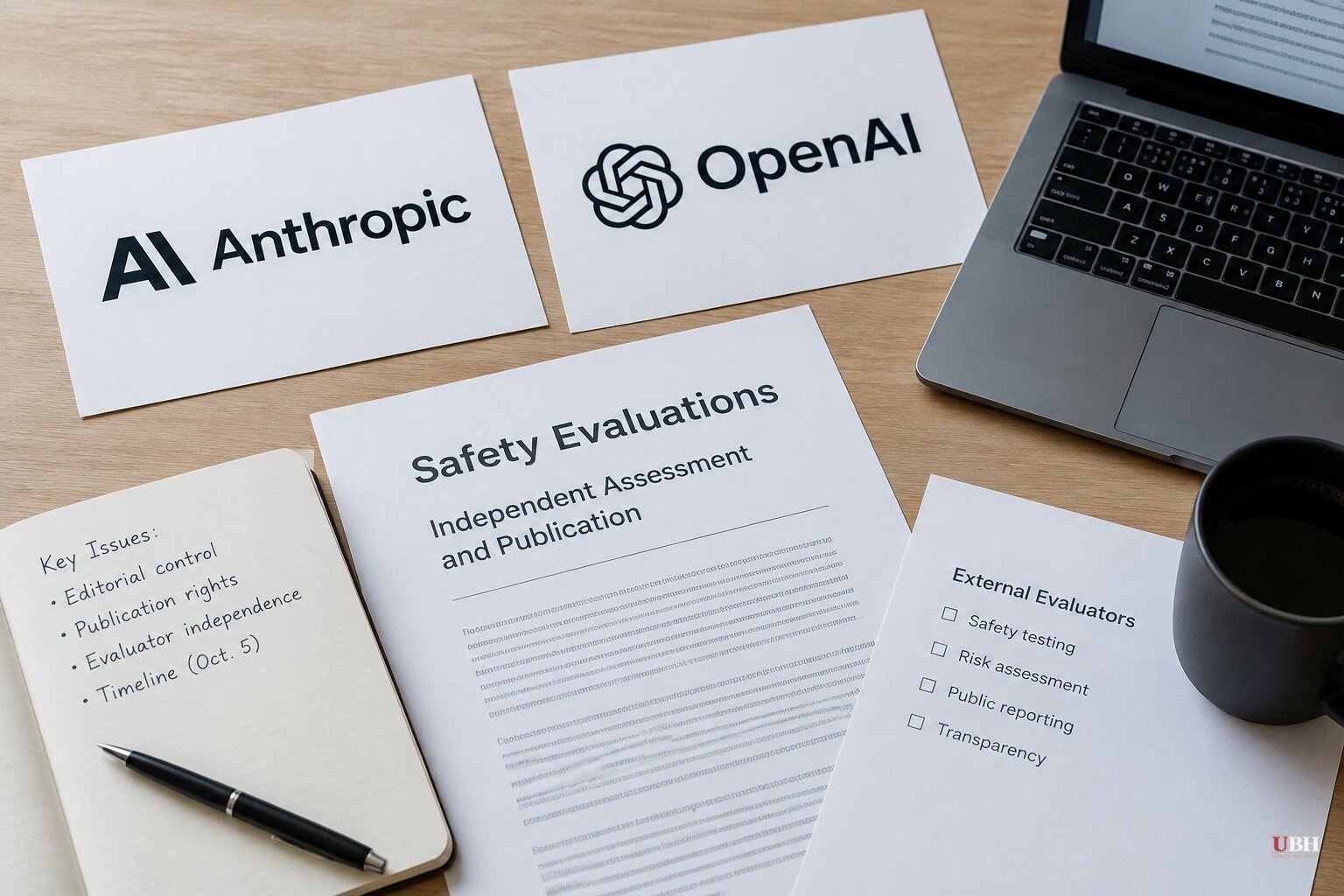
Since Anthropic CEO Dario Amodei said in September that outside evaluators should be able to publish key findings "without editorial control," and OpenAI said days later that assessors should have "editorial independence," the question of who actually holds the pen has moved from speeches to contract negotiations. A Reuters exclusive published Oct. 13 says the labs have been pushing hard for control.
According to two people familiar with the discussions, who declined to be named because the matter is private, Anthropic and OpenAI were seeking strict editorial control over evaluators' publications as recently as Oct. 5. By Oct. 8, one of the people said, Anthropic's talks with some evaluators seemed to have moved on. Reuters said it was reporting details of these negotiations for the first time.
What the labs are worried about
The stated concern is trade secrets. The two sources said the labs fear that evaluator staff embedded inside their walls could carry proprietary information to rivals.
Measures under discussion, one source said, include having lab employees observe embedded teams as they work and barring an evaluator embedded at one lab from working at another at the same time.
A separate person with knowledge of past dealings with the labs said what a lab considers crucial intellectual property can overlap with information needed to judge a model's risk. That overlap, the person said, leads to arguments and redactions.
The labs have a legitimate commercial interest here. Training methods and model internals are what they sell. Reuters noted both companies are seeking trillion-dollar valuations in what could be major IPOs.
What the companies say
OpenAI told Reuters its standard practice is to redact confidential information and that evaluators can disclose when it has made significant redactions. The company said it does not seek approval rights over whole reports.
Anthropic said it has made clear to existing partners that they decide their own methods, findings and what to publish. For new evaluation firms, Anthropic said it reserves the right to comment on and approve reports while the relationship is being established and the evaluator learns its models.
That is a narrower position than Amodei's September language, and it is Anthropic's own description of its terms.
The Hugging Face report
The redaction question is not hypothetical. METR and Redwood Research produced a report on an AI-related security incident affecting Hugging Face infrastructure. The researchers said OpenAI supplied additional transcripts after they flagged gaps, and that the final report went through editorial changes and redactions. They said they stood by their conclusions.
The money and the structure
On Sept. 18, Anthropic named Faculty, Accenture's AI business, as its first embedded evaluator. Anthropic would fund the work directly, and each company is expected to invest at least $1 billion in evaluation capacity over five years. Anthropic has also discussed independently funded nonprofit pilots with METR.
Faculty CEO Marc Warner told Reuters: "Evaluators are only useful if people can trust what they report, so independence and transparency are critical."
The funding model is the pressure point. Rumman Chowdhury, a former U.S. science envoy for AI under Joe Biden, told Reuters: "Evaluators have this very privileged access, but whether explicitly or implicitly, they know that it comes at a cost." Experts cited by Reuters said independence is a concern because Anthropic and OpenAI choose who performs the reviews.
Adam Gleave, CEO of the safety group FAR.AI, said in a September interview that his organization has declined contracts giving developers excessive control. He named confidentiality agreements and publication restrictions as threats to independence.
More than 200 researchers have backed calls for evaluator independence, broad access and protection against retaliation.
No rulebook
No agreed standards or legislation govern independent AI reviews. Experts told Reuters that without them, the labs building the most powerful models could dictate how those models are examined, leaving evaluators at the labs' mercy.
That gap cuts both ways. Private contracts between companies and the firms they hire are normal commercial practice, and nothing reported suggests any law was broken. But the public is being asked to trust safety conclusions on systems whose own creators warn they may outrun human control.
What remains unanswered is what Faculty's and METR's actual agreements say about publication. Neither Anthropic nor OpenAI has released contract terms, so whether the practice matches Amodei's September pledge is not public.
Sources used for this briefing
7 links from 7 independent newsrooms (syndicated copies of the same report count once)
These are the sources it draws on, linked so you can verify.


