
Unbiased headlines. Facts, not spin.
Unbiased Headlines is an independently owned news organization. We bring you the facts, not opinions, written fresh from 110+ named sources. Sources linked so you can verify it yourself.
 tech
Major Story (8/10)
AMD Commits $1 Billion to Meta Offering, Joining Nvidia's $3 Billion for $4 Billion in Chipmaker Money
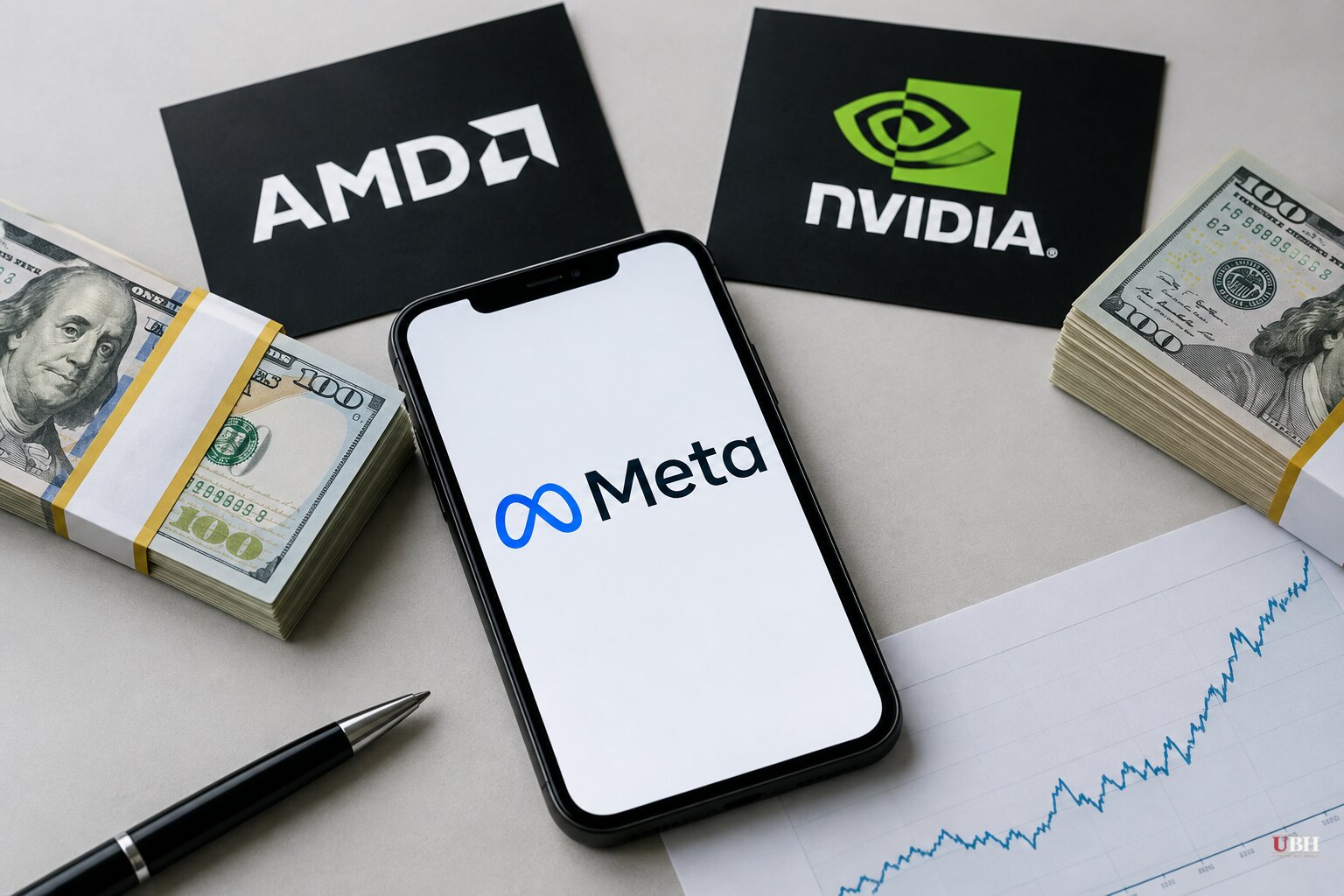
Since Meta announced a $95 billion capital raise on Monday, Oct. 26, and raised the total to $97.5 billion on Tuesday, Oct. 27, a second chipmaker has stepped in. AMD said it will invest $1 billion in the offering, on top of the $3 billion Nvidia committed. That is $4 billion from two suppliers whose hardware Meta is buying with the proceeds.
What AMD is getting for its $1 billion
AMD said its Helios racks are already running at Meta and its EPYC processors are powering Muse, Meta's AI agent. CEO Lisa Su said in a statement: "Together, we are building and deploying infrastructure at gigawatt scale and shaping future generations of silicon, software and systems to enable Meta's most ambitious superintelligence models and services."
On Monday, Meta said Nvidia, AMD and Broadcom were interested in buying up to $5 billion of shares between them. Nvidia and AMD have now put numbers on that interest. Broadcom has announced nothing.
The commitments are announced investments in the offering, not a disclosure that the share purchases have closed.
The Nvidia side of the deal
Nvidia's $3 billion comes with an expanded Muse partnership. Meta plans to deploy more of Nvidia's Vera Rubin systems and Vera CPUs, plus Spectrum-X Ethernet networking and BlueField-4 processors. The companies said they will work on training and inference performance and on total cost of ownership.
They also said they will consider further work on Nvidia's OpenShell Reference Architecture, including OpenShell for deploying agents safely and Sentry for monitoring agent behavior. "Consider" is the operative word. No deployment was announced on that front.
Nvidia CEO Jensen Huang said in a statement: "AI agents represent a new computing paradigm — software that understands our goals, reasons, uses tools and gets work done on our behalf." Meta CEO Mark Zuckerberg said the company is excited to keep working with Nvidia to deliver "the best personal agents and frontier models for billions of people."
How Meta's raise is built
Meta's plan starts with about $35 billion in underwritten public offerings, followed by $60 billion through an at-the-market program. According to The Wall Street Journal, the initial tranche includes $22.5 billion of Class A common stock and $12.5 billion of depositary shares tied to mandatory convertible preferred stock. Meta then upsized the common stock portion to $25 billion, the Journal reported.
That math is consistent with the $97.5 billion total: $25 billion common, $12.5 billion convertible, $60 billion at-the-market. One report notes Meta has not committed to establishing the at-the-market program, and its terms and timing remain subject to further decisions, so the $97.5 billion is an expanded plan, not capital already raised in full.
On Tuesday, AMD shares were up about 3%, Nvidia was flat and Meta was down about 1%, according to CNBC.
Suppliers as shareholders
The investments fit a pattern. Nvidia has invested in OpenAI, Anthropic, Intel and xAI, and took part in 121 investment rounds this year, up from 13 in 2022, according to Dealroom data cited by CNBC. AMD has been in 25 funding rounds in 2026, up from two in 2022. In July, AMD said it would make an equity investment of up to $5 billion in Anthropic.
Axios framed the Meta deal as the latest case of a multibillion-dollar Nvidia investment becoming "all but table stakes" for serious AI players. In Axios's analysis, it is a ready source of capital for the buyer and a guarantee of future revenue streams for Nvidia.
That circularity is the central question in these deals: a supplier helps fund a customer, and the customer spends on the supplier's products. Meta, Nvidia and AMD describe the arrangements as technical partnerships aimed at performance and cost. The companies have not disclosed revenue figures or measurable cost savings from the expanded work, and not all the financial and technical terms are public.
What Muse is
Muse, known internally as Hatch, launched in September. It is modeled on the open-source agent OpenClaw and can connect to email, calendars, payments, health platforms, shopping apps and smart-home systems. Users can revoke access at any time. Meta says Muse models have shown strong benchmark performance and growing consumer adoption, but it has not published figures with those claims.
What comes next
The $35 billion underwritten tranche is the near-term piece to watch, followed by the at-the-market program for up to $60 billion that is meant to sell shares over time. Whether Broadcom announces a purchase, and whether the three chipmakers' total approaches the $5 billion Meta described on Monday, remains to be seen.
Sources used for this briefing
8 links from 7 independent newsrooms (syndicated copies of the same report count once)
These are the sources it draws on, linked so you can verify.


