
Unbiased headlines. Facts, not spin.
Unbiased Headlines is an independently owned news organization. We bring you the facts, not opinions, written fresh from 110+ named sources. Sources linked so you can verify it yourself.
 tech
Notable (6/10)
Event date: September 1, 2026 ·
tech
Notable (6/10)
Event date: September 1, 2026 ·
AirTrunk's Australian Data Centers Top 1.2 Gigawatts as Microsoft, Google and Amazon Sign On
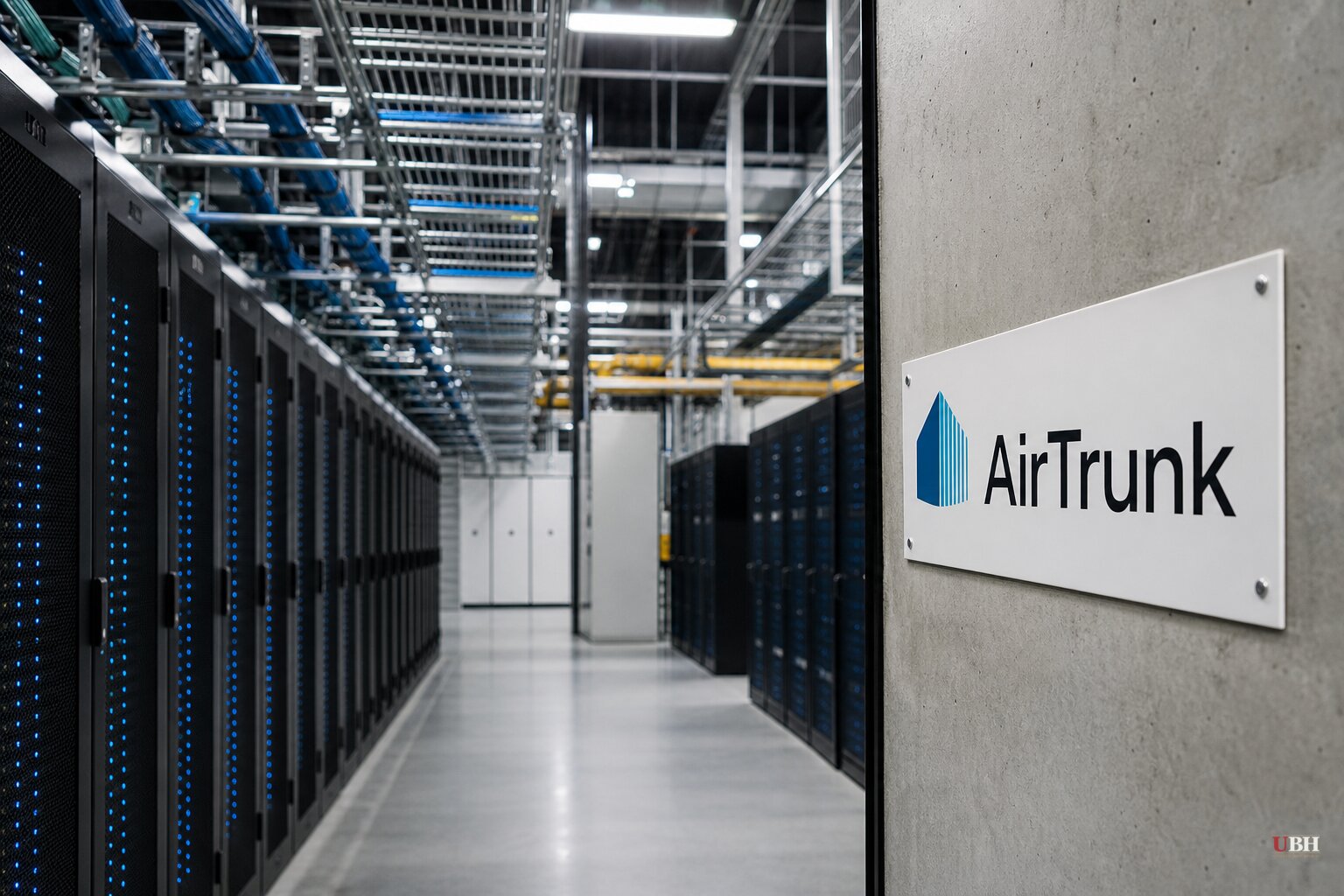
AirTrunk didn't start as a giant. According to a Bloomberg report cited by Data Center Dynamics, the company launched as a Singapore-headquartered startup with plans to spend roughly US$919 million (A$1.23 billion) building data centers in Sydney and Melbourne, then follow with US$747 million more in Singapore and Hong Kong. Founder Robin Khuda, a former NextDC chief financial officer, pitched the company as a low-cost alternative to giants like Digital Realty.
That startup is now the dominant hyperscale data center operator in Australia, and the numbers have grown by an order of magnitude. AirTrunk was acquired by a Blackstone-led consortium in 2024 at a valuation of roughly A$24 billion, according to Crypto Briefing. Its five Australian campuses now carry over 1.2 gigawatts of operational capacity combined.
The New Buildout
The company announced its MEL2 campus in Melbourne in December 2025, a project that will deliver more than 354 megawatts of capacity at a cost exceeding A$5 billion, according to Crypto Briefing. A separate project, SYD3 in Sydney, is targeting more than 400 megawatts, with A$4.3 billion in loan financing reportedly in talks.
The client list is a roll call of American tech power: Microsoft, Amazon, Google, Apple and Oracle are all named as major AirTrunk customers hunting for capacity across the Asia-Pacific region.
Khuda has called the current AI infrastructure buildout "the biggest gold rush in human history." That's his framing, not an independently verified metric, but the dollar figures behind it are concrete and growing fast.
Why Australia
Two advantages keep coming up. First, energy. Australia's abundant solar and wind resources give tech companies a credible path to running data centers on clean power, which matters both for their public sustainability pledges and for long-term electricity costs. AirTrunk has already put that to work: a 25 megawatt Mulwala Solar Farm in New South Wales, backed by both Google and AirTrunk under a power purchase agreement signed in 2023, is nearing grid connection.
Second, geography and stability. Australia sits close to Asian markets with billions of potential cloud and AI users, and it offers what Crypto Briefing describes as a combination of proximity and predictability that some other regional jurisdictions carrying geopolitical risk cannot match. The report doesn't name which countries it means, but the implication in an Asia-Pacific data infrastructure story published in 2026 points toward China, where foreign tech firms face restrictions on cloud and data operations that Australia does not impose.
The Government-Sized Speed Bump
Planning and permitting processes in the country are lagging roughly two years behind comparable timelines in Asia, according to industry assessments cited by Crypto Briefing. In an industry Khuda himself calls a gold rush, a two-year head start for competitors in Singapore or Japan is a real competitive disadvantage, not a rounding error.
Grid constraints add a second layer of friction. Building a 354 megawatt data center is one engineering problem. Actually connecting that campus to a grid that can reliably deliver that much power, without straining supply for homes and businesses nearby, is a separate and harder problem that Crypto Briefing flags as an open challenge, without offering a resolution.
Hyperscale data centers are enormous, continuous electricity draws, and grid operators around the world, not just in Australia, have raised questions about whether local infrastructure can absorb that demand without driving up costs for ordinary ratepayers or triggering reliability problems elsewhere on the network. Neither source cited here quantifies that risk for Australia specifically, so it remains a documented industry-wide worry rather than a proven local crisis.
What is proven is the money. Between MEL2's A$5 billion price tag, SYD3's A$4.3 billion loan talks, and a company valuation that has roughly doubled the country's original data center investment plans many times over since AirTrunk's startup days, private capital is betting heavily that Australia can win this race. Whether Australia's own regulators clear the runway fast enough to let it happen is the question nobody in these reports has answered yet.
Sources used for this briefing
2 links from 2 independent newsrooms (syndicated copies of the same report count once)
These are the sources it draws on, linked so you can verify.


