
Unbiased headlines. Facts, not spin.
Unbiased Headlines is an independently owned news organization. We bring you the facts, not opinions, written fresh from 110+ named sources. Sources linked so you can verify it yourself.
 health
Major Story (7/10)
Airline Groups Ask CDC to Delay Nov. 3 Ebola Attestation Rule for All U.S.-Bound Passengers
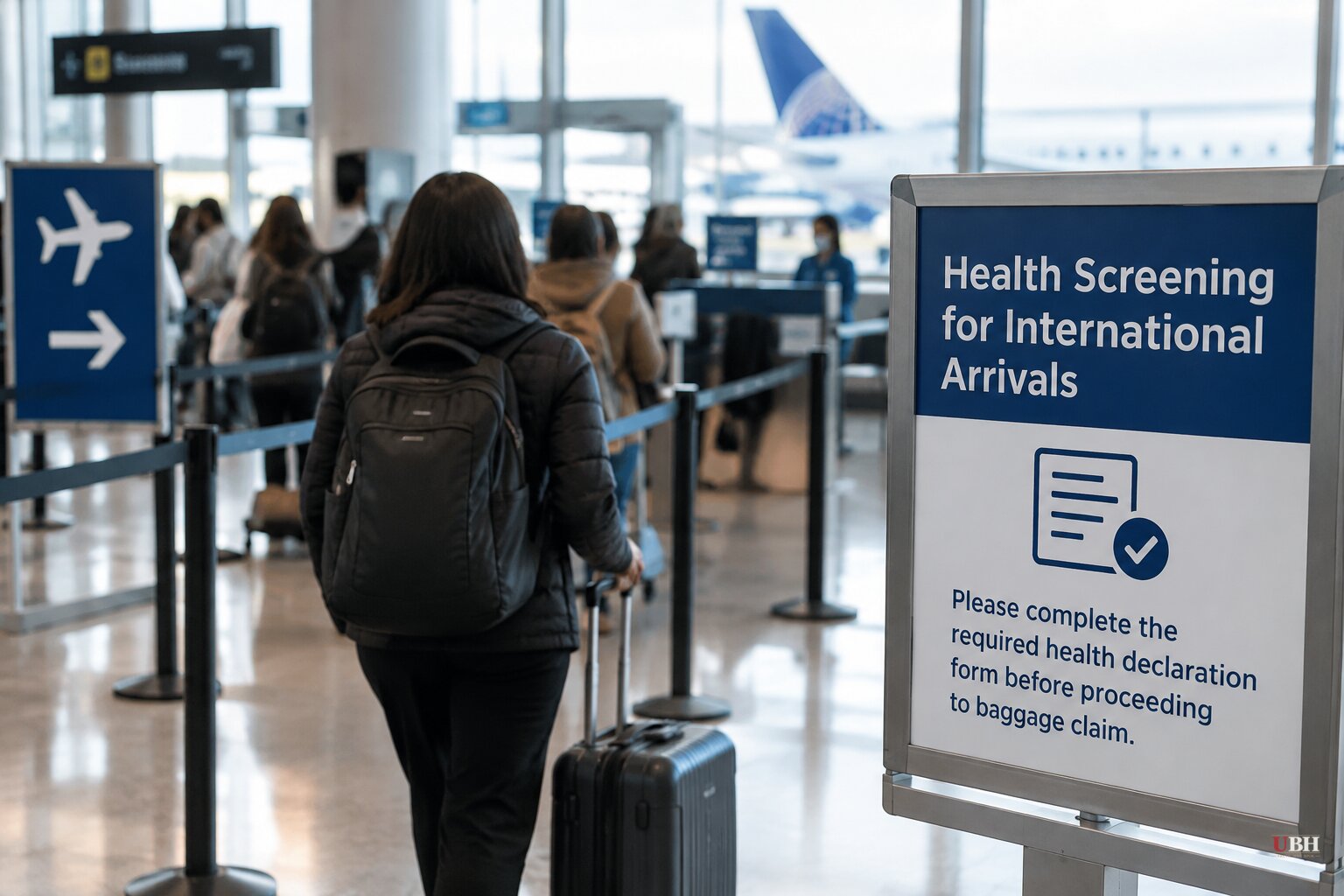
Since the CDC barred foreign passengers who had been in the Democratic Republic of Congo in May, and extended that bar to U.S. citizens in July, the agency's Ebola rules have been aimed at travelers with a DRC link. The new order is not. It reaches everyone.
The CDC order, signed Oct. 22, requires every passenger and crew member on an international flight to the United States to sign a paper or digital statement that they have not been in the DRC during the previous 21 days. It takes effect at 11:59 p.m. ET on Nov. 3 and runs through Dec. 18 unless the agency modifies or rescinds it.
What the order requires
The rule covers U.S. citizens, green card holders, visa holders, ESTA travelers and airline crew. Passengers connecting through a U.S. airport on the way to a third country are included.
Each person signs their own form. Parents or authorized adults can sign for children under 18. Airlines must collect the forms, keep them for at least 42 days after the flight, and refuse boarding to anyone without one.
The form carries OMB Control No. 0920-1474 and warns that knowingly false statements can bring criminal fines and imprisonment under 18 U.S.C. § 1001. The CDC has also warned that airlines that fail to comply face civil and criminal penalties and can be denied permission to disembark passengers.
"Presence" in the DRC is defined broadly. A connection through a Congolese airport counts even if the passenger never leaves the plane. Flying over Congolese airspace without landing does not.
The attestation is an enforcement tool for a restriction that already exists. It does not add a new ban.
The airlines push back
Airlines for America, which represents American, Delta, Southwest, United and JetBlue, sent the CDC a letter dated Oct. 26. The group said it supports the agency's public health goals but called the plan too broad and too fast.
"Changes to check-in systems, digital signatures, station procedures, and training cannot readily be completed in the allotted time," the group wrote. It asked for a delayed start date and a "more proportionate and measured U.S. response."
The group also asked the CDC to exempt crew members, the U.S. military and jumpseat travelers. It called the plan "overly stringent, costly and burdensome to Americans and the US airline industry."
The numbers in its letter: U.S. Customs and Border Protection screened about 130 million air passengers in 2025, and fewer than 25,000 of them had a connection to the DRC.
IATA, which represents more than 370 airlines in over 130 countries, sent its own letter dated Tuesday, Oct. 27. "It is unreasonable for the U.S. government to require all airlines serving the U.S. market to modify their procedures to accommodate the collection of attestations from each individual (passenger and crew) flying to the United States in less than two weeks," IATA wrote.
IATA also questioned why the mandate covers only air travel. "It is difficult to understand why other modes of transportation, maritime and surface, were not included in this mandate," the group said.
Both letters were reviewed by Reuters before becoming public.
The case for the rule
The CDC did not immediately respond to a request for comment on the airline letters. Its order says the DRC remains the epicenter of the outbreak and carries a substantially higher public health risk than neighboring countries, which is why this order targets the DRC alone rather than also naming Uganda and South Sudan. Foreign nationals who were in Uganda or South Sudan in the prior three weeks remain barred under earlier orders.
Dr. Tyler Evans, a California infectious disease physician and CEO of Wellness Equity Alliance, backs the move. "This was a step in the right direction, given the fact that we really do have to take this seriously. We have to ensure that this does not cross borders," he told Fox News Digital. He called it "the second-largest outbreak of Ebola in history."
The outbreak involves the Bundibugyo strain, which spread undetected for months before it was declared in May. It kills about half of those infected and has no approved treatment or vaccine. The Africa CDC has confirmed about 4,700 deaths.
The tradeoff
The two sides are working from different premises. The CDC's order treats the risk of Ebola reaching the United States by air as high enough to justify a universal process. Airlines for America argues that a ban on DRC travelers already exists and that the added paperwork falls on tens of millions of passengers with no DRC link.
The rule also lands ahead of the Thanksgiving and holiday travel season. One travel-industry guide notes that the CDC rates the risk to the U.S. public as low and that no U.S. cases tied to the current outbreak have been reported.
Airlines can fold the declaration into online check-in. Where they have not, a paper form will be handed out at the gate. Whether carriers can build that process in five days is the question their letters put to the CDC.
The agency has not said whether it will delay the start date, exempt crew or narrow the order. Absent a change, boarding agents on flights leaving foreign airports after 11:59 p.m. ET on Nov. 3 will have to turn away anyone who has not signed.
Sources used for this briefing
7 links from 7 independent newsrooms (syndicated copies of the same report count once)
These are the sources it draws on, linked so you can verify.


