
Original briefings. Zero spin.
Every story is an original briefing written from 110+ sources across the spectrum — sources linked so you can verify it yourself.
 health
Notable (6/10)
Event date: July 29, 2026 at 12:00 PM
health
Notable (6/10)
Event date: July 29, 2026 at 12:00 PM
Air Force, Navy and Coast Guard Veterans Show Higher ALS Rates Than Army Veterans, Harvard Study Finds
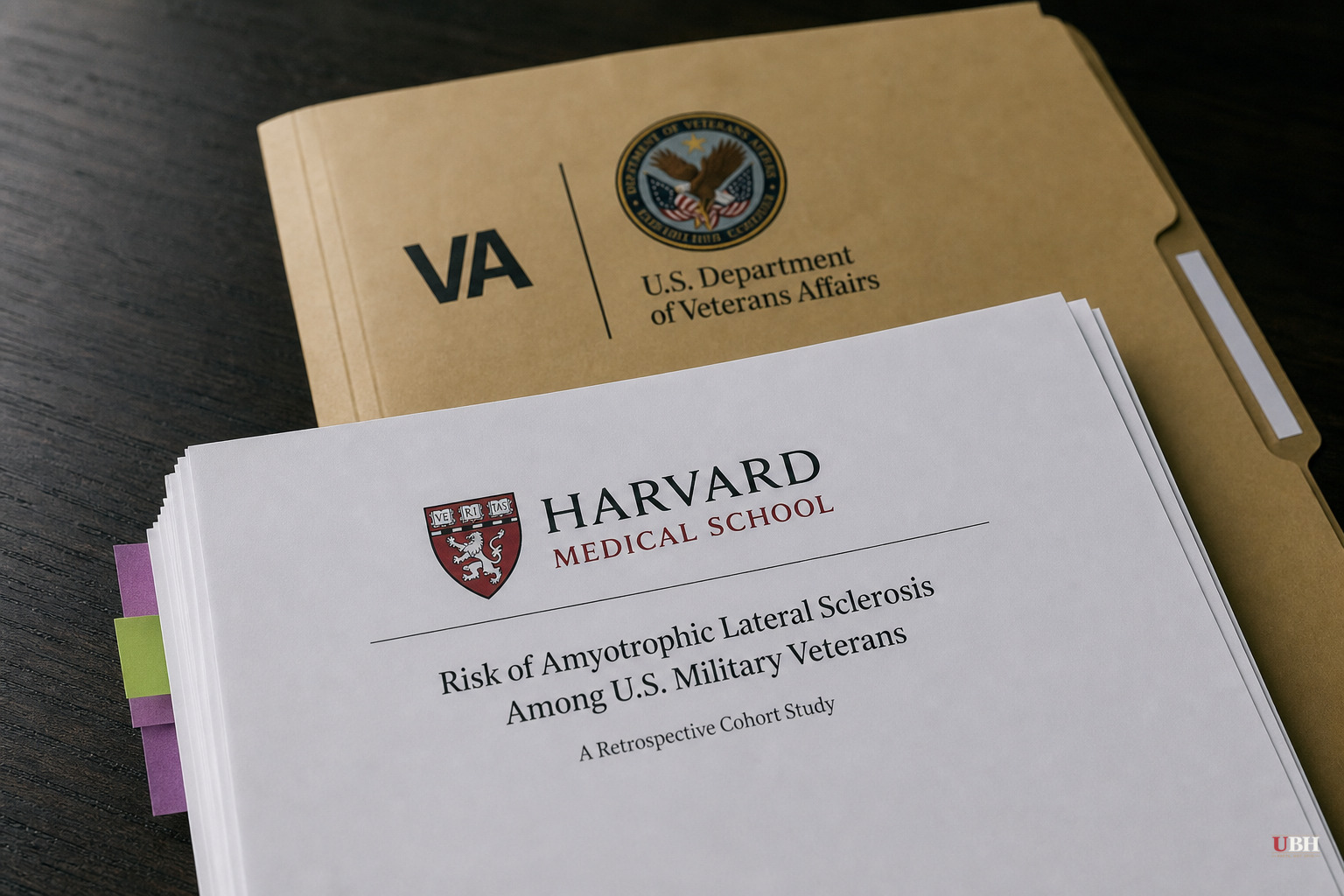
Veterans who served in the Air Force, Navy or Coast Guard are getting ALS at meaningfully higher rates than Army veterans. That's the finding from a Harvard T.H. Chan School of Public Health study published July 29, 2026, in the journal Neurology. The results have researchers asking new questions about what exactly the military exposes people to.
The numbers are specific. Researchers led by Andrea Roberts, with senior author Marc Weisskopf, a Harvard environmental epidemiology professor, pulled health records for roughly 9.2 million male veterans who used Veterans Health Administration care between 2000 and 2024, plus nearly 785,000 women. Of those, 13,935 men and 484 women developed ALS.
After controlling for age, race and ethnicity, male Air Force veterans had a 29% higher ALS rate than Army veterans. Coast Guard veterans came in at 26% higher, Navy at 15% higher. Marine veterans, meanwhile, had a 22% LOWER rate than the Army. Officers had it worse than enlisted troops across the board: 64% higher risk for men, 72% higher for women, according to the Harvard write-up.
One more wrinkle: longer service was tied to LOWER ALS rates, not higher. That's counterintuitive, and Weisskopf says it might point to unique risks tied to short-duration military jobs rather than years of cumulative exposure.
Why It Matters
Weisskopf isn't dressing this up as solved science. "Military service is a known risk factor for the development of ALS, but little is known about what factors may contribute to that risk," he said, according to Harvard's release. He floated some theories: officers dealing with more psychosocial stress, pilots getting hammered by G-forces, noise, vibration and circadian disruption, while enlisted troops face harder physical labor, heavy weapons handling, and exposure to fuels and solvents.
Caroline Ingre, an ALS researcher and chief physician at Karolinska University Hospital in Sweden, told Sweden Herald that the connection between military service and ALS "is not fully established" and that any explanation right now is a hypothesis, not a conclusion. She raised physical strain, emotional strain, chemical exposure during combat, and even genetic predisposition, the idea that the traits making someone fit to be a soldier or athlete might independently correlate with ALS risk, as competing possibilities.
This is a real limitation in the study design: the VA records show WHO got ALS and where they served, not WHAT specifically caused it. Correlation across branches doesn't prove a specific toxin, job, or stressor is the trigger. Weisskopf himself said future research needs to identify the actual exposures.
The Pesticide Data Point
A separate systematic review, published Aug. 4, 2026, in Occupational & Environmental Medicine and covered by the Epoch Times, adds a plausible thread. Researchers who pooled eight studies from 1990 to 2025 found occupational pesticide exposure tied to a 60% higher odds of ALS overall, with herbicide exposure carrying a slightly bigger risk than insecticides or fungicides. Men exposed had double the ALS risk compared to unexposed men; no elevated risk showed up for exposed women.
Martin Scholze, a research fellow at Brunel University of London, told the Science Media Center the 60% finding rests on a small number of studies and should be treated as "suggestive rather than definitive." He also flagged that most of the underlying research relied on self-reported exposure rather than hard measurements.
Pesticides aren't a new suspect in military health. Breitbart reported in May on a JAMA Neurology study finding Camp Lejeune veterans exposed to contaminated water, including the carcinogen trichloroethylene, faced a 70% higher risk of Parkinson's disease, a different neurological disorder but a similar exposure pattern: troops stationed somewhere for years, drinking or breathing something nobody disclosed until decades later.
What Should Happen Next
Weisskopf was blunt that ALS remains rare, and even a 29% or 64% relative increase translates to a small absolute risk for any individual veteran. He's also explicit that the researchers didn't determine which military jobs or exposures are actually responsible.
The next step, according to Harvard's release, is identifying the specific exposures behind the branch and rank gaps. That means someone has to go look at pilot cockpits, ship engine rooms, coast guard vessels, and officer duty stations, and measure what's actually in the air, water, or workload. Until that happens, veterans in the Air Force, Navy and Coast Guard know they're at higher relative risk. They still don't know why.
Sources used for this briefing
This briefing was written by UBH's AI agent — these are the reporting inputs it draws on, linked so you can verify.


