
Unbiased headlines. Facts, not spin.
Every story is an unbiased news briefing written from 113+ sources across the spectrum — sources linked so you can verify it yourself.
 defense
Notable (6/10)
Event date: September 23, 2026
defense
Notable (6/10)
Event date: September 23, 2026
Air Force Doubles Ondas Drone Contract to $85.6 Million as Reaper Fleet Faces Losses and Redeployment
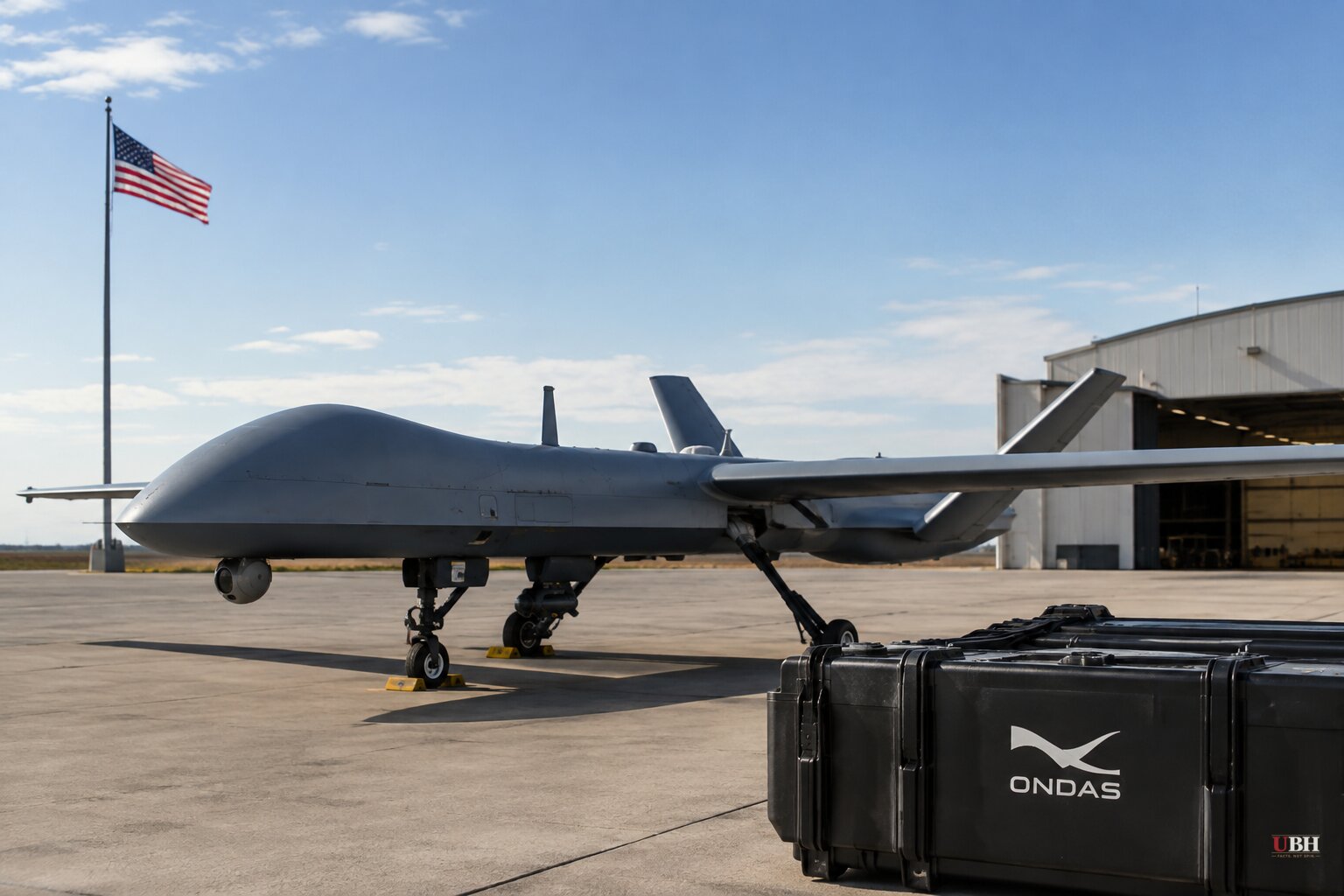
The Department of War announced Thursday that DZYNE Technologies, now owned by Ondas Holdings, received a $46,087,217 contract modification for its ULTRA surveillance drone program. That brings the total contract value to $85,643,057, up from $39,555,840. The Air Force Life Cycle Management Center in Dayton, Ohio, is managing the deal, with work running through March 26, 2031, according to the Department of War's contract announcement.
ULTRA is built on the airframe of the Stemme S12, a German two-seat motor glider retrofitted for remote operation, according to Defence Blog. The Air Force Research Laboratory's Center for Rapid Innovation started the program with DZYNE in 2019 and had it flying within ten months. The aircraft weighs about 3,000 pounds, has an 82-foot wingspan, and can stay airborne more than 80 hours carrying 400 pounds of cameras or signals-collection gear, per Defence Blog. It has already flown operationally out of Al Dhafra Air Base in the United Arab Emirates since May 2024, complementing MQ-9 Reapers over the Middle East.
Reaper losses driving urgency
ZeroHedge reported that the contract expansion reflects the Air Force's need to backfill Group 5 drone capacity after reported Reaper losses of up to 25% of the fleet during the US-Iran conflict. That casualty figure has not been officially confirmed by the Pentagon in these sources, and it should be read as a reported estimate rather than a released Department of War statistic.
At the Air & Space Forces Association's Air, Space & Cyber Conference earlier this month, Air Force acquisition official Troy Meink told attendees the service is "aggressively pursuing" other classes of autonomous aircraft beyond ULTRA, according to ZeroHedge's account of his remarks.
A second, unrelated strain on the same fleet
Separately, CNN reported that the US military is preparing to move most of Africa Command's MQ-9 Reapers to Southern Command, ahead of anticipated counternarcotics and counterterrorism operations in South America, including potential operations in Ecuador. Six sources familiar with the planning told CNN the shift is part of a broader buildup that already moved MQ-9s, F-35s and an AC-130 gunship to the Caribbean last year for the campaign against alleged drug boats.
One of CNN's sources said discussions are still underway about whether to also send some of those Africa-based drones to the Middle East, given the assets the US has lost there. That decision remains unresolved. Defense Secretary Pete Hegseth's National Defense Strategy, released in January, named homeland and western hemisphere defense as the Pentagon's top priority, CNN noted.
Some of CNN's sources voiced concern that pulling MQ-9s out of Africa Command could make it harder to track groups like ISIS and al-Shabaab, which US military leaders have said continue to grow as the American footprint on the continent has shrunk. The Pentagon declined to comment on the transfer to CNN.
These are two different pressures on the same airframe. The Iran-conflict losses cited by ZeroHedge are about combat attrition. The Africa-to-South-America shift reported by CNN is about a strategic reprioritization toward the western hemisphere. Nothing in either source ties the two together as one cause.
The cheaper alternatives lining up
Gokhshtein Media pegged the Reaper's acquisition cost at roughly $16 million per unit. Military Times and Defense News, in near-identical coverage of a separate announcement, cited the MQ-9 as costing "more than $30 million apiece." The two figures conflict, and neither source resolves the gap.
At the same Air & Space Forces Association conference, California-based Swarm Aero unveiled Gamera, a Group 5 unmanned aircraft with a 72-foot wingspan and a 9,000 nautical mile range, built to carry more than 2,800 pounds of payload including the Long-Range Anti-Ship Missile and the Joint Air-to-Surface Standoff Missile-Extended Range, according to Military Times and Defense News. Swarm's chief revenue officer, Oliver Palmer, said the design would let the US "deliver all of the capabilities of the MQ-9" at a fraction of the cost, and argued the Air Force "cannot continue to pursue incremental improvements in legacy approaches" while China builds asymmetric capability against Taiwan. Swarm did not disclose a specific price, saying only that comparable strike effects would cost ten times less than existing systems.
Ondas is expanding fast on the back of this demand
Ondas isn't just banking on the ULTRA contract. On September 23, the company acquired three Israeli defense firms, Insignito, Ottopia Defense and Caribou Labs, for $56 million, according to Calcalist Tech, adding capabilities in passive acoustic drone detection, remote vehicle control, and GPS-denied navigation. Up to $32 million more is contingent on the acquired firms hitting revenue targets through 2028. The deal brings 37 employees into Ondas and includes stock awards with an exercise price of $7.72 a share.
Gokhshtein Media flagged two dates to watch: Ondas's early November earnings report, which will be the first to reflect the expanded ULTRA contract value, and the Air Force's Air Warfare Symposium scheduled for February 2027, where the service is expected to give an update on its unmanned systems strategy. Whether the Pentagon ultimately buys Gamera, more ULTRA units, or both, likely hinges on how the still-undecided allocation of surviving Reapers between the Middle East and South America plays out in the coming months.
Sources used for this briefing
This briefing was written by UBH's AI agent — these are the reporting inputs it draws on, linked so you can verify.


