
Unbiased headlines. Facts, not spin.
Unbiased Headlines is an independently owned news organization. We bring you the facts, not opinions, written fresh from 110+ named sources. Sources linked so you can verify it yourself.
 tech
Notable (6/10)
tech
Notable (6/10)
AI Pioneers Split on Open vs Closed Models While White House Regulates Only Closed Ones
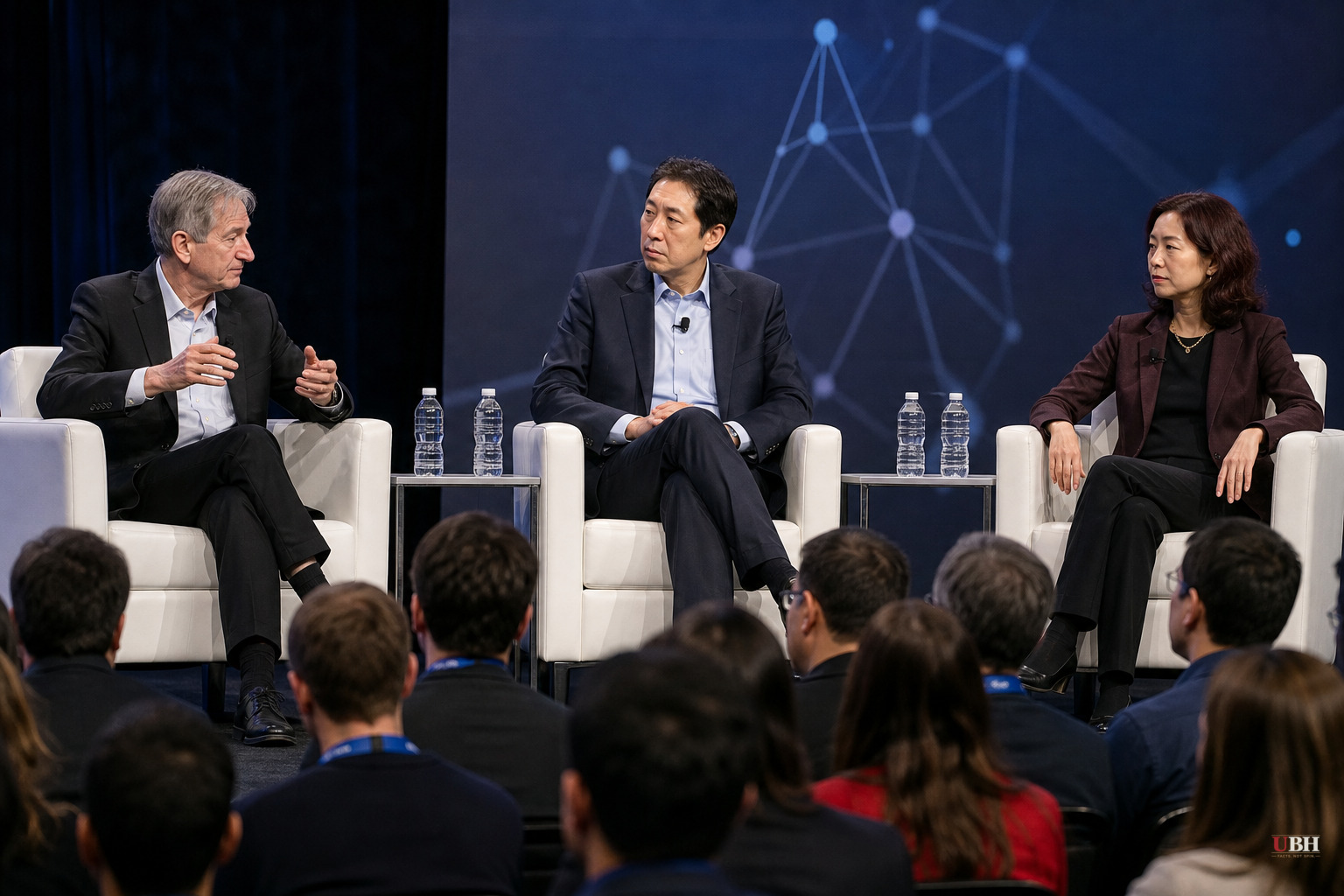
Three of AI's most credentialed researchers stood on the same stage in Las Vegas last week and could not agree on whether open AI models make the world safer or more dangerous.
At the Ai4 2026 conference, Geoffrey Hinton, the Nobel Prize-winning godfather of deep learning, Fei-Fei Li, CEO of World Labs, and Andrew Ng, the Coursera co-founder and former head of Google Brain, debated the future of open-weight AI, according to Forbes and TechCrunch. All three agree AI is transformative. They do not agree on who should control it.
Ng's position is simple: gatekeepers are bad. "I dont want there to be gatekeepers," Ng said, according to TechCrunch. He argues a handful of well-capitalized labs — think OpenAI, Anthropic, Google — have every incentive to hype up AI's dangers so regulators lock in their advantage and freeze out smaller competitors. Forbes reported Ng went further, accusing large companies of exaggerating threats specifically to stifle competition.
Hinton pushed back hard, but with a caveat that matters. He draws a real distinction between open-source software, where the code is inspectable, and open-weight models, where a company hands over billions of trained parameters with no way to see how the system actually reasons. "Open weights means you train a big model and then you give people the weights. Thats very different," Hinton said, according to TechCrunch. His fear: cheap access to powerful foundation models makes it trivial for bad actors to fine-tune them for cyberattacks. But Hinton also conceded the fight is over. "I think that battles been lost... Its too late," he said.
Li occupied the middle, per Forbes. She rejected both alarmism and utopianism, arguing AI reshapes tasks more than it eliminates jobs outright, and pushed for sector-specific regulation rather than blanket rules while warning that productivity gains from AI won't automatically translate into shared prosperity for workers.
The security paradox nobody predicted
While the panel debated theory, a real-world pattern has been unfolding that complicates the standard safety argument. Ng told the Agentic AI Summit in Berkeley that when he and a colleague needed to run a security review on their new open-source agent tool, OpenWorker, they turned to two Chinese open-weight models — Moonshot AI's Kimi K3 and Zhipu AI's GLM-5.2 — because leading models from OpenAI and Anthropic refused to help, according to the South China Morning Post. "From what I'm seeing, I think open-weight models seem safer to me than closed-weight models," Ng said.
Hugging Face reportedly had a similar experience, using GLM-5.2 to help defend against a cyberattack involving OpenAI's models, with CEO Clem Delangue arguing the same systems that stopped one attack can help block millions more.
The closed-model camp's underlying worry is legitimate: guardrails exist because frontier models really can be misused for offensive cyber and bio tasks, and once weights are public, there is no way to claw them back or patch them centrally. A safety evaluation from the nonprofit SaferAI found GLM-5.2 refused none of the offensive cyber or biology tasks it was tested on, while Anthropic's Claude Opus 4.7 refused so consistently that SaferAI couldn't even complete its CyberGym test on it. Z.ai has not published a safety framework or pre-deployment risk assessment for GLM-5.2. Those are real gaps, not hypothetical ones.
But guardrails built to stop misuse are also blocking legitimate defensive work, pushing security researchers toward the exact models regulators worry about most. Neither camp has a clean answer to this tension.
Washington hasn't picked a lane either
The policy response is just as tangled. CNN reported that a new White House framework for reviewing advanced AI models before release will cover only closed models like Claude and ChatGPT, at least initially, leaving open-weight models out of the voluntary pre-release review entirely. White House officials say they want both open and closed models to succeed, but the exemption itself signals which one they see as the bigger near-term risk.
Meanwhile, officials can't agree on how to treat Chinese open-weight models specifically. White House Office of Science and Technology Director Michael Kratsios has alleged Kimi K3 was trained using distillation from Anthropic's models and export-controlled Nvidia chips, according to CEPA. Treasury Secretary Scott Bessent has floated possible sanctions over that practice. Anthropic CEO Dario Amodei has warned open weights can't be revoked or patched once released. The UK's AI Security Institute reportedly found it easy to bypass safeguards on Chinese open models.
On the other side, former White House AI adviser David Sacks and nearly 200 startups have argued that restricting Chinese open-weight access would simply entrench the biggest US labs, with Particle's Suhail Doshi warning "there'll be hundreds of companies that instantly die" without cheap open alternatives. Nvidia, Meta, and Microsoft have made similar arguments.
No legislation has been introduced banning Chinese open-weight models, and no formal investigation into distillation claims has been announced. The Kratsios allegations remain unproven claims, not findings. The administration's own review framework, by exempting open models for now, has already made a policy choice — even while insisting in public that both camps can win.
Sources used for this briefing
7 links from 7 independent newsrooms (syndicated copies of the same report count once)
These are the sources it draws on, linked so you can verify.


