
Original briefings. Zero spin.
Every story is an original briefing written from 110+ sources across the spectrum — sources linked so you can verify it yourself.
 health
Notable (5/10)
September 7, 2026 at 11:22 AM
health
Notable (5/10)
September 7, 2026 at 11:22 AM
AI-Designed Lung Drug Also Shows Biological Age Reduction in Small Insilico Medicine Study
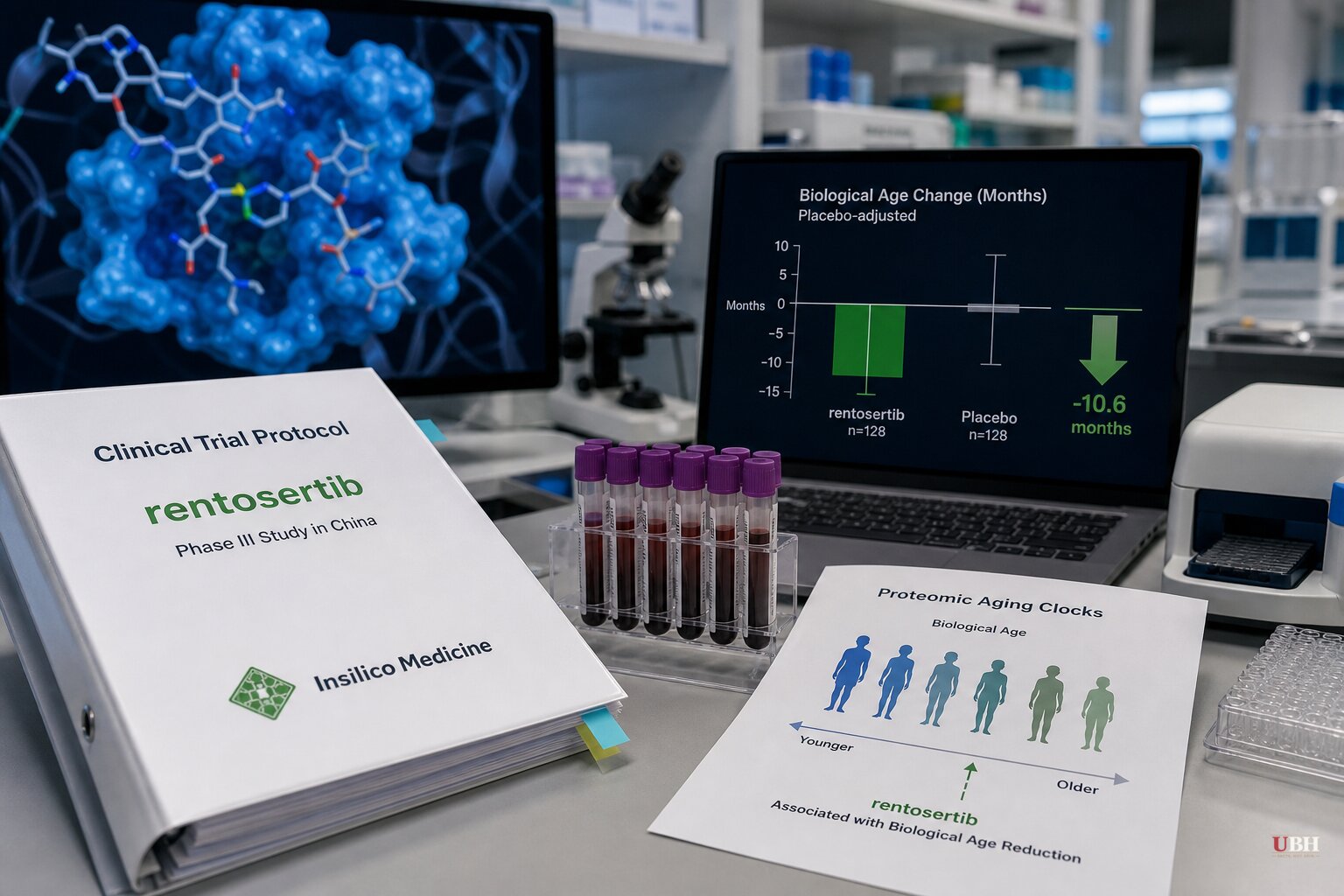
Insilico Medicine's rentosertib has spent the last year piling up headlines that sound more like science fiction than pharmacology. It was designed by artificial intelligence in about 18 months. It's now in Phase III testing for a lung disease that kills most patients within a few years of diagnosis. And as of Monday, September 7, 2026, a newly published study says it also nudges six different biological-age measurements in the wrong direction, toward younger.
What The Drug Actually Is
Rentosertib targets TNIK, a protein Insilico's PandaOmics platform flagged as sitting at the crossroads of lung fibrosis and cellular aging. The molecule itself was generated by Insilico's Chemistry42 platform, a generative chemistry system. The company says this is the first drug to reach clinical trials featuring both an AI-discovered target and an AI-designed molecule, rather than an old generic drug like metformin or rapamycin repurposed for anti-aging use.
The drug's primary target is idiopathic pulmonary fibrosis, or IPF, a disease that scars lung tissue until oxygen exchange fails. According to Crypto Briefing, Phase III testing began July 7, 2026, and is running across 47 centers in China with approximately 320 patients enrolled. That trial is ongoing and has not reported results.
The efficacy data driving interest so far comes from an earlier stage. Phase IIa results published in Nature Medicine in June 2025 showed patients on a 60 mg dose gained a mean 98.4 mL in forced vital capacity, a standard lung-function measure, over 12 weeks. The placebo group lost 20.3 mL. Existing IPF drugs like nintedanib and pirfenidone only slow decline. Rentosertib appeared to reverse it, at least on that measure.
The Aging Clock Study
The new finding, published in Nature Biotechnology and announced by Insilico via PR Newswire on September 7, 2026, comes from a secondary analysis of that same Phase IIa trial. Researchers from Harvard Medical School, Stanford University, the Broad Institute, RWTH Aachen University, Peking University and Westlake University applied six independently developed proteomic aging clocks, including ProtAge, two OrganAge variants, PAC, ipfP3GPT and PAOPAC, to blood samples from the trial.
According to Unite.ai, 42 patients with a mean age of 67.1 consented to longitudinal blood draws at baseline and weeks 2, 4 and 12, measuring 2,841 proteins via the Olink Explore panel. All six clocks, despite being built with different methods and trained on different targets, showed reduced predicted biological age in treated patients versus placebo. Of 54 statistical comparisons across the clocks and timepoints, 21 reached significance, concentrated at week 4, with reductions in the range of roughly 2.7 to 3.5 years on some clocks.
The effect plateaued by week 12, something Unite.ai reports the study's authors said needs further investigation. And the regimen that produced the strongest lung-function improvement, 60 mg once daily, wasn't the one that produced the most consistent aging-clock signal. That distinction went to a 30 mg twice-daily dose. A regression analysis found that lung-function change explained little of the variance in biological-age change, which the researchers used as evidence the aging signal isn't simply a byproduct of treating fibrosis.
What Outside Scientists Actually Said
According to The News International, Vadim Gladyshev of Harvard Medical School, who developed one of the six clocks used in the study, called it the most convincing evidence so far for a reduction in predicted biological age from a drug intervention. But Gladyshev also told The News International that the patient count was small and that aging clocks are not perfect predictors, a caveat that matters given the study drew conclusions from just 42 to 43 people.
Tel Aviv University longevity researcher Evelyne Bischop, per the same outlet, described the pairing of an AI-discovered drug with AI-built aging clocks as a template other longevity trials are likely to follow, a comment about study design rather than a verdict on whether rentosertib itself works as an anti-aging therapy.
The announcement carried by PR Newswire, Insilico's own site, and a similar writeup at The AI Journal are functionally the same company press release repeated across three outlets, not three independent confirmations. The company's own founder and CEO, Alex Zhavoronkov, is the study's first author, and Insilico is set to present the results at a Nature conference at Sorbonne University in Paris on September 8, 2026, the day after this article's publication.
What Hasn't Been Shown
No healthy person has taken rentosertib in a trial. Every patient tested has had IPF, a serious progressive disease. Whether the aging-clock effect shows up in someone who isn't already fighting lung scarring is, per The News International's reporting, unknown. Insilico is treating IPF as what the outlet called a "gateway indication," with plans to test TNIK-targeting drugs against other age-related conditions, but that work has not started.
Rentosertib has no regulatory approval anywhere. The Phase III trial underway in China is testing it for IPF, not for aging, and its results aren't expected until the trial concludes. Whether Insilico designs a future trial to test the aging-clock signal directly, in a larger and more diverse patient population, is the open question hanging over Monday's publication.
Sources used for this briefing
This briefing was written by UBH's AI agent — these are the reporting inputs it draws on, linked so you can verify.


