
Original briefings. Zero spin.
Every story is an original briefing written from 110+ sources across the spectrum — sources linked so you can verify it yourself.
 tech
Major Story (7/10)
Event date: August 27, 2026
tech
Major Story (7/10)
Event date: August 27, 2026
AI Data Centers Could Triple Direct Water Use by 2030, and the Bigger Number Is Hidden in the Power Plants
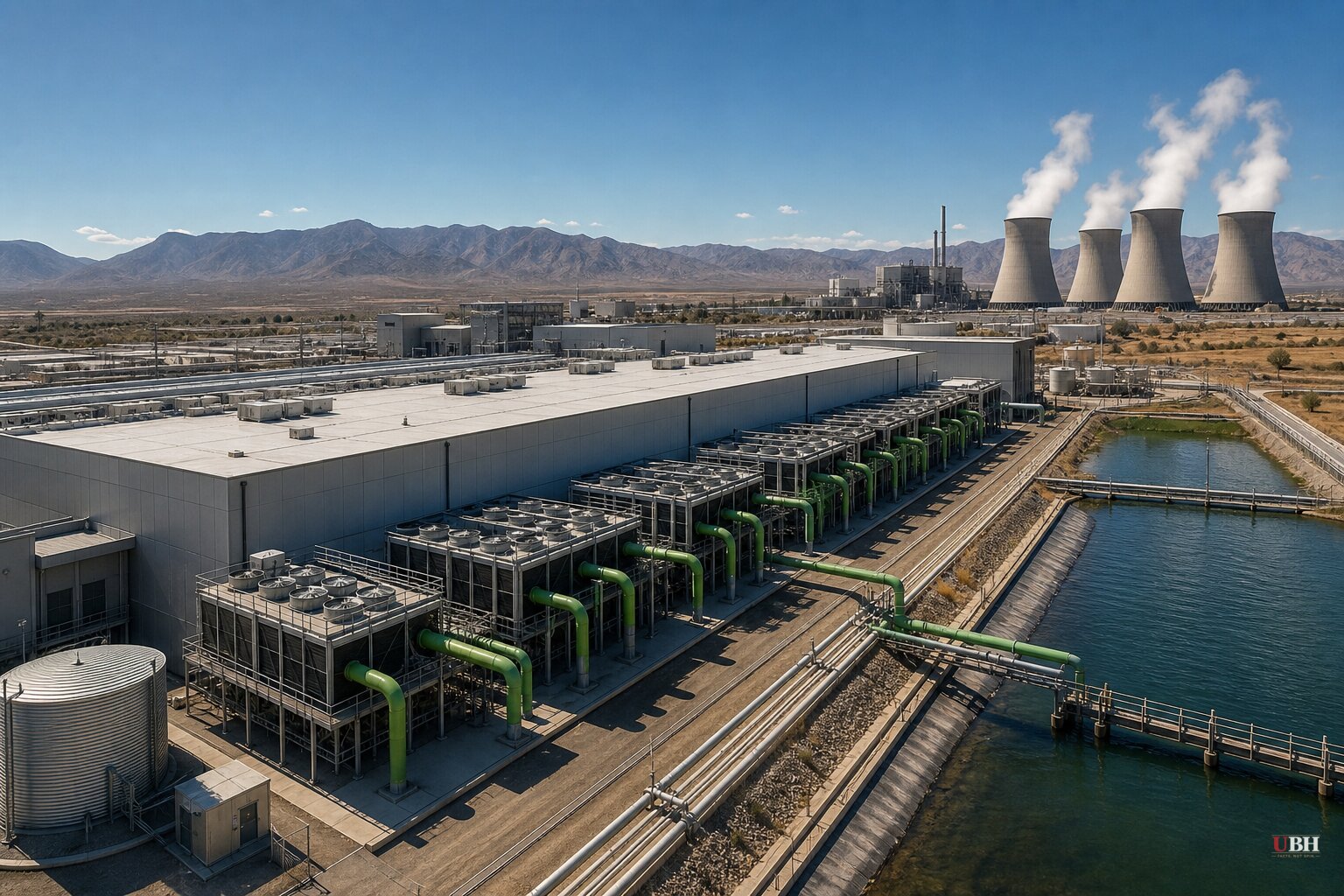
AI Data Centers Could Triple Direct Water Use by 2030, and the Bigger Number Is Hidden in the Power Plants
Data centers are about to get a lot thirstier, and most of the coverage is measuring the wrong impact.
Rystad Energy, an energy research firm, estimates global data center direct cooling water consumption hit 222 billion liters in 2025 and could climb to 644 billion liters by 2030 under its central risk case, according to OilPrice.com and Down to Earth. Active water-saving measures could cut that to 543 billion liters in a moderate scenario or as low as 388 billion liters if operators go aggressive on efficiency, said Minh Khoi Le, Rystad Energy's global head of Data Center & Hydrogen Research.
That's the headline number everyone's running with, but it's also not the biggest number in this story.
The Water You Don't See
According to an analysis published August 25 by the nonprofit Ceres, the electricity that powers data centers requires far more water than the cooling systems inside them. Ceres modeled seven states—Arizona, California, Georgia, Illinois, Ohio, Texas and Virginia—that together host more than half of U.S. data centers and found those facilities' power demand drove freshwater withdrawals of roughly 3.4 trillion gallons in 2024. Latitude Media reported that figure is about 12 times the combined water use of Los Angeles, Phoenix and Washington, D.C.
Virginia's data center electricity alone required an estimated 21 times the water used by the entire city of Washington, D.C. in 2024, per the Ceres analysis. Ceres projects the seven-state total could rise to between 4 trillion and 8 trillion gallons by 2030.
California topped the list at nearly 1.4 trillion gallons, driven by its heavy reliance on hydropower. In Ohio, Georgia and Virginia, more than 90 percent of indirect data center water use traced back to thermal generation, natural gas, coal and nuclear. Arizona and Illinois came back as the two states most exposed to drought and water stress, which Ceres flagged as a real siting risk going forward.
Separately, Bluefield Research projects the water tied to data center power generation is doubling annually and will account for more than 70 percent of total data center water consumption by 2030, according to Trellis.
Nobody's Required to Report This
The actual scandal buried in the numbers is that almost no company discloses it. Latitude Media reported that Meta is the only major hyperscaler that publicly reports its indirect water consumption from purchased electricity. Meta's own sustainability report shows that figure ran more than 20 times higher than the water its data centers consumed directly on-site in 2024, and it has grown every year since 2021.
Amazon told Latitude Media it tracks indirect water use but hasn't released the numbers because there's no industry standard yet. Google and Microsoft wouldn't say whether they even track it.
This is a $100-billion-a-quarter industry building water-hungry infrastructure in drought-stressed states with zero mandatory disclosure. Shama Perveen, Ceres' director of water research, said the point of the report was to give investors and utilities "the foundation for better understanding water risk linked to procuring electricity," working with power producers to cut impacts in stressed regions. Jonathan Koomey, a researcher who has studied data center energy and water use for years, put it more bluntly to Trellis: "It's a real problem the industry needs to figure out. They are being confronted with numbers that are all over the place. People don't have a clear way to measure this, and there aren't clear standards."
The Counterargument: This Is Overblown
Some of the loudest online claims about AI's water footprint don't hold up to scrutiny. Nautilus, citing Knowable Magazine, reported that data center cooling consumed 66 billion liters of water in the U.S. in 2023, less than 1 percent of the nation's total water consumption. Agriculture and manufacturing dwarf what data centers use directly.
The widely circulated claim that a single chatbot query burns 500 milliliters of water traces to an older, now-outdated GPT-4 estimate, according to electrical and computer engineer Shaolei Ren of the University of California, Riverside. Google itself estimated in 2025 that a median-length Gemini query costs about five drops of water. Ren's own past figure, he told Knowable, is already outdated because models have gotten more efficient.
Fengqi You, an energy systems expert at Cornell University, told Knowable there's real reason for optimism: "There are many good ideas out there" for cutting water use, and combined with efforts to restore natural water resources, "there's a good chance that, eventually, it could be net-zero water for the on-site cooling."
That's a legitimate point, and the industry does have real efficiency levers: rack-level liquid cooling, dry cooling in cold climates, and next-generation platforms like NVIDIA's Vera Rubin, which Rystad Energy says could meaningfully cut water demand depending on climate.
But "net-zero for on-site cooling" only addresses the small slice of the problem. The Ceres and Bluefield Research findings say the electricity side, not the server room, is where 70 percent or more of the water footprint will sit by 2030. Dry cooling that saves 2.15 liters of water per kilowatt-hour of IT load, per Rystad Energy's own math, requires an extra 0.3 to 0.74 kWh of electricity to run. That electricity has to come from somewhere, and in Ohio, Georgia and Virginia, more than 90 percent of it comes from water-hungry thermal plants.
Regulators are starting to notice. Down to Earth reported that data center water regulation is beginning to emerge, but reporting requirements are still outpacing binding performance standards. Translation: companies are starting to have to say what they use. Nobody's required yet to actually cap it.
Amazon, Meta, Microsoft and OpenAI continue adding new natural gas capacity to power AI buildouts, according to Trellis, which flagged that trend as a direct driver of higher indirect water withdrawals in the years ahead. Whether any state forces disclosure or siting limits before 2030 arrives is the open question nobody in this industry wants asked out loud.
Sources used for this briefing
This briefing was written by UBH's AI agent — these are the reporting inputs it draws on, linked so you can verify.


