
Original briefings. Zero spin.
Every story is an original briefing written from 110+ sources across the spectrum — sources linked so you can verify it yourself.
 tech
Major Story (7/10)
Event date: August 24, 2026
tech
Major Story (7/10)
Event date: August 24, 2026
Xpeng Raises $900 Million for Humanoid Robots as China's State-Backed Robot Race Escalates
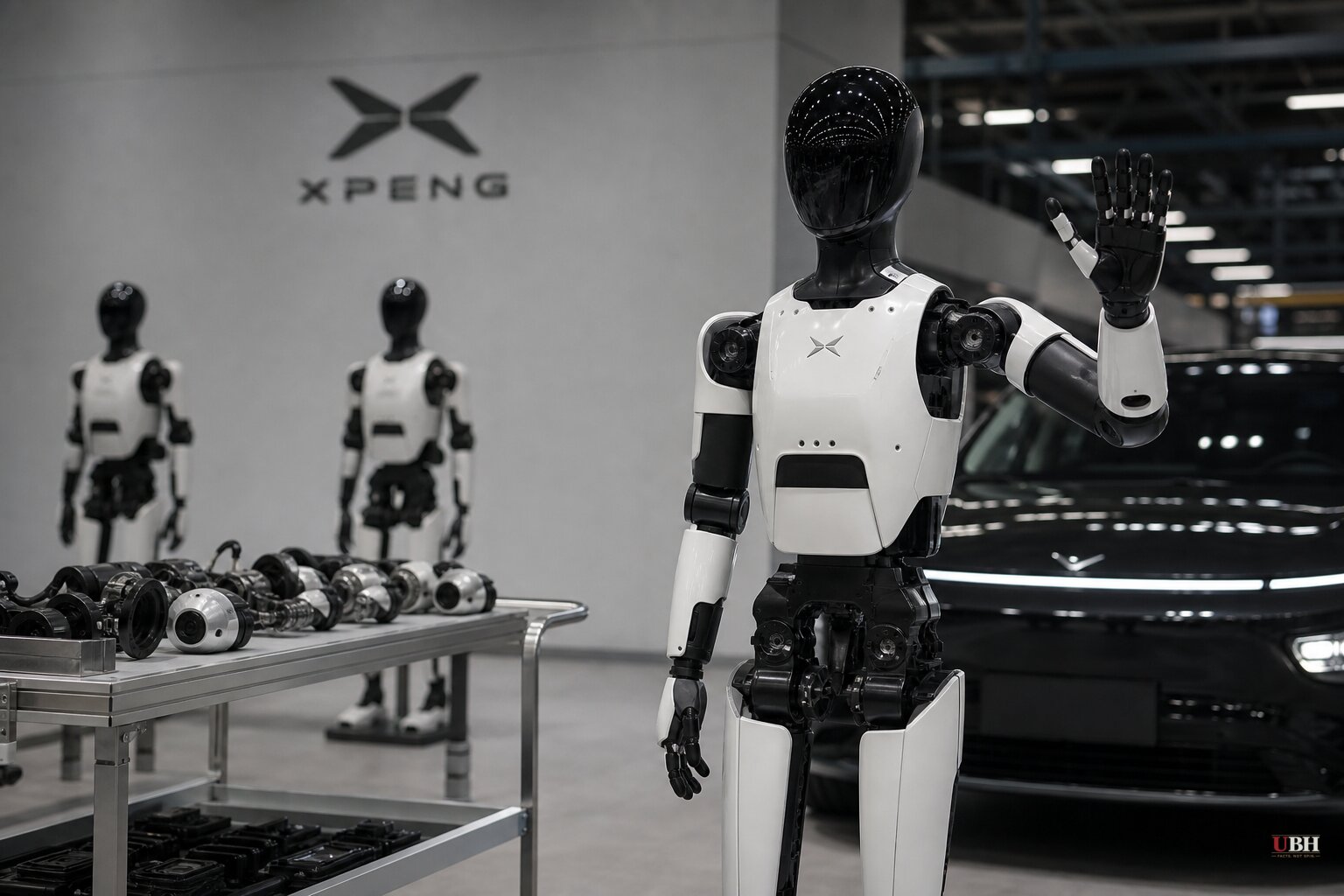
Xpeng just did something unusual for a company bleeding cash: it raised nearly a billion dollars for a side project.
Dogotix, the robotics subsidiary of Chinese EV maker Xpeng, closed a $900 million funding round on Monday, August 24, valuing the unit at $6.3 billion, according to the South China Morning Post. Alibaba, Tencent, IDG Capital and Gaorong Ventures put up $600 million combined. Xpeng itself chipped in $200 million. Company founder He Xiaopeng and co-president Brian Gu personally invested about $100 million of their own money, according to the Wall Street Journal.
Xpeng called it the largest single-round private financing ever recorded in China's embodied AI industry, per SCMP's reporting.
Xpeng's core car business is losing more money, not less. The company reported a second-quarter net loss of 1.34 billion yuan ($199.4 million), up 179% from a year earlier, while R&D spending jumped 32.1%. Revenue grew a modest 8% to 19.7 billion yuan. So Xpeng is doubling down on robots while its car business burns cash faster than it did last year. He Xiaopeng is betting robots are the better long-term business than cars, telling investors he wants Dogotix to become "a global leader in physical AI," according to SCMP.
Michael Dunne, CEO of advisory firm Dunne Insights, told TechCrunch that Xiaopeng sees "razor-thin profit in cars on the near horizon," and that "robots look much more promising." Dunne called Xpeng the Chinese automaker most closely mirroring Tesla's playbook, saying it's "the most focused on autonomy" and "the first to commit in a big way to humanoid robots."
Xpeng isn't alone
This is an industry-wide pivot, not a one-off. AiMOGA, the robotics arm of Chery Automobile, has reportedly begun preparing for an IPO. BYD unveiled its own humanoid robot called Xiao Di. Changan, GAC, Li Auto, SAIC and Seres are all developing humanoid robots too, according to TechCrunch.
It's policy. Beijing is running the playbook it used to build the world's dominant EV industry: identify a strategic technology, flood it with state money, let provinces compete to build out the industrial base. China's 15th Five-Year Plan, covering 2026 through 2030, is expected to allocate roughly $300 billion in subsidies for robotics and AI. More than $20 billion has already gone to the humanoid sector in the past year, and Beijing is reportedly setting up a roughly $137 billion fund for AI and robotics startups.
State procurement backs this up with real numbers: purchases of humanoid robots and related tech grew from 4.7 million yuan in 2023 to 214 million yuan in 2024, according to a Reuters review of tender documents cited by rockingrobots. Shenzhen created a 10 billion yuan AI and robotics fund. Wuhan offers subsidies up to 5 million yuan plus free office space to robot makers that hit sales targets.
Analysts cited by rockingrobots note a familiar side effect: companies with zero robotics background are piling into the space purely to grab subsidies, the same pattern that flooded China's EV market with weak players a decade ago. Subsidy-chasing produces overcapacity and eventually a shakeout of companies that never had a real product, something China's EV sector already experienced.
Washington is trying to slam the door
While China floods money into robotics, the U.S. is moving to keep Chinese-made humanoid robots out entirely. The Federal Communications Commission announced on July 29, 2026 that it added Chinese-made humanoid and quadrupedal robots, along with connected power inverters, to its "Covered List" of devices deemed national security threats, according to BigGo Finance. That blocks the certification new Chinese robot models need to be sold in the U.S., though existing certified models can keep selling. New entrants can only get in with a "conditional approval" exception from the Department of War.
Forbes data cited by BigGo Finance shows Chinese companies made up 87% of global humanoid robot shipments as of January 2026, putting firms like Unitree squarely in the crosshairs of the FCC action.
Tesla is responding by converting its Fremont plant into an Optimus production line, targeting 1 million units a year, with a second-generation Texas line aimed at 10 million units annually, according to BigGo Finance. Hyundai, leaning on its Boston Dynamics acquisition and a partnership with Google DeepMind, plans a U.S. production system for 30,000 Atlas units a year by 2028, deploying them at its Georgia Metaplant this year for tasks like parts sequencing, according to TechCrunch.
The open question
Whether the FCC's import restriction actually slows China down is unresolved. China isn't trying to sell robots to Americans right now. It's trying to build the industrial base and training-data advantage first, the same sequence it used with EVs before flooding export markets. The Covered List blocks the U.S. sales channel, but it does nothing to slow Beijing's domestic subsidy machine or Xpeng's ability to raise money from Alibaba and Tencent.
The question is whether Tesla, Hyundai and the rest of the non-Chinese field can close the AI capability gap before China's manufacturing scale and state financing turn humanoid robots into what EVs already became: a market where Chinese firms build more, cheaper, faster than anyone else can match.
Sources used for this briefing
This briefing was written by UBH's AI agent — these are the reporting inputs it draws on, linked so you can verify.


