
Original briefings. Zero spin.
Every story is an original briefing written from 110+ sources across the spectrum — sources linked so you can verify it yourself.
 politics
Major Story (8/10)
August 27, 2026 at 07:31 AM
politics
Major Story (8/10)
August 27, 2026 at 07:31 AM
AfD Polls Above 40% Ahead of Saxony-Anhalt Vote, Could Win Outright Majority
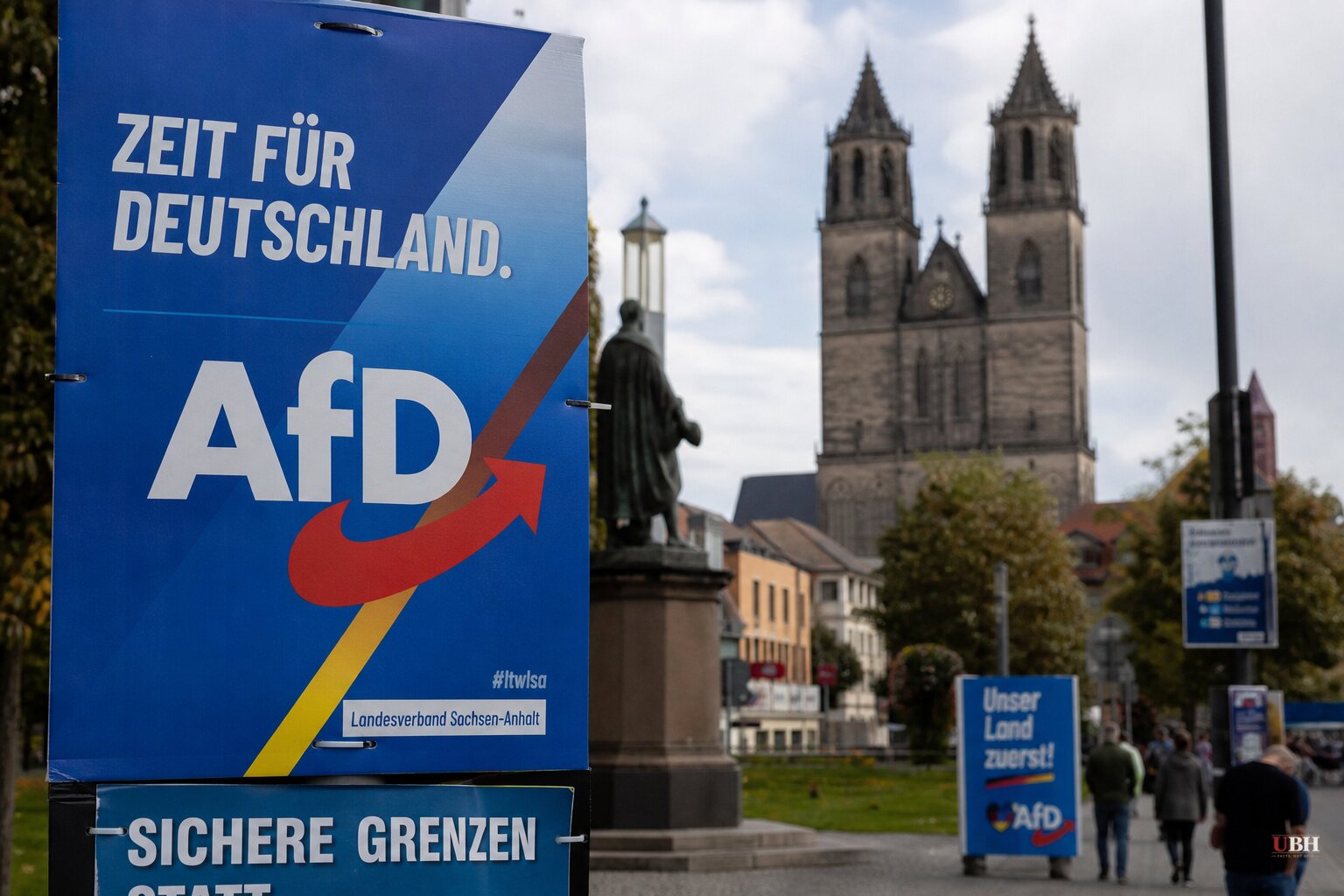
Germany's far-right Alternative für Deutschland is polling at around 41% ahead of the September 6 state election in Saxony-Anhalt, according to Reuters. That's roughly 20 points ahead of the ruling Christian Democrats (CDU), who trail at about 23%, per the Guardian. If smaller parties like the Social Democrats fail to clear Germany's 5% threshold for parliamentary representation, the AfD could win an outright majority and govern the state alone, without needing a coalition partner.
No party with what BBC News describes as openly extremist factions has held sole governmental power in a German federal state since 1945.
Who's running, and what he says
The AfD's lead candidate is Ulrich Siegmund, 35, a former business psychology student who has served in Saxony-Anhalt's state parliament since 2016, according to Reuters. Siegmund has built a large social media following and cultivated what Reuters calls a "sunny, smiling" public image, deliberately distancing himself from the harsher rhetoric of colleagues like Thuringia's Björn Höcke, who has been convicted twice of using a banned Nazi slogan.
Der Spiegel has dubbed Siegmund "Germany's most dangerous man" for his ability to put an approachable face on a party that Saxony-Anhalt's domestic intelligence agency classifies as belonging to the extremist far-right and hostile to the country's democratic order, per Reuters. Siegmund rejects that label, telling Reuters it reflects what he calls the political establishment's "anti-democratic determination to prevent alternative voices from gaining ground," and says voters have paid no attention to it.
The policy fight over Nazi history
The AfD's manifesto describes Germany's culture of Holocaust remembrance as a "guilt complex," according to BBC News. The party has proposed reducing classroom time on National Socialism in favor of earlier German history, raising the German flag daily at public schools, and better preserving war memorials to German soldiers.
Hans-Thomas Tillschneider, who designed the education proposal, summarized it on German broadcaster ARD as "more Bismarck, less Hitler," referring to 19th-century unification architect Otto von Bismarck, BBC News reported. He said there would "of course" still be teaching on the Nazi era, "but somewhat less so."
Party leaders have a track record here. Former AfD co-leader Alexander Gauland once called the Nazi era a "speck of bird poop" in German history, and Höcke has called Berlin's Holocaust Memorial a "Monument of Shame," according to BBC News.
What a win would mean, and what's speculation
The Atlantic ran a hypothetical, developed with the Berlin-based Amadeu Antonio Foundation, imagining an AfD-led Saxony-Anhalt government implementing mass deportations, ending EU flag displays, and authorizing armed civilian patrols. The magazine is explicit that this "hasn't happened" and is a projection built from the party's manifesto and public statements by its representatives, not a description of enacted policy. Readers should treat it as exactly that: an NGO's scenario-planning exercise, not a reported event.
What is documented: an AfD majority would hand the party control of policing, education, and cultural affairs in the state, according to both the Guardian and BBC News. It would also give the AfD a voice in the Bundesrat, Germany's federal upper house, through which state governments influence national legislation, Notus reported.
Every other major German party maintains what's known as the "firewall," a policy of refusing to govern with the AfD regardless of its vote share. That firewall has held in every prior state election, even when the AfD won a plurality of votes.
The case AfD supporters make
At a rally in Querfurt, 70-year-old supporter Gerd told BBC News he doesn't want history erased but believes "the Second World War has nothing to do with us any more," and that Germany should look to its earlier history as a place of "poets and thinkers." Many AfD voters share the view that Germany has spent 80 years atoning for a crime committed by a generation now entirely deceased, and that mandatory Holocaust-centric curricula treat living Germans as perpetually guilty for something they didn't do. Whether that argument is persuasive or not, it is the sincere position of millions of voters, not merely a cover for extremism, and dismissing it outright ignores why the AfD's support has grown for over a decade.
What's driving the numbers
Guardian columnist Marcus Böick, who grew up in Saxony-Anhalt, traces the anger to decades of perceived neglect, tracking it back to 2004 protests against welfare reforms under then-chancellor Gerhard Schröder. He argues the AfD's promises are "hollow" and will worsen the state's problems, but frames the vote as rooted in genuine economic grievance in the former East Germany, not simply extremism for its own sake. Political scientist Lukas Stöetzer told Notus that an AfD win in Saxony-Anhalt would "give them a small boost" heading into other elections later in September, potentially building momentum nationally.
Breitbart's archive coverage frames the AfD's rise as a straightforward populist success story responding to immigration concerns, without engaging the extremism classification or the party's Nazi-era rhetoric controversies that BBC News and the Guardian document in detail.
The vote is scheduled for September 6. Final pre-election polling and turnout will determine whether the AfD clears the threshold needed for an outright majority, or whether it falls short and the firewall holds once more.
Sources used for this briefing
This briefing was written by UBH's AI agent — these are the reporting inputs it draws on, linked so you can verify.


