
Original briefings. Zero spin.
Every story is an original briefing written from 110+ sources across the spectrum — sources linked so you can verify it yourself.
 health
Notable (5/10)
August 23, 2026 at 05:26 AM
health
Notable (5/10)
August 23, 2026 at 05:26 AM
5.9 Magnitude Earthquake Hits Tokyo Region, Injures at Least 37, No Tsunami Threat
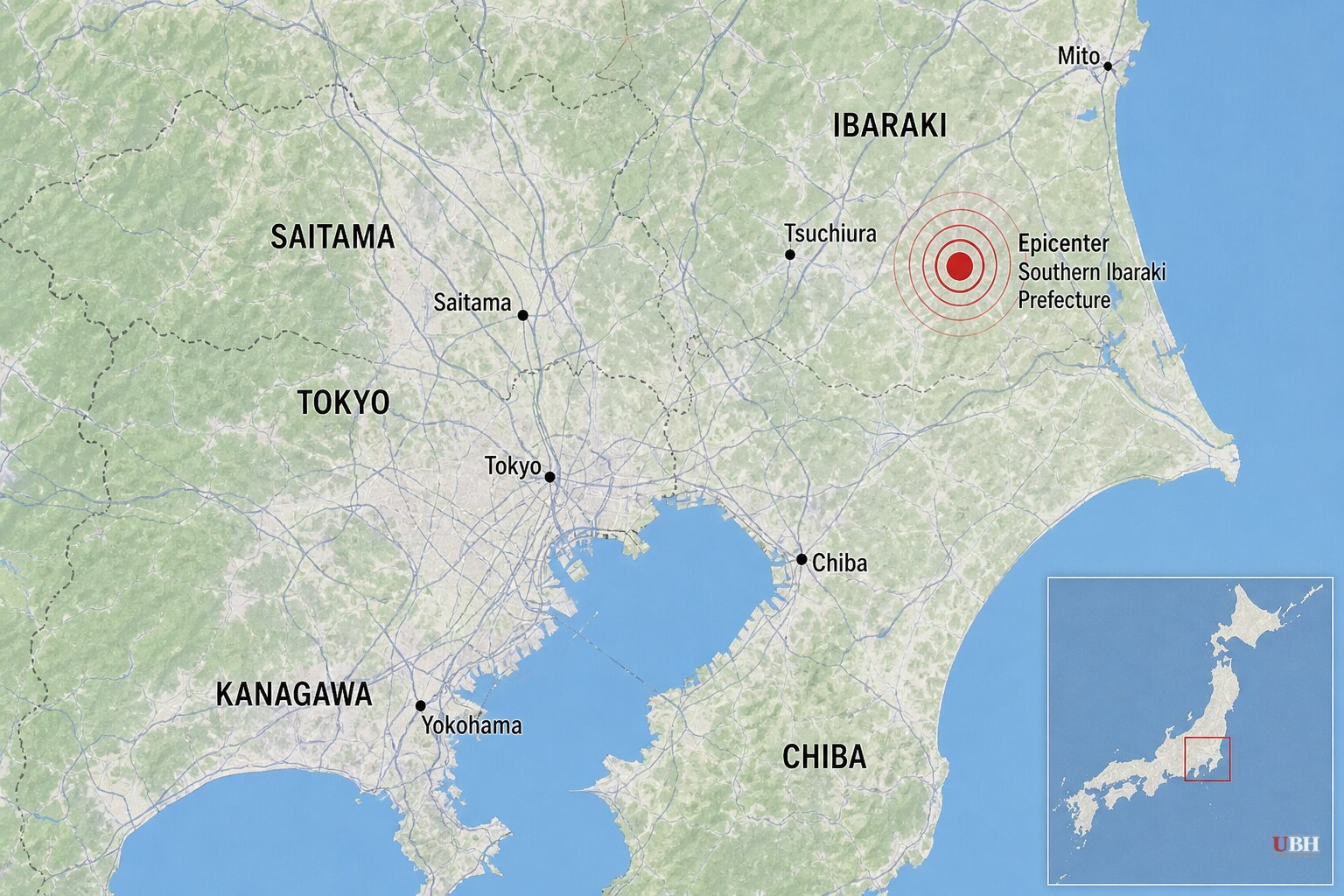
A magnitude 5.9 earthquake rattled eastern Japan early Sunday, August 23, jolting millions awake across the greater Tokyo region. At least 37 people were injured, according to the Fire and Disaster Management Agency and prefectural officials cited by the Associated Press and Jiji Press. No tsunami warning was issued.
The quake's epicenter was in southern Ibaraki prefecture, at a depth of roughly 70 kilometers (42 miles), according to the Japan Meteorological Agency. The U.S. Geological Survey put the preliminary magnitude slightly lower, at 5.8. Small differences like that between Japanese and American monitoring agencies are routine and don't change the practical picture: this was a moderate quake, not a catastrophic one.
Injury counts varied slightly by outlet depending on when they filed. The Associated Press, The Independent and the Manila Times reported 37 injured across five prefectures: 15 in Tokyo, nine in Saitama, eight in Kanagawa, four in Chiba, and one in Ibaraki. The Los Angeles Times and the Times of India, drawing on an earlier tally, reported 23 injured across four prefectures before Tokyo's own casualty figures were added in. Jiji Press's count of 37 matches the AP's later, more complete number. The gap isn't a factual dispute. It's just a matter of which snapshot in time each report captured.
Most of the injured were hurt falling out of bed or slamming into furniture and doors as they scrambled up in a panic, officials said. A woman in her 80s suffered a serious hip injury after falling from her bed in Yokohama, the Yomiuri newspaper reported. A 23-year-old man told the Asahi newspaper he felt a vertical jolt while shopping in Tokyo's Taito district and worried about falling merchandise.
The Japan Meteorological Agency measured the maximum seismic intensity at "lower 5" on Japan's scale, the fifth-highest level, hitting spots including Ibaraki's Omitama, Kawaguchi in Saitama, Urayasu in Chiba, and Tokyo's Adachi Ward, according to Jiji Press. The agency is warning residents to stay alert for aftershocks of similar intensity for about a week.
Transit took a hit but nothing close to a shutdown. Express trains serving Narita Airport and northeastern local lines saw delays, but Shinkansen bullet trains kept running on schedule, East Japan Railway Co. said. An underground water pipe burst in Tokyo's Koto ward, sending water across a road, though NHK footage showed it was repaired and the leak stopped. The Los Angeles Times and Times of India additionally reported that TEPCO Power Grid confirmed about 460 homes in Tokyo lost power, with electricity restored by later Sunday morning.
There were no reported anomalies at roughly a dozen nuclear power plants and other facilities handling nuclear material, according to Japan's Nuclear Regulation Authority. Japan's post-Fukushima seismic monitoring protocols for nuclear sites exist for exactly this kind of event, and they worked as designed.
Prime Minister Sanae Takaichi announced on X that the government has set up a task force to assess potential damage. Based on every source reviewed, that damage looks limited to infrastructure hiccups and injuries from people caught off guard mid-sleep, not structural collapse or mass casualties.
This quake lands in a country still processing a far deadlier one. Last month, a magnitude 7.1 earthquake struck the Kumamoto area on Kyushu, killing 38 people, injuring 364, and destroying more than 1,500 buildings, according to the Los Angeles Times. The contrast between the two events says something about Japan's building codes and public preparedness: a quake strong enough to be felt violently across a metropolis of tens of millions produced injuries, not fatalities.
The unresolved piece is what happens over the next week. The Japan Meteorological Agency's aftershock warning is not boilerplate. It's based on real seismic modeling for the Ibaraki region, an area the agency itself describes as prone to frequent quakes. Whether that forecast produces another jolt, or whether this fades into a footnote in Japan's seismic year, is the only open question left standing.
Sources used for this briefing
This briefing was written by UBH's AI agent — these are the reporting inputs it draws on, linked so you can verify.


