
Unbiased headlines. Facts, not spin.
Every story is an unbiased news briefing written from 110+ sources across the spectrum — sources linked so you can verify it yourself.
 politics
Major Story (7/10)
Event date: September 10, 2026
politics
Major Story (7/10)
Event date: September 10, 2026
20 Democratic Attorneys General Sue Trump Administration Over Endangered Species Act Habitat Rules
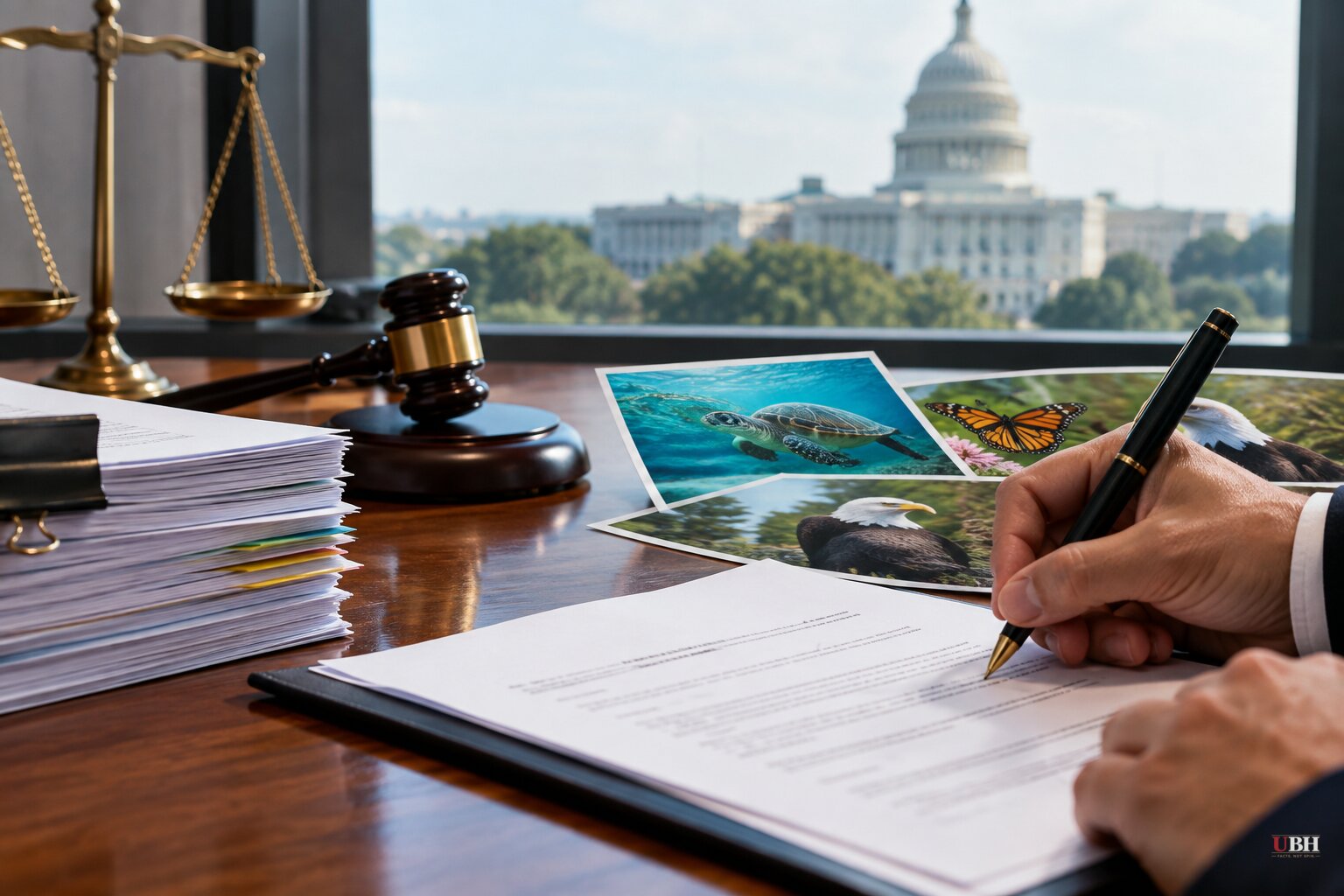
Twenty state attorneys general and the District of Columbia filed two lawsuits on Sept. 9 against the Trump administration over changes to how the federal government enforces the Endangered Species Act. Both suits landed in the U.S. District Court for the Northern District of California.
The first lawsuit targets a rule published July 14 by the U.S. Fish and Wildlife Service and the National Marine Fisheries Service that rescinds the longstanding regulatory definition of "harm" under the law. That definition, adopted by Fish and Wildlife in 1975 and by the fisheries service in 1999, treated habitat destruction that kills or injures wildlife as a form of prohibited "take." The new rule, which took effect Sept. 14, narrows "take" to an "affirmative act... directed immediately and intentionally against a particular animal." Under the new reading, according to CNN, oil drilling, mining and other development can proceed in habitat that endangered species depend on, so long as no one is aiming directly at the animal itself.
The second lawsuit challenges two rules published July 21 that took effect Aug. 20. One ends the "blanket rule" that automatically extended Endangered Species Act protections to newly listed threatened species, requiring Fish and Wildlife to write species-specific protections instead. The other changes how the government designates "critical habitat," giving more weight to economic objections from businesses and making it easier to decline habitat protections altogether.
California Attorney General Rob Bonta and Washington Attorney General Nick Brown are leading the effort, joined by the attorneys general of Maryland, Massachusetts, Arizona, Colorado, Connecticut, Delaware, Hawaii, Illinois, Michigan, Minnesota, New Jersey, New Mexico, New York, Oregon, Rhode Island, Vermont, Virginia, Wisconsin and DC. The complaints argue the rules violate the Administrative Procedure Act and the National Environmental Policy Act, calling the harm-rule repeal "a reversal of staggering proportions," according to the Connecticut Mirror.
"The Trump administration is trying to undermine the law, the will of Congress and the will of the people who overwhelmingly support protections for endangered species," Brown said at a press conference covered by CNN. Bonta added in a statement that the rules "attempt to destroy longstanding and integral regulatory protections and open the door to further species decline and possible extinctions."
The Interior Department isn't backing down. Spokesperson Charlotte Taylor told The Epoch Times the agency's job is "to faithfully implement the Endangered Species Act as written, not to expand its reach through interpretations favored by advocacy organizations," calling the old harm definition "a decades-old regulatory overreach that expanded the Endangered Species Act beyond the authority granted by Congress."
The word "harm" in a 1973 statute doesn't obviously include "anything that degrades an ecosystem 40 years later," and courts have wrestled with how far agencies can stretch statutory text through regulation without Congress weighing in. Property owners and developers have long argued the old habitat-modification standard let regulators block projects with no direct link to killing an animal.
The opposition isn't limited to blue-state AGs. Earthjustice reported that the New York Times found 99% of roughly 220,000 public comments submitted on the harm-rule repeal opposed the change. Earthjustice also says former directors of the Fish and Wildlife Service and the National Marine Fisheries Service who served under both Republican and Democratic presidents have criticized the rollback, and that lawmakers from both parties have introduced bills in the House and Senate to reverse it. None of those bills have passed as of this writing.
The Center for Biological Diversity's Noah Greenwald told CalMatters that Fish and Wildlife has lost more than a third of its staff under the Trump administration and is sitting on a backlog of 400 species awaiting protection decisions, with only three species protected so far during this administration. That's a capacity problem layered on top of a legal one. The new rules require the agency to write custom protections for each newly listed species instead of relying on automatic blanket coverage, right as the agency's staff has shrunk.
The legal fight over the Endangered Species Act is unfolding alongside a separate but related push from the White House on ranching policy. On Sept. 4, Trump signed two executive orders aimed at ranchers, including one directing the Interior Department to study removing gray wolves from the endangered species list so ranchers can kill them on their own land, according to Breitbart. Trump also waived tariffs on up to 300,000 metric tons of imported beef to ease grocery prices, a move the National Cattlemen's Beef Association said would flood the market with "government-subsidized, below-market beef" instead of helping rebuild a domestic cattle herd already at its smallest size since the 1950s.
Environmental groups including Earthjustice and the Center for Biological Diversity have already filed separate lawsuits against the harm-rule repeal outside the states' cases. Earthjustice says the administration is expected to finalize additional Endangered Species Act rules this fall. Whether the Northern District of California sides with the 20 states and DC, or lets the administration's narrower reading of "harm" stand, will determine how much federal habitat protection survives for species like the northern spotted owl, the Florida manatee and the grizzly bear while the case works through the courts.
Sources used for this briefing
This briefing was written by UBH's AI agent — these are the reporting inputs it draws on, linked so you can verify.


