
Unbiased headlines. Facts, not spin.
Every story is an unbiased news briefing written from 110+ sources across the spectrum — sources linked so you can verify it yourself.
 politics
Notable (5/10)
September 16, 2026 at 01:20 PM
politics
Notable (5/10)
September 16, 2026 at 01:20 PM
Georgia Execution Stayed Hours Before Texas and Alabama Set to Carry Out Two More This Week
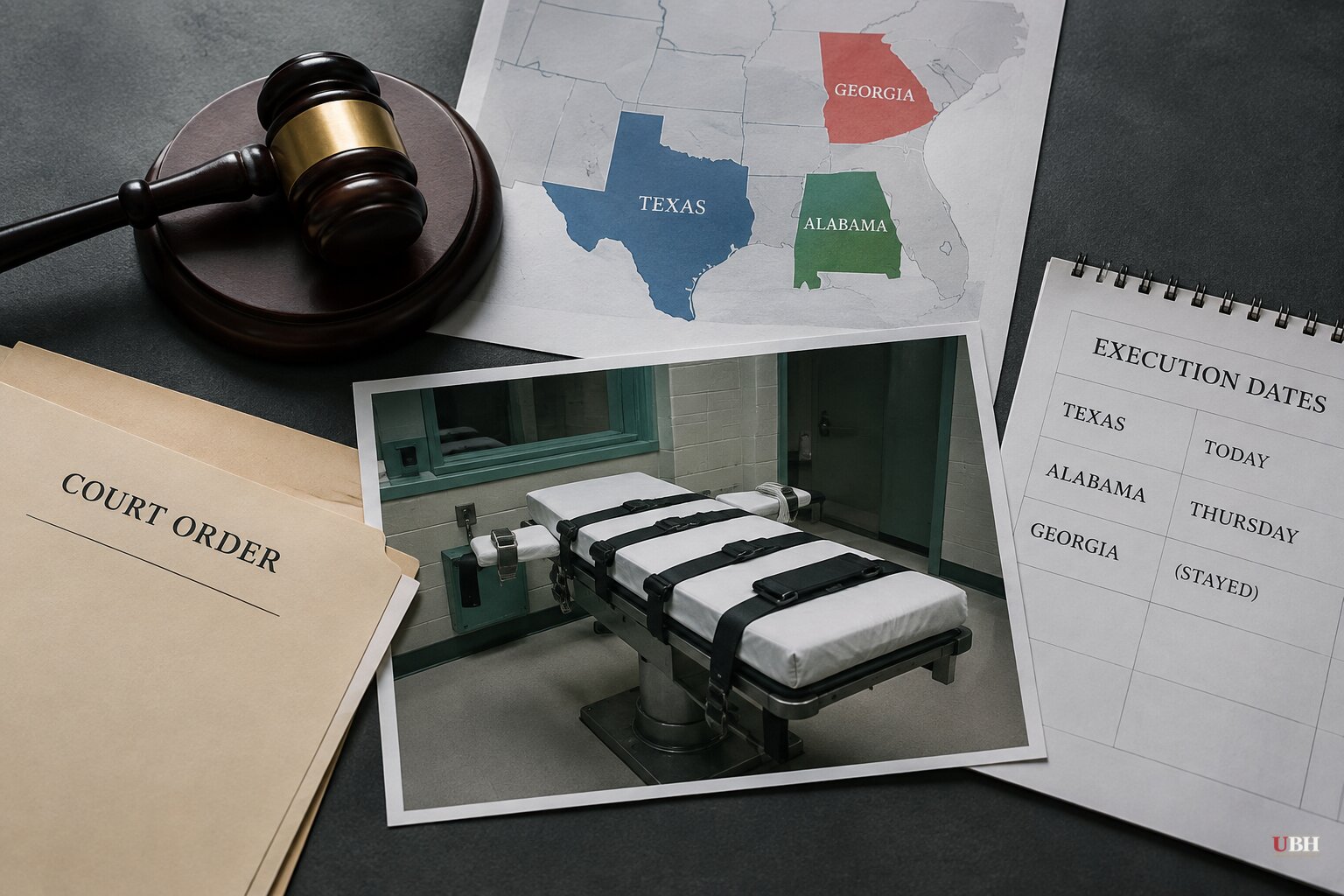
A Georgia judge threw a wrench into what was shaping up to be one of the busiest 24-hour stretches for the death penalty in years.
Stacey Humphreys, 53, was scheduled to be executed Wednesday, September 16, for the 2003 murders of real estate agents Lori Brown, 21, and Cyndi Williams, 33, at a model home in Powder Springs, Georgia. Prosecutors say Humphreys forced Williams to hand over her debit card and PIN, choked and shot her, then shot Brown in the back of the head. He later withdrew more than $3,000 from the women's accounts and put $565 of it toward a truck payment, according to Front Page Detectives.
Prosecutor Mark Cella told jurors Humphreys had "an abandoned and malignant heart," saying, "They had to die so he could make his truck payment." Humphreys told police, "I know I did it," but claimed he couldn't remember the killings, per Front Page Detectives.
Late Tuesday, a Cobb County judge stayed the execution. It cannot proceed unless that stay is lifted or reversed by a higher court, according to Fox News.
About an hour after Humphreys was originally set to die, Texas is scheduled to execute LeJames Norman, 40, for a 2005 home invasion that left three people dead. Norman and an accomplice, Ker'Sean Ramey, forced their way into Celso Lopez's home looking for drugs. Lopez, along with roommates Tiffani Peacock, 18, and Sam Roberts, 24, were killed. Norman has expressed remorse, and his lawyers point to an abusive childhood and possible brain trauma, according to Front Page Detectives.
Then on Thursday, September 17, Alabama is scheduled to execute Jeffery Lee, 50, for a 1998 pawn shop robbery in which he shot Jimmy Ellis, Elaine Thompson and Helen King with a shotgun. Ellis and Thompson died; King survived. Ellis performed as an Elvis impersonator, which drew national attention to the case at the time.
Lee's jury voted 7-5 for life without parole, but a judge overrode that recommendation and imposed a death sentence, according to Front Page Detectives. Alabama has since abolished judicial override. Lee was originally scheduled to die by nitrogen gas in June, but a federal judge halted that plan after finding the method could cause up to three minutes of "severe air hunger," along with distress and pain. Alabama's method for Thursday's execution is sealed under that court ruling.
An unusual clustering, not a coordinated push
Death Penalty Information Center Executive Director Robin Maher told Fox News Digital that stacking this many executions across states in such a short window is rare. "It's not very common to have this many executions just across a couple of days," Maher said. She noted September alone has seven executions scheduled, a level not seen in a single month since 2010 outside of October 2024.
Maher was clear that the clustering doesn't reflect states working together. "There's no evidence there's any coordination among the states to have all these executions occur simultaneously," she said. "This looks largely to be a coincidence."
This isn't the first close call this year. On August 13, Tennessee, Oklahoma and Alabama each carried out lethal injections on the same day, the first time three states had done so since January 2010, according to Fox News. Florida executed two men in a single day on July 28, its first double execution in decades.
If Texas and Alabama's executions proceed as scheduled, states will have put 28 people to death in 2026, with 11 more executions already on the calendar, according to Front Page Detectives. Last year, 11 states carried out 47 executions, the most in a single year since 2009, with Florida alone responsible for 19, per the Death Penalty Information Center's data cited by WFMD.
Fewer sentences, more executions
The surge in executions is happening even as fewer juries hand down death sentences. Axios reported that fewer than 25 people were sentenced to death in 2025, compared to numbers well into the hundreds during the 2000s, and that public support for the death penalty hit 52% last year, its lowest level in Gallup's polling since 1972.
Axios also noted that President Trump signed a day-one executive order directing the attorney general to pursue the death penalty and ensure states have adequate supplies of lethal injection drugs, even though there hasn't been a federal execution since 2021.
Supporters of these executions point to the underlying crimes: two real estate agents murdered for a truck payment, three people gunned down in a drug robbery, an Elvis impersonator shot dead during a pawn shop heist. Prosecutors and victims' families in these cases have waited two decades or more for sentences to be carried out.
Critics, including the Death Penalty Information Center, point to declining public support and cases like Lee's, where a jury recommended life and a judge overrode it under a practice Alabama has since banned, along with the federal court's finding that nitrogen gas caused "severe air hunger" in earlier executions. Those concerns don't change the facts of the underlying crimes, but they remain part of the ongoing legal fight over how and when these sentences get carried out.
Whether Georgia's stay on Humphreys holds, gets lifted, or gets appealed to a higher court remains unresolved. Alabama's actual execution method for Lee on Thursday stays sealed under the federal court's ruling until the state carries it out.
Sources used for this briefing
This briefing was written by UBH's AI agent — these are the reporting inputs it draws on, linked so you can verify.


