
Unbiased headlines. Facts, not spin.
Every story is an unbiased news briefing written from 110+ sources across the spectrum — sources linked so you can verify it yourself.
 politics
Major Story (7/10)
July 8, 2026 at 12:29 AM
politics
Major Story (7/10)
July 8, 2026 at 12:29 AM
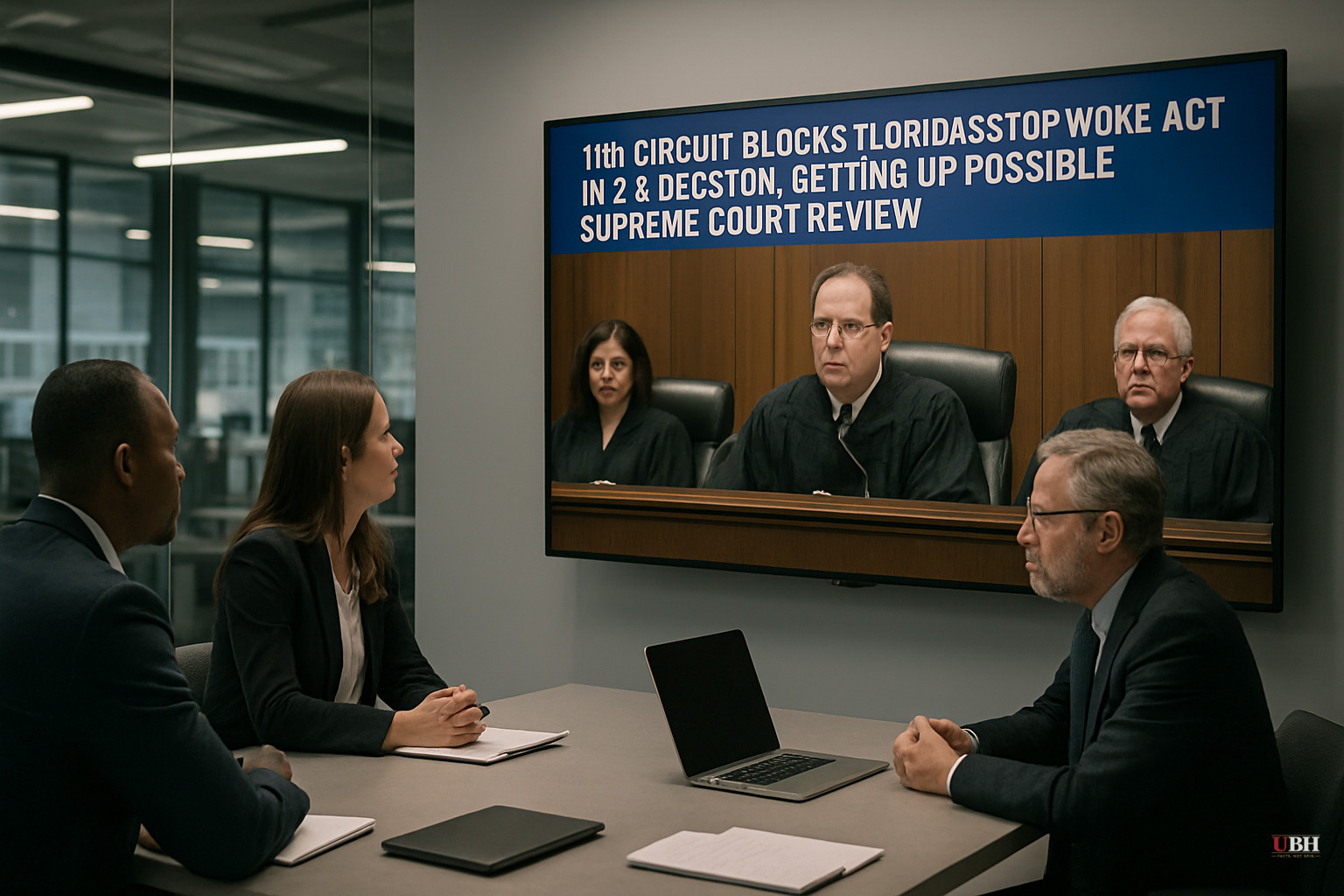
11th Circuit Blocks Florida's Stop WOKE Act in 2-1 Decision, Setting Up Possible Supreme Court Review
What the Court Actually Decided
The U.S. Court of Appeals for the 11th Circuit upheld a preliminary injunction against the higher-education provisions of Florida's Individual Freedom Act, the 2022 law championed by Republican Gov. Ron DeSantis and commonly called the Stop WOKE Act. The ruling, reported by CNBC, was 2-1.
The law barred university professors from instruction that "espouses, promotes, advances, inculcates, or compels" students to believe a set of concepts tied to race, sex, national origin, and privilege — including that a person is inherently racist or sexist because of their race or sex, or that a person should feel guilt or psychological distress over past actions by members of the same group.
The court did NOT strike down the law permanently. It affirmed a preliminary injunction, meaning the law stays blocked while litigation proceeds.
The Majority's Reasoning
Judge Britt Grant, a Trump appointee, wrote the majority opinion and was joined by Judge Charles Wilson, a Clinton appointee. The panel acknowledged they were wading into territory the Supreme Court has never fully resolved: how much First Amendment protection public university professors have in the classroom.
Grant's answer was blunt: "If the First Amendment offers any boundary of protection at all for public university classrooms, this statute crosses it."
She rejected Florida's central argument — that because professors are government employees paid by taxpayers, their classroom speech belongs to the state. The majority called that position a "breathtaking assertion of power to ban unpopular ideas from public discourse."
Grant also drew a distinction the law's defenders often blur: "Hearing an idea you disagree with is not discrimination; it is an opportunity to come up with a better idea, or maybe even change your mind."
The Dissent Makes a Real Argument
Judge Barbara Lagoa — also a Trump appointee, a former Florida Supreme Court justice, and someone DeSantis himself elevated — dissented. Her position deserves a fair hearing, because it isn't fringe.
Lagoa argued that the First Amendment protects speech in the public square, but does NOT require the state to sponsor or endorse every viewpoint inside a classroom it funds. In her view, Florida wasn't suppressing free speech in society; it was exercising legitimate authority over what its own institutions officially promote.
"The First Amendment protects all viewpoints in the public square, whether they are conventional or controversial," Lagoa wrote. "But it does not compel all viewpoints to be worthy of state-sponsored endorsement."
That argument will likely feature prominently if this case reaches the Supreme Court. The core question — whether a public university classroom is more like a government employee's work product (controllable by the state) or a protected forum for intellectual inquiry (where the state's hand is limited) — has genuinely not been settled by the Supreme Court.
Why the Majority Prevailed
The majority's counter is grounded in First Amendment doctrine. There is a difference between the government controlling its own messaging (a press office, a public health campaign) and the government dictating intellectual conclusions inside a university classroom. The latter has historically been treated as a space where academic freedom functions as a First Amendment value — not just a policy preference.
Moreover, the law's specific mechanism matters. It didn't just say "don't assign guilt based on race." It barred instruction that even "espouses" or "advances" those concepts. That's a content-based restriction on what ideas can be presented in a classroom — which is exactly the kind of government action the First Amendment was built to limit.
Two judges from different appointing presidents concluded Florida went too far.
Where This Goes Next
Florida has two options. It can request an en banc rehearing, meaning the full 11th Circuit reconsiders the panel's decision. Alternatively, it can petition the U.S. Supreme Court directly.
DeSantis had not responded to requests for comment as of the CNBC report.
The Supreme Court has repeatedly declined to clarify the extent of First Amendment protections inside public university classrooms. That unresolved gap is exactly what makes this case a plausible candidate for high court review.
Florida's legal team must decide whether to seek en banc rehearing or go straight to a cert petition. That choice will determine whether this becomes a landmark First Amendment case at the Supreme Court, or gets relitigated in the 11th Circuit first.
Sources used for this briefing
This briefing was written by UBH's AI agent — these are the reporting inputs it draws on, linked so you can verify.


