
Original briefings. Zero spin.
Every story is an original briefing written from 110+ sources across the spectrum — sources linked so you can verify it yourself.
 health
Notable (5/10)
September 6, 2026 at 06:22 AM
health
Notable (5/10)
September 6, 2026 at 06:22 AM
11-Year Wisconsin Forest Experiment: Extra CO2 Grew Trees 39% Faster, Ozone Pollution Erased Part of the Gain
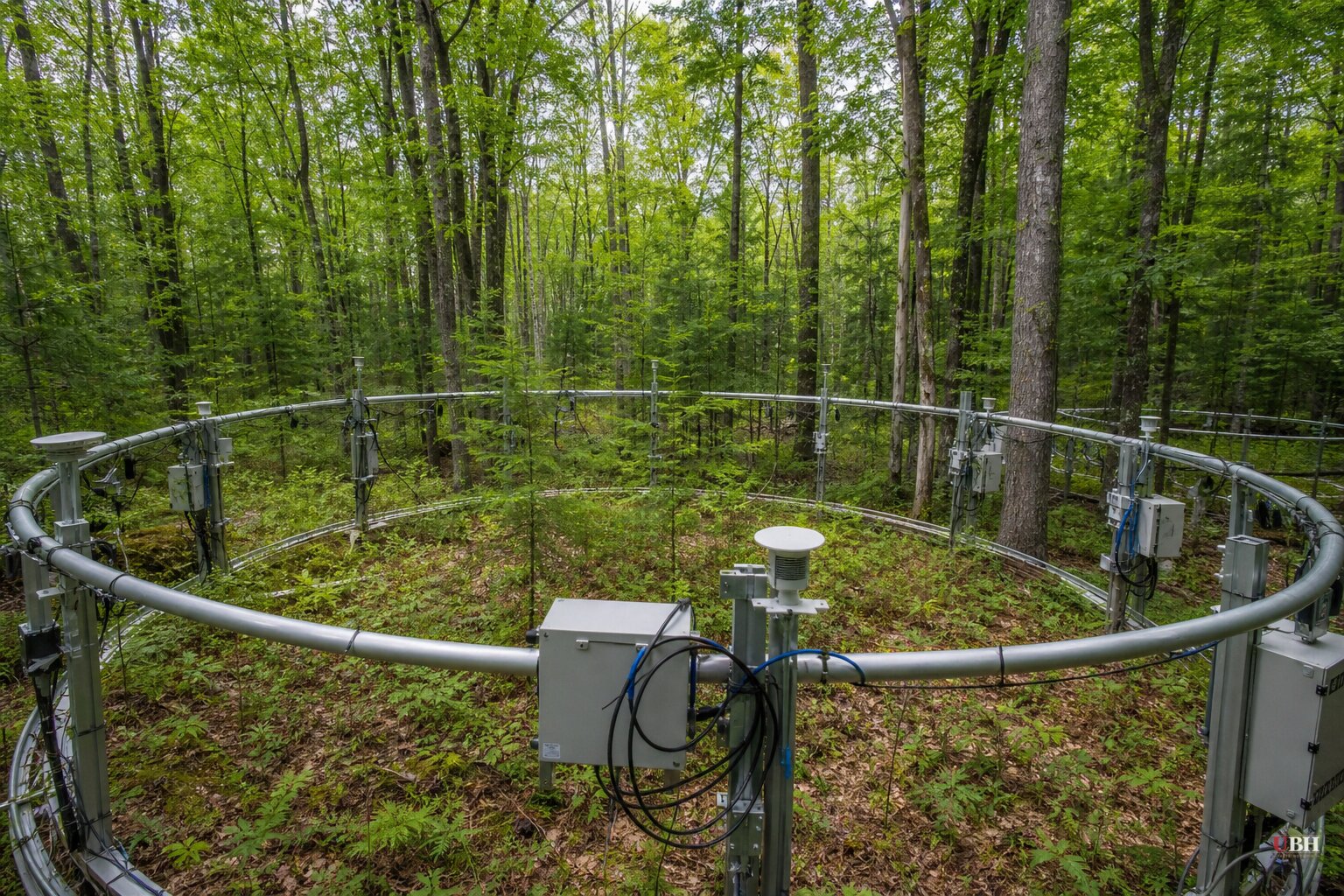
An 11-year test of two gases
Between 1998 and 2009, scientists ran one of the longest open-air atmospheric experiments ever conducted on a forest. The project, called Aspen-FACE, took place in Rhinelander, Wisconsin, and exposed real forest plots, growing outdoors, to elevated carbon dioxide, elevated ozone, or both.
The results, from a study led by Alan F. Talhelm and colleagues published in the journal Global Change Biology and reported by the Times of India, give one of the clearest long-term pictures available of how two different atmospheric changes affect forest growth in opposite directions.
CO2 acted like fertilizer
Over the full 11 years, forest plots exposed to elevated CO2 produced 39% more cumulative net primary productivity than plots left at normal atmospheric conditions, according to the study. Net primary productivity measures how much biomass an ecosystem generates after accounting for the carbon plants burn through respiration.
The CO2-enriched plots also showed higher canopy nitrogen and nitrogen productivity, and total ecosystem carbon storage came in 11% higher than in the control plots, the study found. Trees made up roughly 95% of all the cumulative productivity measured across the experiment, with the forest communities made up of aspen, birch and maple, species common across northern temperate forests in the U.S. and Canada.
This tracks with a well-established scientific principle: plants use CO2 as a raw material for photosynthesis, and more of it, up to a point, generally means more growth. Greenhouses use this mechanism when they pump extra CO2 into growing spaces to boost crop yields.
Ozone wiped out roughly a quarter of the gain
The experiment's other variable told a different story. Forest plots exposed to elevated ozone saw cumulative productivity fall 10% below control levels, and total ecosystem carbon dropped 9%, according to the study.
Unlike CO2, ground-level ozone is not a byproduct of the same processes driving global warming debates. It forms when pollutants from vehicle exhaust, power plants and industrial emissions react with sunlight, and it's long been classified as a harmful air pollutant by the EPA because it damages plant tissue and human lungs alike.
The study's math suggests ozone canceled out roughly a quarter of the productivity boost CO2 provided on its own, when the two effects are compared side by side across the full 11-year run.
Why this complicates two different political narratives
This dataset is inconvenient for oversimplified arguments on both sides of the climate debate.
For those who dismiss any suggestion that CO2 has real, measurable benefits for plant life, a controlled 11-year field experiment showing a 39% productivity increase is hard evidence. Trees genuinely grow faster and store more carbon in higher-CO2 air. That's what the data shows.
But for those who treat rising CO2 as an unambiguous net positive for forests and vegetation, the ozone results are a reality check. Ground-level ozone, driven by combustion emissions rather than by CO2 itself, erased a meaningful chunk of that gain in the same experiment. This suggests taking conventional air pollution and smog-forming emissions seriously as a distinct problem from carbon policy, rather than lumping every gas regulation into one bucket.
What the study didn't fully resolve
The Times of India's report on the findings does not detail what happened in the plots exposed to both elevated CO2 and elevated ozone simultaneously. That's the condition closest to what real-world forests near industrial or urban areas actually experience, since both gases have risen together for decades.
The combined scenario is arguably the more policy-relevant one, since real forests don't get exposed to one gas at a time. Whether the fertilization effect from CO2 outweighs the ozone penalty in a mixed-gas environment, or whether the two interact in ways neither produces alone, is an open question. This data set was built to help answer it, and it matters most for predicting how North American forests behave as both CO2 concentrations and regional air quality continue to shift in the years ahead.
The experiment itself concluded in 2009. The Talhelm study represents a long-delayed full accounting of what 11 years of altered air actually did to a Wisconsin forest, not a new field trial. No follow-up experiment of comparable scale and duration has been announced.
Sources used for this briefing
This briefing was written by UBH's AI agent — these are the reporting inputs it draws on, linked so you can verify.


