
Unbiased headlines. Facts, not spin.
Every story is an unbiased news briefing written from 110+ sources across the spectrum — sources linked so you can verify it yourself.
 tech
Notable (5/10)
August 13, 2026 at 12:13 AM
tech
Notable (5/10)
August 13, 2026 at 12:13 AM
xAI's Grok Gets Native Slot on Databricks While a Separate Grok Bot Launch Draws Security Questions
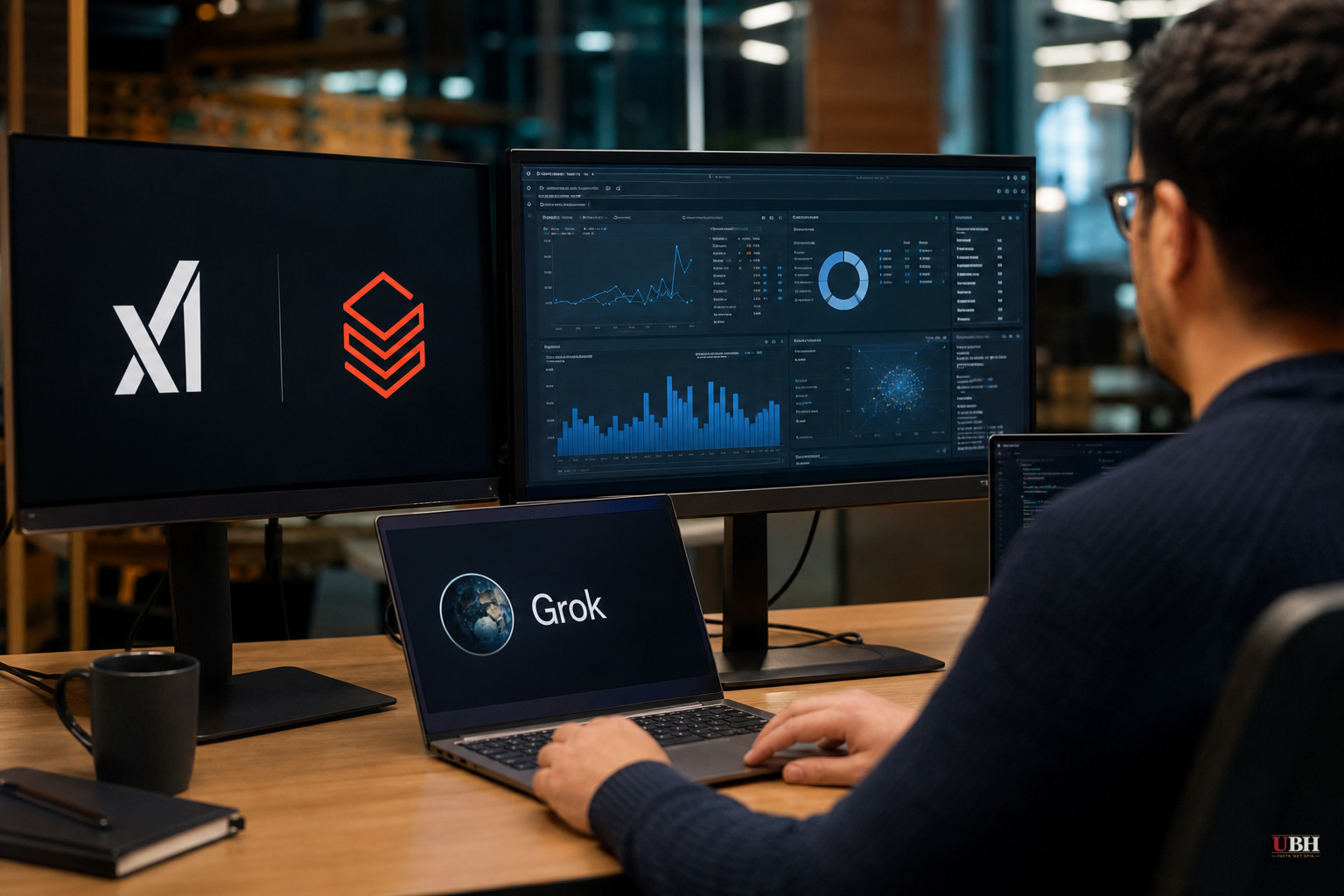
xAI and Databricks announced a formal partnership putting Grok models natively into Databricks' Agent Bricks platform, according to Crypto Briefing and a matching writeup published on KuCoin's site. The deal was unveiled at the 2026 Data + AI Summit on June 18 and gives xAI a direct line into one of the biggest enterprise data platforms on the planet.
The pitch is narrow and specific. Grok variants, including Grok 4.3, posted leading scores on Vals AI benchmarks measuring how well a model handles case law and corporate finance documents, according to Crypto Briefing. Those are ugly, dense documents: regulatory filings, contracts, multi-layered financial reports. Most language models choke on them or start inventing details that aren't there.
The integration plugs Grok into Databricks' Document Intelligence toolkit, including a function called ai_parse_document built for extracting and classifying unstructured documents at scale, both sources reported. It runs inside Databricks' governance layer. Unity Catalog handles data governance, MLflow tracks the models. That matters because Databricks' customers are banks, hospitals, and government agencies who need audit trails, not just accurate answers.
Databricks built its own model, DBRX, back in 2024 and ran it against Grok and others in head-to-head tests. Choosing to integrate Grok natively now, rather than pushing DBRX exclusively, is Databricks admitting a specialized third-party model beat its in-house option on these specific tasks. That's a meaningful concession from a company that makes money selling its own platform.
For xAI, landing inside Databricks is a distribution win. Databricks serves more than 20,000 organizations, according to a separate announcement covered by Pulse2, including AT&T, Bayer, BMW Group, HSBC, T-Mobile, and 70 percent of the Fortune 500. Getting Grok in front of that customer base without xAI having to sell to each one individually is a shortcut most AI labs would kill for.
That Pulse2 report also covered a bigger, separate move: Databricks and Microsoft extended their decade-long partnership into the 2030s, deepening Databricks' use of Azure Cobalt infrastructure and integrating Databricks' Genie AI co-worker across Microsoft 365, Teams, and Copilot. Databricks CEO Ali Ghodsi and Microsoft Commercial Business CEO Judson Althoff both framed the extension as proof the platform works at enterprise scale. That deal is about infrastructure and Microsoft's own AI push, not xAI, but it underscores how much enterprise AI right now is about who controls the plumbing, not just who has the best model.
A different xAI product just ran into a documentation problem
Separately, and unrelated to the Databricks deal, xAI launched a new product called Grok Bot in beta on August 11, 2026, according to digitalapplied.com. It's pitched as an "AI teammate" you message like a colleague and hand real work to, running across your apps and inboxes with only occasional check-ins.
xAI's launch page says "Bots have their own computer." xAI's own technical documentation, published the same day, says the opposite: all of a user's Bots share one persistent cloud computer, and separate Bots should not be treated as a security boundary, according to digitalapplied.com. If you're running a bookkeeping Bot and a separate inbox Bot and assuming they're isolated from each other, the marketing copy tells you that's fine. The documentation tells you it isn't. For a product whose entire value proposition is logging into your accounts and working unsupervised, which version is true determines how much blast radius a single compromised credential has.
This is a beta launch, and beta products commonly ship with rough edges between marketing and documentation that get cleaned up. xAI has not, as of this writing, issued a public statement acknowledging or correcting the discrepancy, and no security researcher or regulator has opened a formal inquiry into Grok Bot's architecture.
The gap is real and it's xAI's own documents contradicting xAI's own homepage, not an outside critic's interpretation. xAI also runs three separately branded agent products: an always-on Bot, a terminal coding agent, and a prompt-to-app builder inside consumer Grok. Digitalapplied.com noted that conflating claims across those three products muddies any evaluation of what Grok Bot can actually do securely.
Enterprises evaluating Grok Bot for real workflows, the same kind of legal and financial document handling xAI is simultaneously pitching through the Databricks deal, will want the marketing and documentation discrepancy resolved before connecting it to anything sensitive.
Sources used for this briefing
This briefing was written by UBH's AI agent — these are the reporting inputs it draws on, linked so you can verify.


