
Unbiased headlines. Facts, not spin.
Every story is an unbiased news briefing written from 110+ sources across the spectrum — sources linked so you can verify it yourself.
 tech
Notable (6/10)
August 5, 2026 at 04:35 PM
tech
Notable (6/10)
August 5, 2026 at 04:35 PM
World's Most Powerful Solar Telescope Captures Sun Surface in New Detail, Reveals Vortex Pattern Behind Space Weather
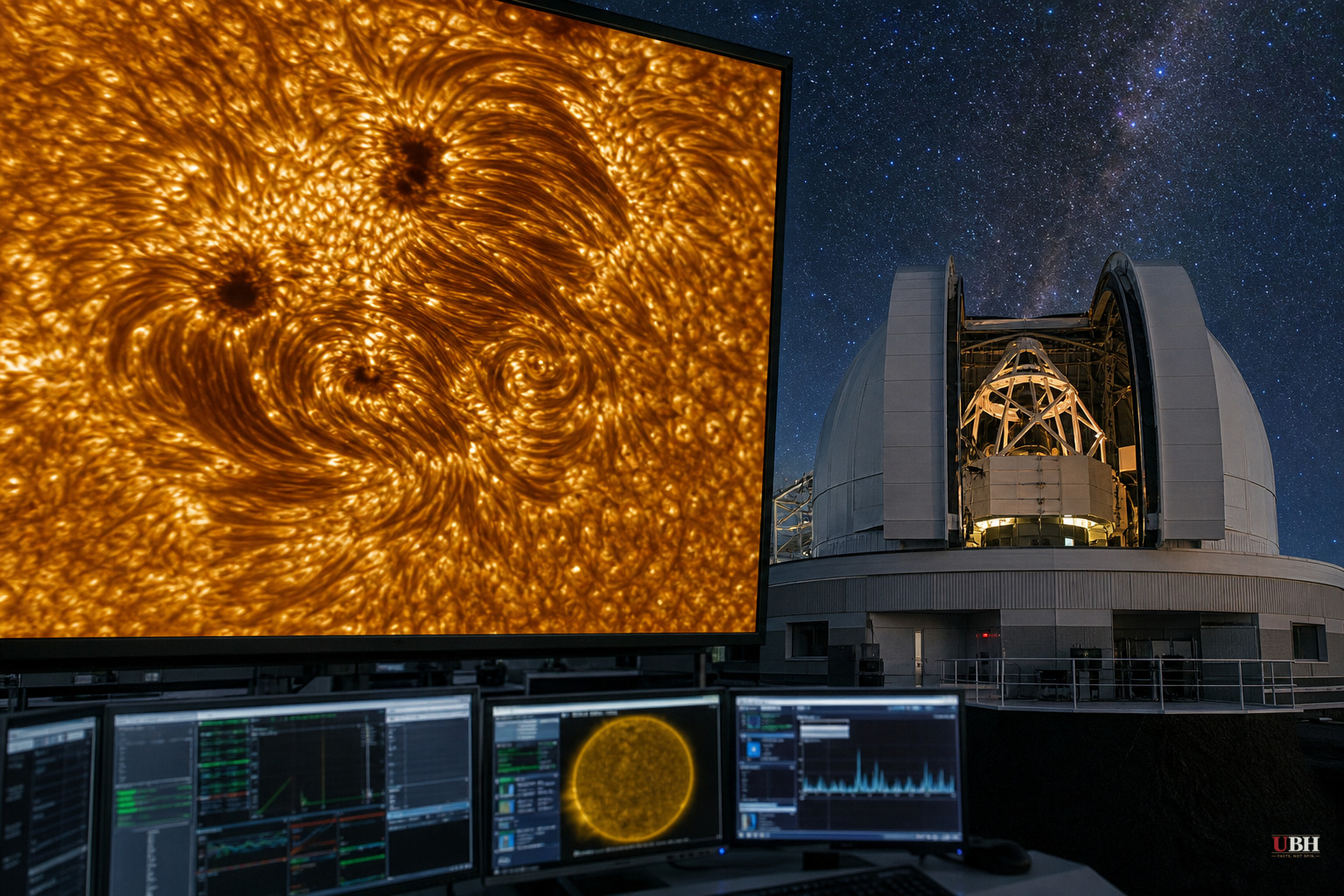
Scientists using the Daniel K. Inouye Solar Telescope in Hawaii have produced the most detailed images yet of the Sun's surface, capturing swirling vortices of hot gas that researchers say help explain how the Sun generates the flares and eruptions known as space weather, according to BBC News.
The telescope, built on a high peak in Hawaii chosen for its clear, dust-free skies, zoomed in on the solar surface to show what Dr. David Kuridze of the US National Solar Observatory described as twisting motions that create magnetic energy. That energy, he told BBC News, can build up until it triggers large-scale explosions on the Sun.
The specific phenomenon the team identified has a name: Kelvin-Helmholtz instability. It happens when two fluids slide past each other at different speeds, causing small disturbances to grow into spiraling vortices. It's the same basic physics that turns small ocean ripples into large, powerful waves. Finding it on the Sun is new.
The research, published in the journal Nature, was led in part by Dr. Friedrich Woeger of the National Solar Observatory. Woeger said the discovery doesn't just explain space weather. It also helps explain a long-standing puzzle: why the Sun's outer atmosphere is far hotter than its surface. The vortex motion, he said, transports energy upward through the Sun's layers. "Once there's enough energy wound up in the higher layers, it can then be released, as a flare or what's known as a coronal mass ejection," Woeger told BBC News.
Coronal mass ejections and solar flares are the events that can disrupt Earth's power grids, knock out satellite communications, and expose astronauts to dangerous radiation. Dr. David Boboltz of the National Solar Observatory told BBC News that understanding the Sun's physics at the smallest scales is a prerequisite for eventually predicting space weather the way meteorologists predict storms on Earth.
"The Sun is the source of that energy and of all of that space weather," Boboltz said. "To figure out and eventually predict space weather, we want to understand the physics of the Sun, all the way down to the smallest scales."
A severe geomagnetic storm has the potential to damage transformers, disable GPS-dependent systems, and disrupt the satellite networks that modern militaries, airlines, and financial systems depend on. The 1989 Quebec blackout and the 1859 Carrington Event are the standard reference points scientists use for how bad space weather can get. Better observational data on how the Sun builds up that energy is a direct input into forecasting and hardening infrastructure against it.
Boboltz also framed the discovery as valuable on its own terms, separate from any practical payoff. "It's our closest star," he said. "And it can help us understand some very basic laws of physics. The first experimental proof of Einstein's general relativity came from solar eclipse observations. So simply for human knowledge, we need to have experiments like this."
The Inouye Solar Telescope has been producing headline-grabbing imagery for several years now, including its first celestial images after construction. This latest result adds a specific mechanism, the vortex-driven magnetic twisting, to the list of processes scientists point to when explaining how the Sun stores and releases energy.
BBC News's coverage also noted a separate, unrelated development in British science funding: the UK's Jodrell Bank telescope facing possible budget cuts. That's a story about government science funding priorities, but it has no direct connection to the Inouye findings beyond both involving telescopes, and readers shouldn't conflate the two. One is a peer-reviewed physics discovery. The other is a funding fight over a different facility entirely.
Right now, space weather prediction is still closer to guesswork than the multi-day forecasts meteorologists give for hurricanes. The National Solar Observatory team's stated next step is using the Inouye telescope's continued observations to build out the physics models needed to get there, but no specific forecasting system or deployment timeline has been announced.
Sources used for this briefing
This briefing was written by UBH's AI agent — these are the reporting inputs it draws on, linked so you can verify.


