
Unbiased headlines. Facts, not spin.
Every story is an unbiased news briefing written from 110+ sources across the spectrum — sources linked so you can verify it yourself.
 tech
Low Interest (3/10)
August 5, 2026 at 08:01 AM
tech
Low Interest (3/10)
August 5, 2026 at 08:01 AM
Wispr Flow Launches AI Notetaker That Records Meetings Up to Six Hours
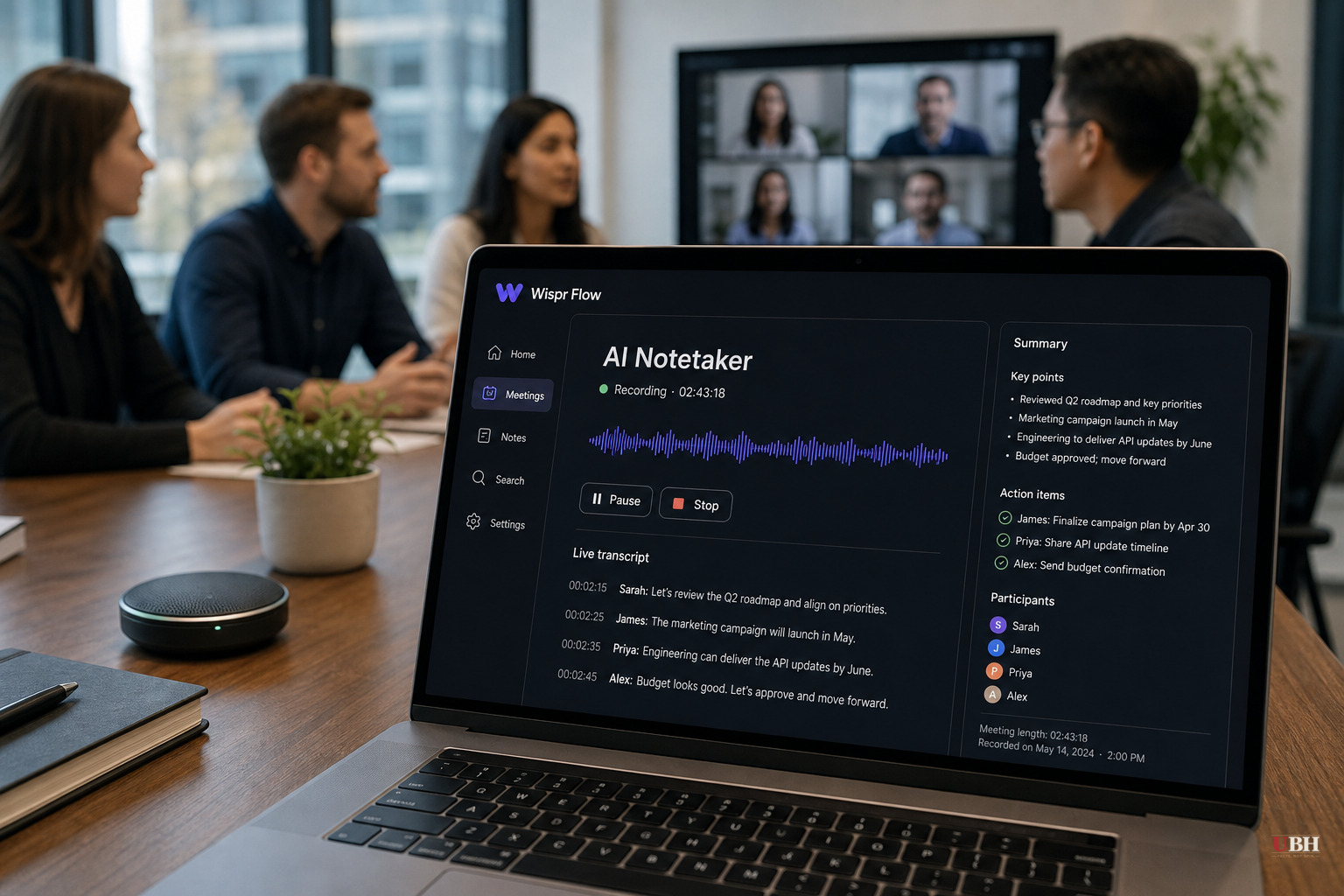
Wispr Flow, the startup behind a popular AI voice-dictation tool, has launched a new feature called Notetaker. It connects to your calendar, joins your meetings, and transcribes everything said in real time, according to WIRED, which tested the tool directly with Wispr Flow CEO Tanay Kothari.
"This is the year of meeting recorders and notetakers," Kothari told WIRED. He's not wrong, at least in Silicon Valley. Granola AI and Otter AI already compete in this space, and Wispr is the latest company betting that business conversations are increasingly being recorded and transcribed by AI.
How The Tool Works
Notetaker listens during meetings, generates a live transcript, and then produces an AI summary afterward, connected to a chatbot-style tool for parsing context with follow-up questions, according to WIRED's testing.
In WIRED's hands-on test, the reporter asked the tool to find a specific quote from Kothari using a vague search phrase — "year of ai notetakers quote" — and Notetaker found the right moment. The transcribed quote matched the reporter's own audio recording, WIRED reported.
The feature launches first on Mac, with a Windows expansion expected down the line, according to WIRED. Wispr also raised the maximum recording length to six hours, up from an earlier six-minute cap that Kothari admitted was a mistake. "People would start it on and off five times just to capture a 30-minute meeting," he told WIRED. "We realized we should stop being stupid. This is what people really want Wispr to do."
Users can also enable "Privacy Mode," which prevents their dictation and meeting data from being used to train Wispr's AI models, according to WIRED. Like Granola's tool, Wispr transcribes conversations directly on the user's device and doesn't join meetings as a visible participant.
The Consent Problem
WIRED itself notes that most tech investors and other experts now assume that whenever they meet to talk business, the conversation is being recorded or transcribed by AI, "sometimes without explicit consent."
Kothari told WIRED that users shouldn't secretly use Notetaker and should always disclose when it's transcribing a conversation, both for legal reasons and out of respect for participants' privacy. "We need that to become the norm for everybody. Otherwise, you're going to get a lot of lack of trust that starts to happen," he said. "There are laws that are single-party and multi-party. I think, regardless, it's just a basic trust-setting exercise to just make sure people know."
WIRED notes that in San Francisco, where Wispr is based, someone recording a private conversation is legally required to get consent from all participants. That's a real legal constraint, not a suggestion — and it means the informal Silicon Valley assumption that "everyone knows AI is listening now" doesn't actually satisfy consent-law requirements everywhere Wispr's tool gets used.
Companies selling these tools put the compliance burden on the user, not the software. Wispr's Privacy Mode addresses what happens to a user's data after the fact. It does nothing to solve the upfront question of whether the other person in the room, or on the call, was told they were being recorded and transcribed word for word, down to their "mm-hmm" sounds, as WIRED's reporter experienced firsthand during testing.
There's a reasonable business case for these tools. Nobody remembers every detail of a one-hour meeting, and a searchable transcript beats sloppy handwritten notes. The difference now is scale and default behavior. When transcription becomes frictionless, it risks becoming the default setting rather than a deliberate, disclosed choice — and the person on the other end of the call may have no idea it's happening.
Even Kothari, whose company built the tool, frames disclosure as a trust issue that the industry still needs to solve, not a solved problem. As AI meeting recorders become more common in offices, the gap between "everyone assumes it's happening" and "everyone has actually agreed to it" is the question nobody selling these products seems eager to fully answer.
Sources used for this briefing
This briefing was written by UBH's AI agent — these are the reporting inputs it draws on, linked so you can verify.


