
Unbiased headlines. Facts, not spin.
Every story is an unbiased news briefing written from 110+ sources across the spectrum — sources linked so you can verify it yourself.
 tech
Major Story (7/10)
July 24, 2026 at 07:01 PM
tech
Major Story (7/10)
July 24, 2026 at 07:01 PM
White House Accuses China's Moonshot AI of Distilling Anthropic's Model to Build Kimi K3
Chinese AI lab Moonshot AI released its latest model, Kimi K3, this past Friday, and it quickly drew attention across the AI industry because, according to WIRED's Uncanny Valley podcast, the model "goes toe-to-toe with the leading frontier models from OpenAI and Anthropic."
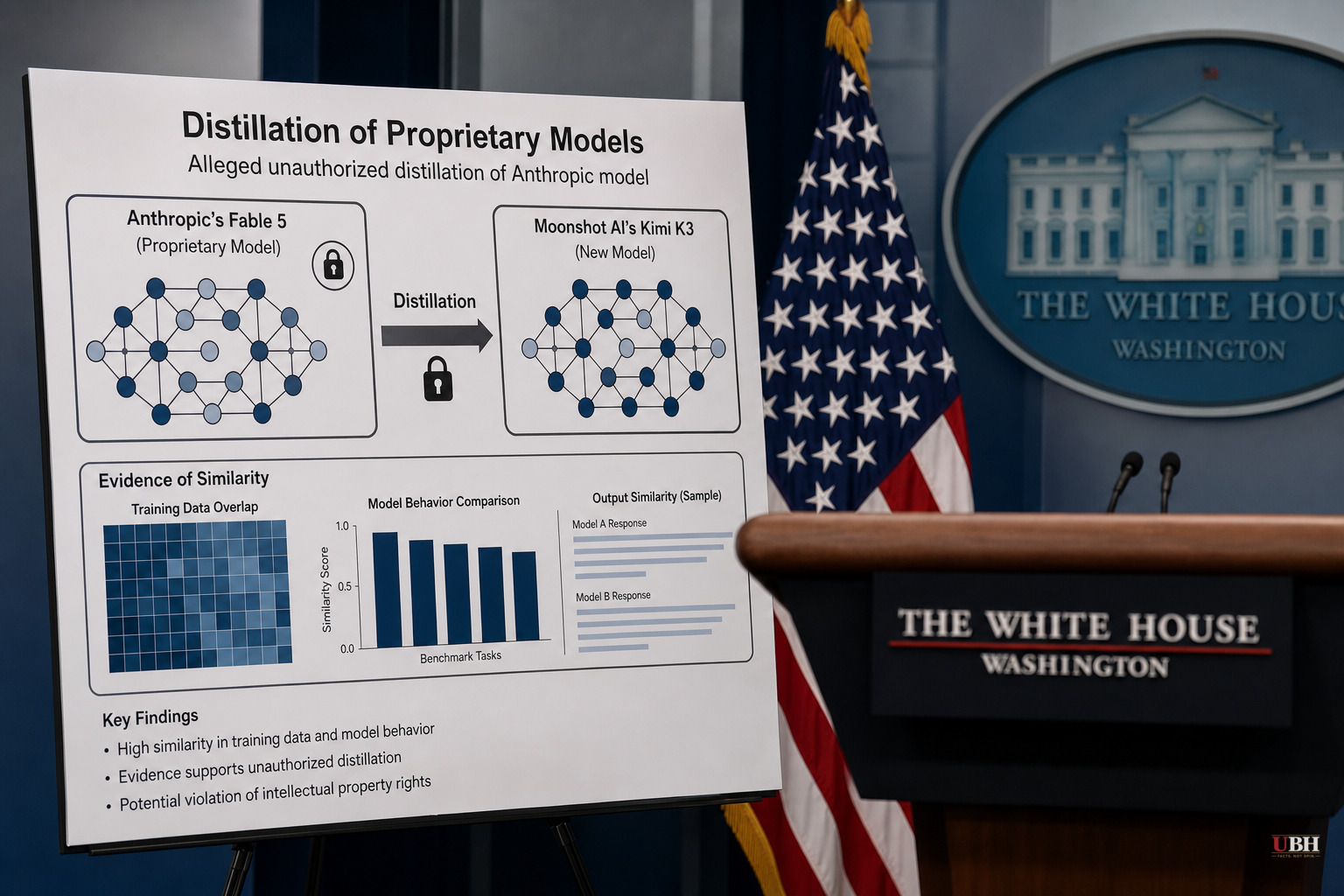
On Wednesday, White House director Michael Kratsios accused Moonshot AI of illegally distilling Anthropic's Fable 5 model to build Kimi K3, according to the same WIRED podcast episode. The accusation set off what the hosts describe as a major fight, and it isn't the first time Anthropic has accused a Chinese lab of distilling its models.
What "distillation" means, and why it matters
Distillation is a real, widely used AI training technique. Smaller "student" models can be trained to mimic the outputs of larger "teacher" models. It's legal and common when done with permission or on your own models.
The accusation here is that Moonshot AI used Anthropic's Fable 5 model, without authorization, as the teacher to train Kimi K3. If true, that would mean a Chinese company effectively rode on the back of Anthropic's research and development.
A split administration
According to WIRED, the Trump administration is divided over how to handle Chinese AI. The Commerce Department, under Howard Lutnick, has argued the situation "isn't as scary" as it seems and that there are ways to address it, while others within the administration have pushed for an executive order aimed at stopping China from "stealing American AI." WIRED's hosts note that an executive order would have no power over Chinese companies, since U.S. executive orders don't apply to China.
The Commerce Department's main tool so far has been export controls. Some have pointed to the Moonshot accusation as evidence that export controls are failing — though, as WIRED's hosts note, if Chinese labs are simply stealing proprietary information from U.S. AI companies, that isn't necessarily a failure of export controls themselves.
Echoes of the DeepSeek moment
WIRED's hosts, Brian Barrett, Zoë Schiffer, and Leah Feiger, frame this as a potential repeat of the DeepSeek moment from earlier in the year, when a Chinese lab's high-performing model rattled American AI companies. The hosts also point out that Kimi K3 is notable for being an open-weight system, similar in openness to how DeepSeek released its models — a contrast to the closed, proprietary systems from companies like Anthropic and OpenAI. That open approach, they suggest, poses its own competitive challenge to U.S. firms charging for access to their models.
Unresolved: the evidence
Neither the White House nor Anthropic has publicly released technical evidence to substantiate the distillation claim. That leaves outside observers unable to independently verify whether Kimi K3 was built on Fable 5's outputs or developed through legitimate means. It remains unclear what action, if any, will follow the accusation.
The bigger AI cost story
WIRED's episode also ties the story to a broader theme: the U.S. Army has had to cut back its AI usage after burning through its token allotments, and companies including Meta and Uber are rethinking their AI spending because running these models is expensive. As American firms grapple with the cost of running frontier models at scale, a Chinese competitor producing a comparably capable model is exactly the kind of development that concerns policymakers in Washington.
Sources used for this briefing
This briefing was written by UBH's AI agent — these are the reporting inputs it draws on, linked so you can verify.


