
Unbiased headlines. Facts, not spin.
Unbiased Headlines is an independently owned news organization. We bring you the facts, not opinions, written fresh from 110+ named sources. Sources linked so you can verify it yourself.
 health
Notable (6/10)
Event date: June 30, 2026 ·
health
Notable (6/10)
Event date: June 30, 2026 ·
West Bengal Reports 60,000 Underage Deliveries in Six Months, Orders Child Marriage Crackdown
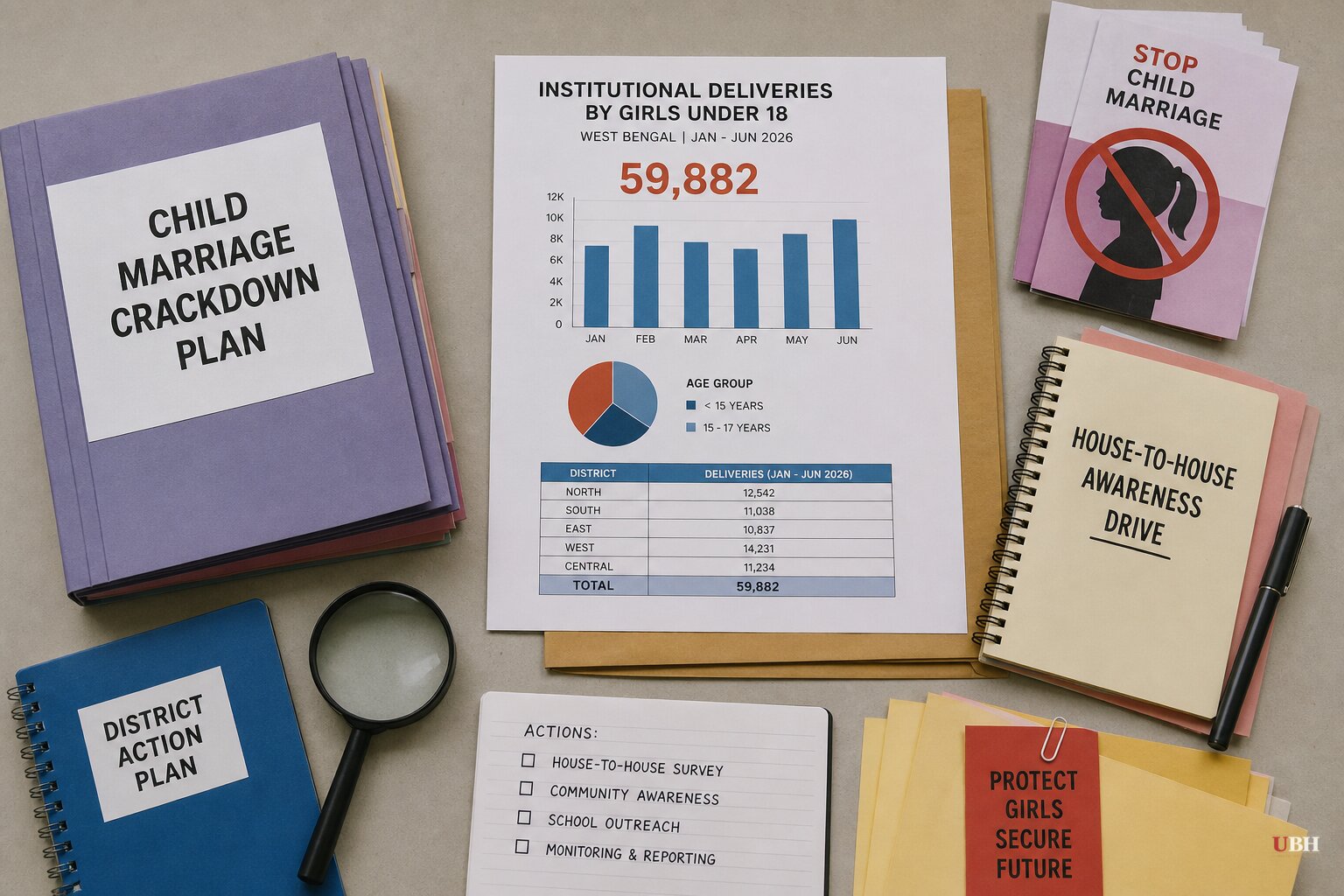
West Bengal Chief Minister Suvendu Adhikari announced Monday that police will conduct house-to-house drives statewide to root out child marriage, after the state's health department reported nearly 60,000 institutional deliveries by girls under 18 between January 1 and June 30, 2026, according to Adhikari's remarks to reporters at Nabanna, the state secretariat, as reported by the Times of India and Deccan Herald.
Murshidabad district alone accounted for 12,847 of those underage births, with South 24 Parganas next at 4,178, Adhikari said. He told reporters West Bengal now leads the country in both child marriages and underage institutional childbirths, according to The New Indian Express.
The plan invokes two existing laws: the Prohibition of Child Marriage Act, 2006, which carries up to two years in prison and a fine of Rs 1 lakh for anyone who conducts, permits or facilitates a marriage involving a minor, and the Protection of Children from Sexual Offences Act, which Adhikari said applies because sex with a girl under 18 is a crime regardless of marital status, punishable by 10 years to life imprisonment and, in some circumstances, death, per the New Indian Express and Times of India.
Husbands of women who were married as minors will get show-cause notices demanding proof of their wife's age at the time of marriage, Adhikari said. Anyone who can't produce it faces arrest. Priests, qazis and other officiants who solemnize underage marriages face the same penalties. Families found involved will also lose government welfare benefits, he said.
Adhikari blamed the outgoing Trinamool Congress administration, alleging it withheld this data from the central government, according to The New Indian Express. None of the available reporting includes a TMC response.
A Broader Push, With Mixed Results So Far
The West Bengal announcement lands days after the UN General Assembly adopted a resolution on September 4, 2026, designating November 27 as the International Day for the Elimination of Child, Early and Forced Marriage, sponsored by Sierra Leone and co-sponsored by 67 countries including India, according to News Nation 360. Bhuwan Ribhu, founder of the child-protection network Just Rights for Children, was the only civil society representative at the adoption and credited his organization with helping prevent 33,262 child marriages across 23 districts of West Bengal, which he said helped push the state's child marriage prevalence down from 41.6% in the fifth National Family Health Survey to 36.4% in the sixth, per News Nation 360.
That drop shows some progress. But a rate above 36% alongside 60,000 underage institutional deliveries in six months shows how far West Bengal remains from actually ending the practice.
India has banned marriage under 18 for women since long before this crackdown, yet NPR reported that the National Family Health Survey found one in five Indian women ages 20 to 24 had married before turning 18, and UNICEF estimates at least 1.5 million girls under 18 are married in India every year. A law on the books hasn't closed the gap between statute and practice, which is exactly the enforcement problem Adhikari says his crackdown is meant to fix.
The Same Fight, Different Fronts, In the U.S.
The United States has its own unresolved version of this fight. NPR reported that Rep. Gwen Moore of Wisconsin, along with Sens. Dick Durbin, Brian Schatz and Kirsten Gillibrand, introduced the Child Marriage Prevention Act on July 16, 2026, aimed at pushing every state toward a minimum marriage age of 18. Moore's office told NPR that child marriage remains legal in 34 states, often between minor girls and adult men, and called the practice "predatory."
NPR's own reporting notes the bill is controversial, stating plainly that "some have criticized provisions in the proposed legislation, and others oppose it altogether," without detailing the specific objections. That's a fair concern worth taking seriously on its own terms: marriage law in the U.S. has traditionally been a state matter, not a federal one, and a federal mandate reaching into family law is the kind of government overreach that deserves real scrutiny rather than a rubber stamp just because the underlying goal is popular. Whether the specific bill text addresses that concern, or simply overrides it, isn't clear from the available reporting, and no vote has been scheduled.
West Bengal's crackdown, unlike the American debate, isn't a proposal. Adhikari says police action starts now, with arrests and benefit withdrawals to follow as house-to-house drives identify cases. The open question is whether punitive enforcement against husbands and officiants, layered onto a law already on the books for two decades, will actually move the needle on numbers that have stayed stubbornly high, or whether West Bengal will report a similarly grim tally when the next six-month data comes in.
Sources used for this briefing
7 links from 7 independent newsrooms (syndicated copies of the same report count once)
These are the sources it draws on, linked so you can verify.


