
Unbiased headlines. Facts, not spin.
Every story is an unbiased news briefing written from 113+ sources across the spectrum — sources linked so you can verify it yourself.
 tech
Notable (5/10)
October 2, 2026 at 06:48 PM
tech
Notable (5/10)
October 2, 2026 at 06:48 PM
Wall Street AI Job Postings Rise 49% This Year as Demand for 'Agent Orchestration' Skills Jumps 1,721%
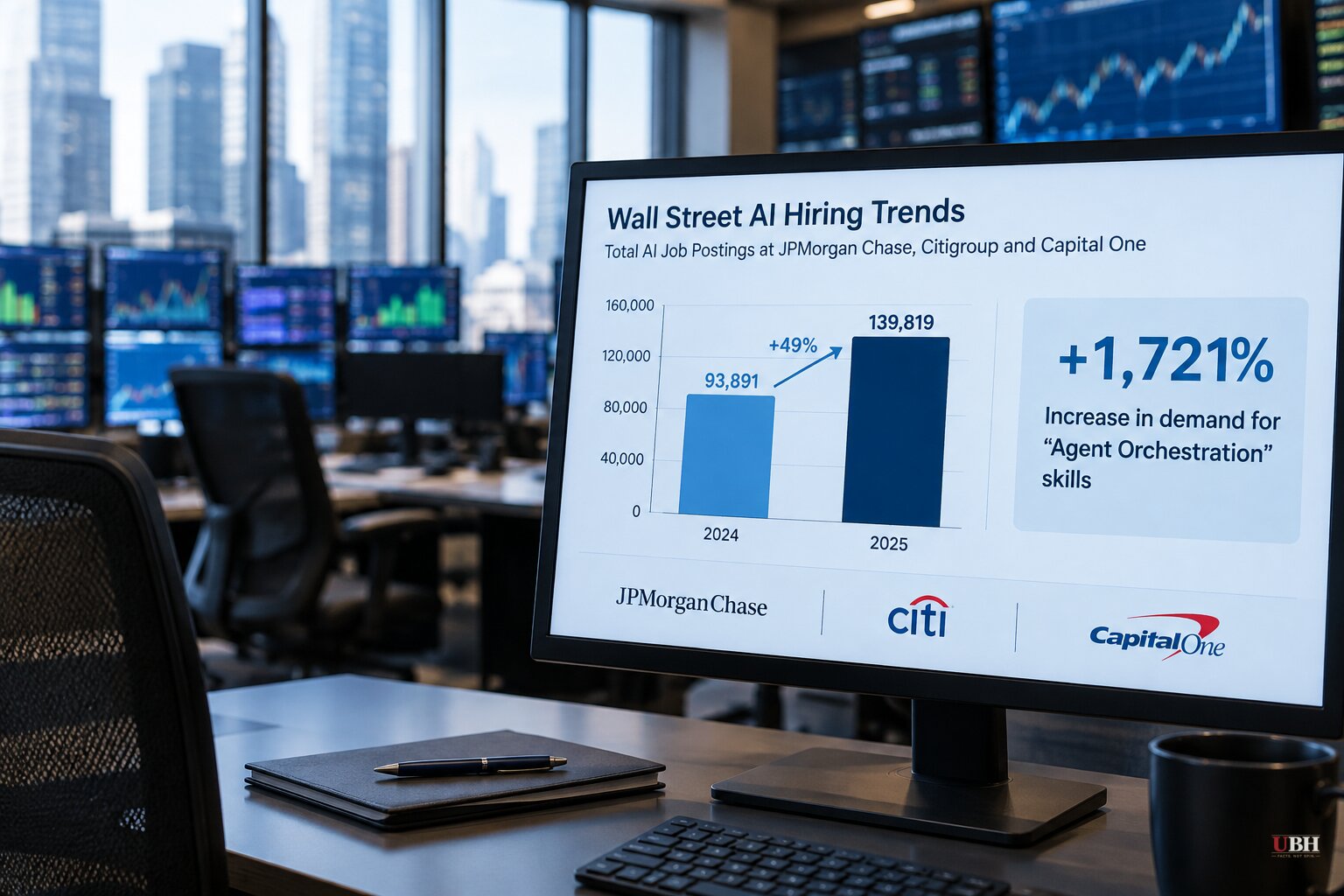
Before AI replaces anyone on Wall Street, it's hiring people to build it first.
According to an analysis by enterprise hiring data firm Draup, provided exclusively to CNBC, AI-related job postings at JPMorgan Chase, Citigroup and Capital One rose 49% this year compared with 2025, reaching 139,819 listings. The fastest-growing skill in that pile isn't coding or data science anymore. It's "agent orchestration," the ability to design AI agents that work together on a task. Demand for that skill jumped 1,721% this year, Draup found.
Draup CEO Vijay Swaminathan called it "arguably the hottest skill on Wall Street" in an interview with CNBC. "It's a massive opportunity," he said. "They need people who understand data and people who understand AI and where to put it."
From chatbots to armies of agents
The first wave of bank AI hiring was engineers and data scientists building models or adapting them to internal data. That phase is over. Banks are now hiring what the industry calls "forward-deployed engineers," people who embed AI directly into trading desks, compliance units, human resources and back-office operations, according to Draup.
Deploying AI inside a bank isn't one model doing one job. It's stringing together multiple specialized agents: one to inspect raw data, another to analyze a document, a third to check regulatory compliance, CNBC reported. Someone has to design that whole workflow and decide when a human needs to step in. That's agent orchestration.
Swaminathan gave a simple example: even automating something as basic as employee vacation approval creates a web of edge cases and exemptions that takes real engineering time to sort out. "There is a lot of complexity in an enterprise," he said. "Sometimes these complexities are visible, but many times they are hidden."
Other specific tools are riding the same wave. References to LangGraph, a framework for building multistep AI workflows, rose 679% this year. Mentions of LlamaIndex, which connects AI applications to a company's own data, rose 291%, according to Draup's analysis.
The pay is following the demand
Generative AI and agent-related roles pay more than other tech jobs in finance. Generative AI managers earn a median base salary of roughly $190,000, Draup found, a figure cited consistently across CNBC's report and republished coverage from Traders Union and Vibe Trader.
That's the free market doing what it's supposed to do. Nobody mandated this hiring surge or set quotas for who gets these jobs. Banks need a specific, hard-to-fake skill set, and they're bidding up the price to get it. The people landing these roles aren't winning diversity points, they're winning because they can actually build a working agent pipeline that passes compliance review.
The honest concern nobody in this data set answers
The obvious question critics of Wall Street's AI push will raise: if banks are automating document review, data inspection and compliance checks with armies of agents, what happens to the junior analysts, tellers and back-office staff whose jobs those agents are built to replace? That's a fair worry, and it's the flip side of the same story CNBC is reporting. A hiring surge in one specialized, high-paid lane doesn't by itself prove headcount is growing bank-wide.
None of the sources here include layoff numbers, net headcount changes, or any statement from JPMorgan, Citigroup or Capital One about total employment trends. Draup's analysis counts job postings for AI-specific skills, not a company-wide jobs tally. The claim that AI is a net job creator at these banks, versus simply concentrating pay and headcount into a smaller, higher-skilled slice of the workforce, remains unproven on the numbers available.
A few outlets republished CNBC's Draup-sourced numbers nearly word for word, including NewsBeep and a report carried on Ground News, without adding independent verification. Traders Union added the detail that Swaminathan sees employers placing more weight on problem-solving and creativity alongside technical tools, but that's additional color from the same Draup analysis, not a separate data source.
The open question going forward: will JPMorgan, Citigroup and Capital One report actual net headcount changes in their next earnings calls that show whether this AI hiring boom is additive or whether it's offsetting cuts elsewhere in the bank. None of that data exists in current reporting.
Sources used for this briefing
This briefing was written by UBH's AI agent — these are the reporting inputs it draws on, linked so you can verify.


