
Unbiased headlines. Facts, not spin.
Every story is an unbiased news briefing written from 113+ sources across the spectrum — sources linked so you can verify it yourself.
 tech
Major Story (7/10)
October 2, 2026 at 08:14 PM
tech
Major Story (7/10)
October 2, 2026 at 08:14 PM
Court Filing Alleges ICE Agents Fed Protester Photos and License Plates Into Palantir Database
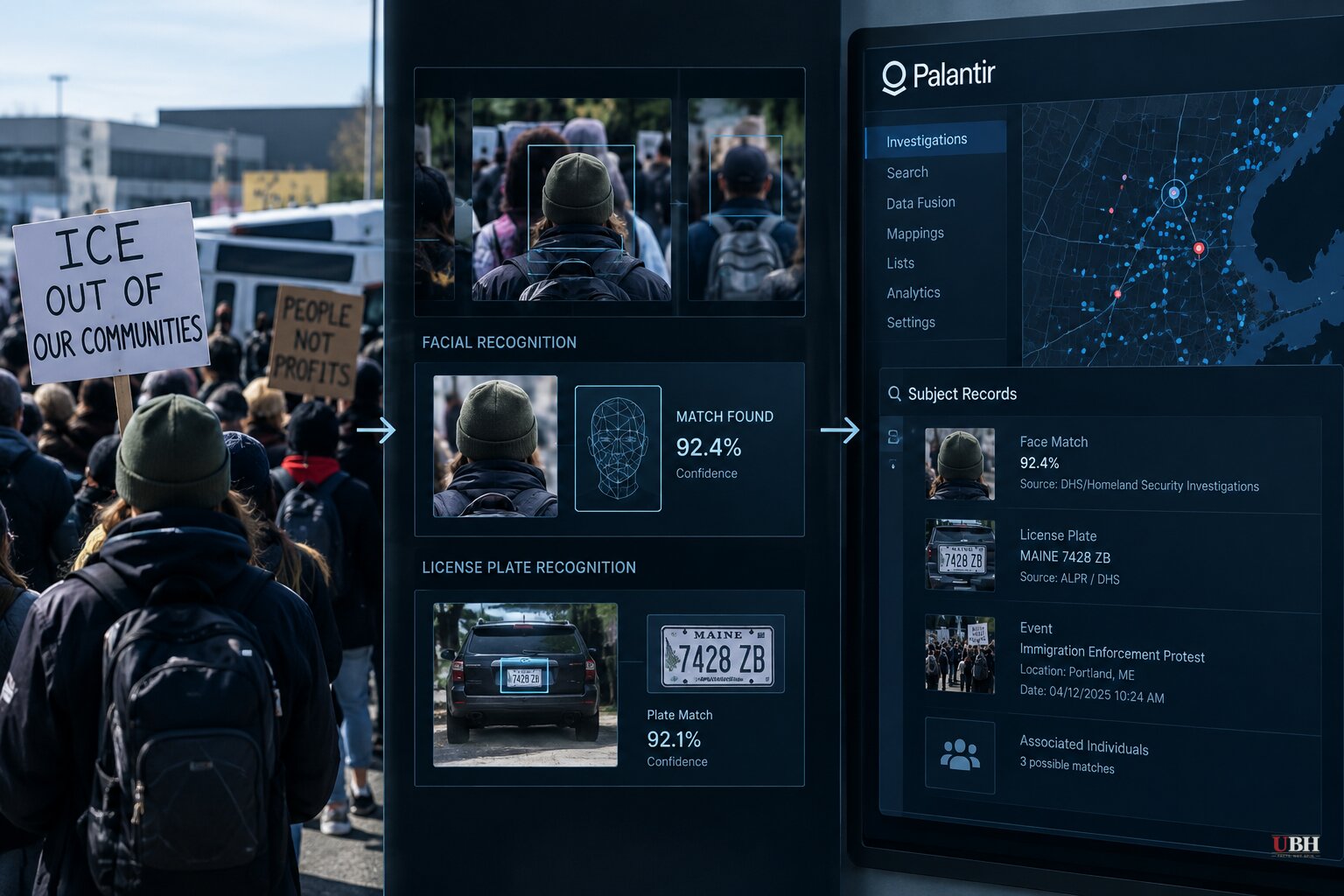
A federal court filing made public Friday lays out detailed allegations that Homeland Security Investigations agents tracked, photographed, and ran background checks on ordinary people who showed up to observe ICE operations in Maine, then stored that information in a case-management database built by Palantir Technologies, according to Wired.
The filing is part of a proposed class action in federal court in Maine brought by four plaintiffs: Elinor Hilton, Colleen Fagan, Polyxenia Pantos, and Carlyn Williams. It was filed under seal in September and unsealed in redacted form this week. The allegations center on "Operation Catch of the Day," an immigration enforcement surge HSI ran in Maine in January.
What the filing claims
According to the filing, one HSI agent identified only as "Agent J.C." created records in the Investigative Case Management database, known as ICM, on at least six observers. DHS says the real number is eight. ICM is the case-management system HSI uses to document its investigations, built for the agency by Palantir.
J.C. allegedly labeled two people he photographed in a Home Depot parking lot as a "Threat to Law Enforcement, Professional Protestor," per the filing. He then reportedly sent their photos, along with images of others, to a Customs and Border Protection officer to run through a facial recognition tool called Mobile Query.
The filing also describes an incident on January 20 in Portland, Maine. Plaintiff Polyxenia Pantos watched and photographed an arrest from a few car lengths away, standing beside a spouse's vehicle. Hours later, the filing alleges, J.C. ran that car's license plate and pulled a report from Accurint, a LexisNexis database used by law enforcement, on the vehicle's registered owner, Carlyn Williams, turning up her home address, phone numbers, and who she lives with.
The plaintiffs say agents also did drive-bys of observers' homes, and that at least one observer has been flagged for mandatory secondary inspection every time she crosses the US border, a designation the filing says will remain in place until January 2027.
What DHS says
A DHS spokesperson told Wired the case is "meritless" and said the lawsuit rests on "the lie that there is a database of 'domestic terrorists' run by DHS." DHS has not been charged with any crime, and no criminal investigation into the agency's conduct has been announced. This is a civil lawsuit, and the allegations in it, drawn from government documents and depositions of DHS agents cited in the filing, remain contested claims that a court has not yet ruled on.
DHS's broader argument, that agents conducting lawful immigration enforcement in a chaotic operational environment need to track who is filming them and why, especially if agents believe someone could be interfering with an arrest or compromising officer safety, is a real operational concern. Protesters and observers showing up at enforcement sites can create genuine safety and logistical complications for agents making arrests. That's a fair starting point for why agencies keep records on people at enforcement scenes.
But the specifics alleged here go well past officer safety. Pulling a home address, phone numbers, and cohabitant information on someone whose only documented conduct was standing near a parked car with a camera is different from noting a name at a scene. Running facial recognition on people because they filmed a Home Depot parking lot is different from flagging a safety risk. If the filing's account holds up, the agency wasn't managing a scene—it was building files on critics.
JoAnna Suriani, an attorney at Protect Democracy representing the observers, put it bluntly: "The government is treating people who exercise their First Amendment rights and seek to hold it accountable as criminal suspects, and that's what we're asking the court to stop."
Palantir did not respond to Wired's request for comment. The company built the ICM system for ICE but has not been named as a defendant, and nothing in the filing alleges Palantir directed how the database was used.
What's unresolved
The case is still a proposed class action, meaning no class has yet been certified by the court. DHS has not confirmed or denied the specific allegations about Agent J.C.'s conduct beyond calling the broader suit meritless. The filing's claim that observer flagging can trigger border secondary inspection through January 2027 has not been independently verified by DHS. A federal judge in Maine will eventually have to decide whether the documented conduct, if proven, amounts to unconstitutional retaliation against people exercising First Amendment rights, or lawful discretion by federal agents conducting an enforcement operation. That ruling, not the unsealed filing, is the next real checkpoint in this case.
Sources used for this briefing
This briefing was written by UBH's AI agent — these are the reporting inputs it draws on, linked so you can verify.


