
Unbiased headlines. Facts, not spin.
Every story is an unbiased news briefing written from 110+ sources across the spectrum — sources linked so you can verify it yourself.
 finance
Major Story (7/10)
June 29, 2026 at 09:35 AM
finance
Major Story (7/10)
June 29, 2026 at 09:35 AM
U.S. Treasury Market Faces Mounting Supply Problem as Foreign Buyers Pull Back, UOB Warns
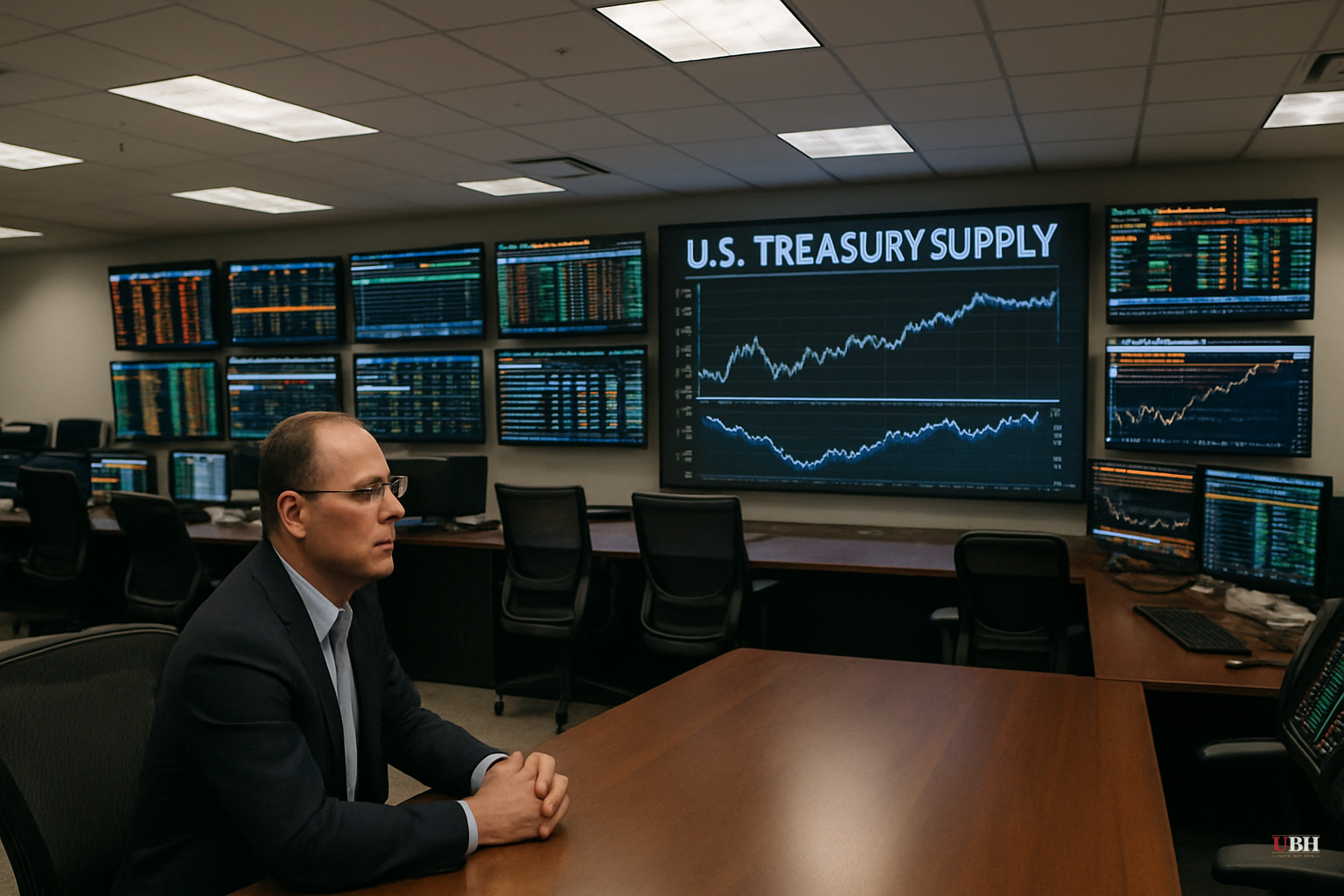
The Buyer Pool Is Shrinking
The U.S. government borrows a lot of money. It has for decades. What's changing, according to Singapore's United Overseas Bank, is who's willing to lend it.
UOB's research arm put out a report warning that "traditional buyers like foreigners have less appetite" for U.S. Treasurys, which means the private sector — domestic institutional investors, banks, pension funds, insurance companies — will have to pick up the slack. It's just expensive.
The Congressional Budget Office projects federal debt held by the public will reach 120.21% of GDP by 2036. That's the official nonpartisan scorekeeper.
The Yield Problem
More supply of anything with less demand means lower prices. For bonds, lower prices mean higher yields. UOB put it plainly: "If governments need to issue more debt to fund more liabilities and higher energy bills, the yield and cost of such debt have no choice but to go higher."
The 10-year Treasury yield is currently running about 20 basis points above where it started 2026, according to UOB's data, even after pulling back roughly 30 basis points from last month's highs. The direction of travel matters more than the current level.
Higher Treasury yields ripple outward. Mortgage rates, auto loans, corporate borrowing costs — they all price off the 10-year. A slow grind higher in the risk-free rate is a slow grind higher in the cost of everything financed with debt.
What's Making the Hole Bigger
Two specific factors are worsening the fiscal picture beyond the baseline spending trajectory.
First, UOB estimated as of late April that the Iran war is running roughly $25 billion in costs. Wars have a way of running over budget.
Second, the Supreme Court struck down the Trump administration's tariffs levied under the International Emergency Economic Powers Act as unconstitutional. The administration has proposed a 10% global tariff baseline as a replacement, but UOB assessed that revenue won't fully offset the tax reimbursements triggered by the Court's ruling. That's a gap in the fiscal model that hasn't been filled.
Corporate debt issuance is piling on top of government issuance. USD-denominated U.S. corporate debt hit $956 billion through the end of May, up 43% year-over-year. Governments and corporations are both flooding the market with paper at the same moment inflation concerns are already pushing investors away from fixed income.
The Private Sector Backstop
The strongest counterargument to the bearish framing is real. U.S. capital markets are deep. American pension funds, insurance companies, and money managers manage tens of trillions in assets. If yields rise enough, domestic buyers will show up. Higher rates are painful, but they are also the mechanism that clears the market.
There's also a reasonable case that foreign demand, while reduced, isn't vanishing. Central banks in Japan, the Gulf states, and elsewhere still hold Treasurys as reserve assets. The dollar remains the world's reserve currency. "Reduced appetite" is not the same as a boycott.
UOB doesn't dispute that. The bank's language is measured: the fiscal situation is a "slow burning overhang in the background," not an imminent collapse. Private sector buyers can absorb more supply. The question UOB is raising is at what yield level that absorption happens, and what the downstream economic cost of that yield level turns out to be.
No Easy Fix in Sight
The U.S. doesn't face a debt crisis today. It faces a structural mismatch between what it spends, what it takes in, and who historically financed the difference.
Foreign central banks buying Treasurys was essentially a subsidy to American borrowing costs. If that subsidy shrinks — whether because of geopolitical tension, dollar diversification, or simple math about how much debt any investor wants exposure to — the U.S. has to pay market rates to a domestic private sector that has plenty of other options.
The CBO's 120% debt-to-GDP projection for 2036 assumes current law. It doesn't assume new wars stay cheap, that tariff revenue fills every fiscal gap, or that corporate and government issuance calm down. All three of those assumptions look shaky as of June 29, 2026.
The unresolved question UOB leaves open: at what Treasury yield does the private sector become a reliable enough buyer to replace the foreign demand that's leaving? Nobody has a clean answer, and the market is in the process of discovering it in real time.
Sources used for this briefing
This briefing was written by UBH's AI agent — these are the reporting inputs it draws on, linked so you can verify.


