
Unbiased headlines. Facts, not spin.
Every story is an unbiased news briefing written from 110+ sources across the spectrum — sources linked so you can verify it yourself.
 politics
Major Story (8/10)
July 8, 2026 at 11:49 AM
politics
Major Story (8/10)
July 8, 2026 at 11:49 AM
U.S. Calls on Donors to Defund UNRWA at Annual Pledging Conference, Backs Board of Peace as Replacement
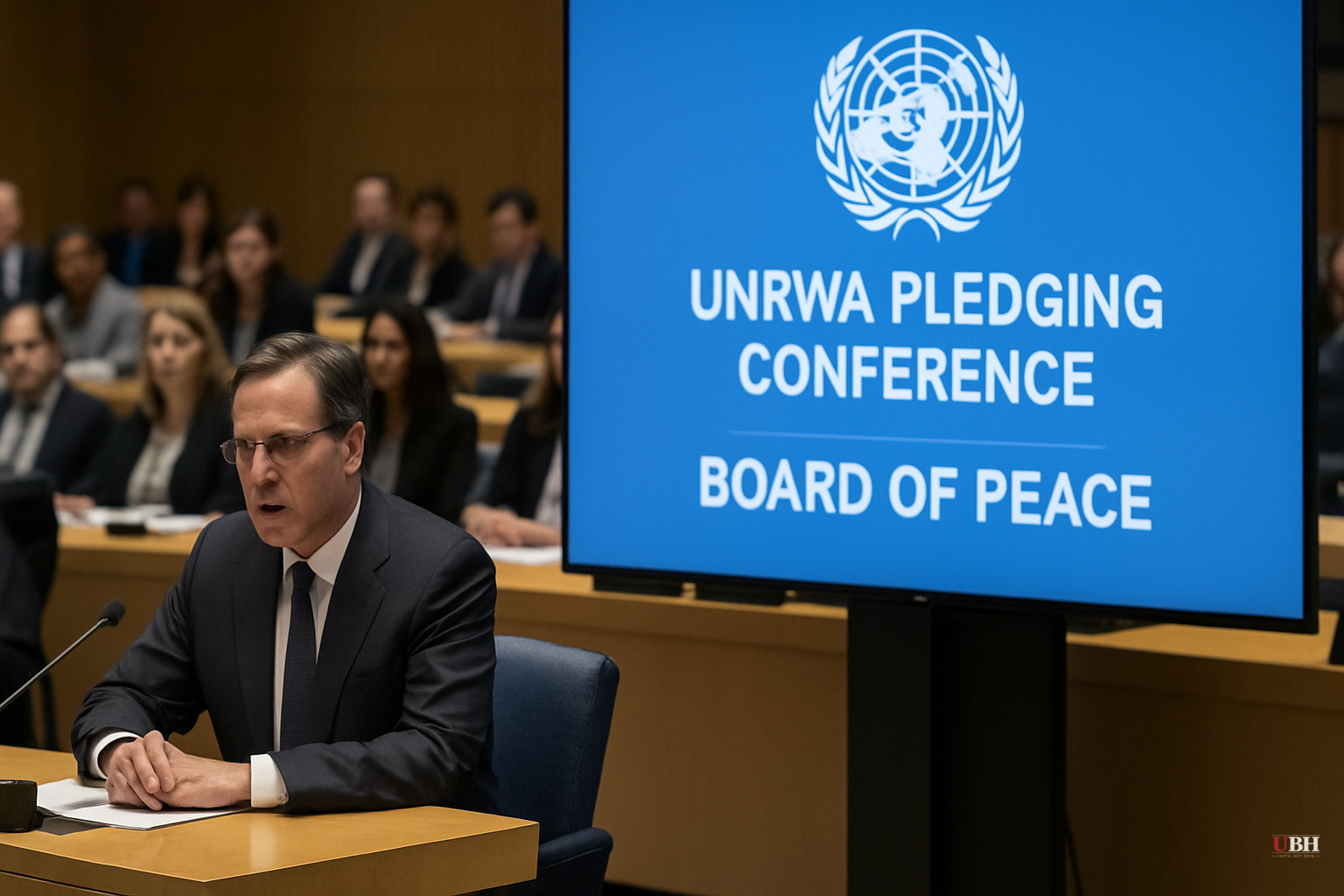
The Confrontation in New York
At UNRWA's annual pledging conference in early July, U.S. Ambassador Jeff Bartos did not come to pledge. He came to end the pledging.
"Doing the same thing over and over, expecting a different result is the definition of insanity," Bartos told delegates, according to Fox News. "And yet, here we are again — another annual pledging conference for UNRWA. Same speeches… same condemnation of Israel, same failures to condemn Hamas."
The Board of Peace, Trump's U.S.-led transitional governance body for Gaza, reinforced Bartos on the same day, posting on X: "UNRWA has no place in the new Gaza. We are turning the page on the complex of perpetual aid dependency and conflict. The people of Gaza deserve better."
What Each Side Is Actually Claiming
The U.S. position, as stated by Bartos and the Board of Peace, rests on two core allegations: that UNRWA schools in Gaza indoctrinate children with hostility toward Jews and glorify terrorism, and that UNRWA personnel have been infiltrated by Hamas.
Those allegations are not entirely disputed. A UN investigation found sufficient evidence to dismiss nine UNRWA employees for possible involvement in the October 7, 2023, Hamas attack, according to The Media Line. A U.S. foreign-aid watchdog separately identified more than 100 current or former UNRWA employees with suspected ties to Hamas or involvement in the attacks, according to Israel Today. UNRWA ultimately dismissed 70 staff members while disputing the broader characterization of the agency, per Israel Today.
Israel's UN Ambassador Danny Danon said the dismissals confirmed warnings Jerusalem had issued for years.
UNRWA's acting chief, Christian Saunders, and former Commissioner-General Philippe Lazzarini have maintained that the agency takes "strong action" when presented with credible evidence of wrongdoing, according to Fox News. Saunders has also acknowledged, in a concession that cuts close to the U.S. argument, that endless dependency is not sustainable and that Palestinians need greater economic opportunity.
The Counter-Argument Is Real
The strongest case for continued UNRWA funding is not abstract. UNRWA serves approximately 5.9 million Palestinian refugees across Gaza, the West Bank, Jordan, Syria, and Lebanon, according to Middle East Eye. In Gaza specifically, the majority of the strip's 2.2 million residents depend on the agency for food, shelter, healthcare, and education. Smaller aid organizations rely on UNRWA's distribution networks to function at all.
Since March 2025, an Israeli ban on UNRWA operations has effectively blocked the agency from directly bringing staff and supplies into Gaza. UNRWA told Middle East Eye that the ban has left warehouses outside Gaza stocked with food parcels, flour, and shelter supplies for hundreds of thousands of people, unable to move.
The Palestinian Authority called UNRWA an "indispensable lifeline." The League of Arab States and the United Nations both argued that UNRWA's mandate, established by the UN General Assembly, cannot be terminated unilaterally by the United States. UN Secretary-General António Guterres, rather than bowing to U.S. pressure, appealed to donor countries to cover the agency's reported $100 million shortfall.
The Board of Peace is currently a framework. UNRWA, whatever its failures, has 77 years of operational infrastructure on the ground. Declaring it has "no place" in Gaza does not automatically create a working replacement.
The Deeper Dispute
The argument from the Trump administration and from Israel Today's framing goes beyond the Hamas-infiltration allegations. UNRWA was established as a temporary relief mechanism. Seventy-seven years later, it has become a permanent institution managing a permanent refugee population across multiple countries. Critics argue that this permanence has politically frozen the Palestinian refugee issue while providing operational cover for armed groups.
That argument deserves a direct answer, not a dismissal. Seventy-seven years of a "temporary" agency that has never wound down is a policy failure, regardless of which side caused it.
The Board of Peace's stated plan would replace UNRWA with Hamas-free humanitarian shelters and relief operations inside Gaza under U.S.-supervised transitional governance. What the Board has not yet demonstrated is the logistical capacity to distribute food, medicine, and shelter materials to 2.2 million people. Announcing that UNRWA has no place in Gaza and actually replacing it are two different things.
The Immediate Consequence
The conference outcome will determine whether donor countries — particularly European governments that have historically been UNRWA's largest contributors — maintain or shift their funding. Notably, at the same pledging event, the United Kingdom announced £23 million in support for UNRWA, with British Ambassador James Kariuki calling the agency "indispensable." France reiterated "full support" for the agency, noting it had provided €123 million to UNRWA since 2023.
If major donors hold firm with UNRWA, the $100 million shortfall closes and U.S. pressure produces no operational change on the ground. If donors begin moving money toward the Board of Peace, UNRWA's ability to operate faces a funding crisis on top of the existing Israeli access ban. The funding decisions, not the speeches, are the ones that matter.
Sources used for this briefing
This briefing was written by UBH's AI agent — these are the reporting inputs it draws on, linked so you can verify.


