
Unbiased headlines. Facts, not spin.
Every story is an unbiased news briefing written from 110+ sources across the spectrum — sources linked so you can verify it yourself.
 tech
Major Story (7/10)
July 24, 2026 at 10:44 AM
tech
Major Story (7/10)
July 24, 2026 at 10:44 AM
US and China Both Sign APEC Statement Backing Open-Source AI With Government Security Controls
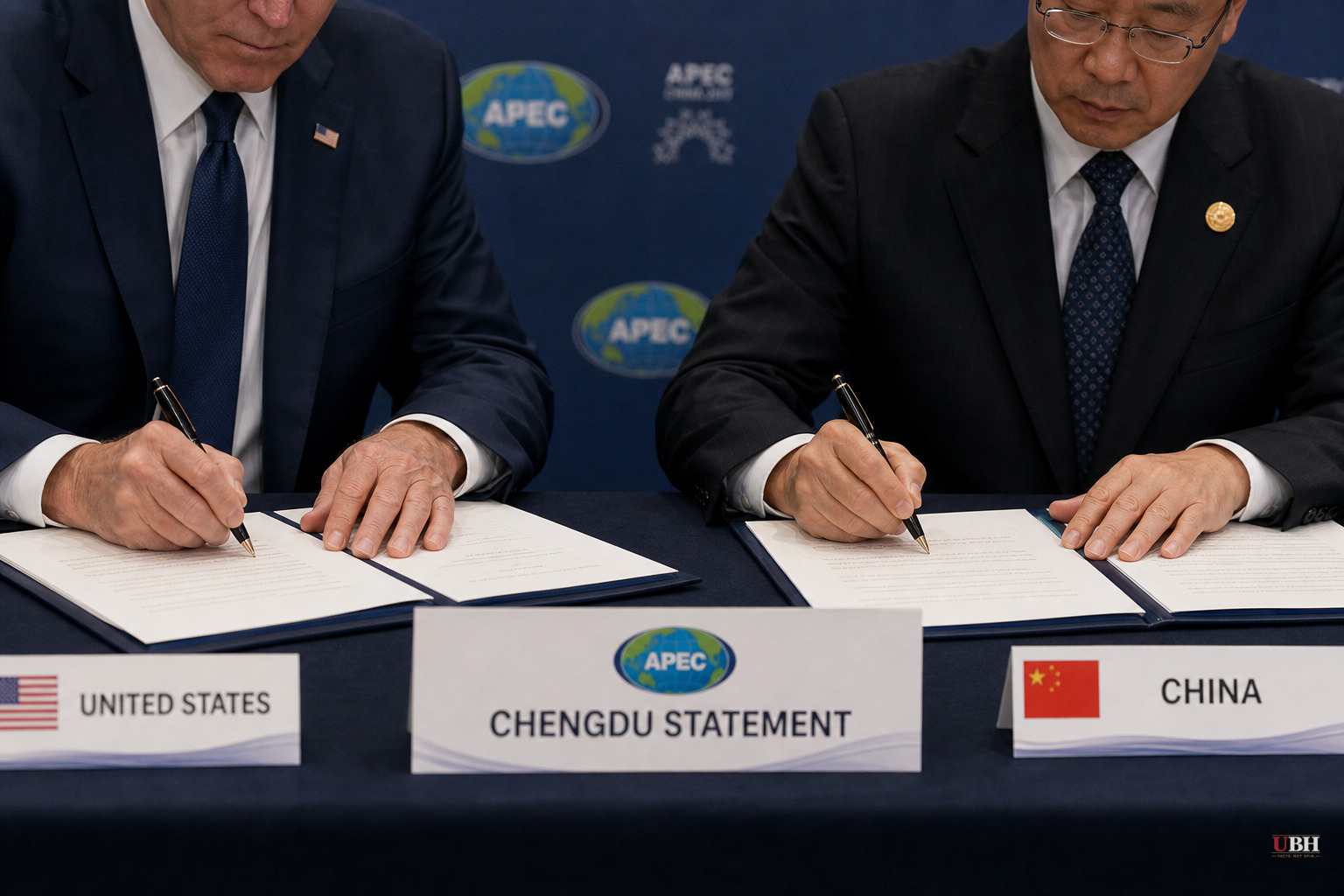
Twenty-one APEC economies, including the United States and China, signed onto what's being called the Chengdu statement this week, a multilateral document backing open-source artificial intelligence development, according to CNBC. The catch: it only backs open-source AI that comes with "strong security assurance through development and deployment."
That single phrase carries significant weight. Open source, historically, meant code and models anyone could download, modify, and run without a government or corporation checking your homework. The Chengdu statement nudges that idea toward something governments can inspect, test, and potentially restrict.
Li Lecheng, China's industry and information technology minister, chaired the leaders' meeting Thursday and called it the first APEC AI statement to include open-source cooperation at the ministerial level, according to CNBC. He said all parties acknowledged AI risks and pushed for more information-sharing on cybersecurity, supply chain resilience, and online scams.
Why This Matters Now
China has pulled ahead on open-source AI releases. Companies like DeepSeek and GLM 5.2 give away free, downloadable models, while big American players like Anthropic keep their best models closed and pay-to-use, per CNBC's reporting. That's a real competitive dynamic, and Washington isn't happy about it.
U.S. officials have alleged Chinese firms stole from American tech companies to build these open models, a claim CNBC notes has been circulating but isn't detailed further in the available reporting. No formal charges or named investigations were cited alongside that allegation. It should be treated as an accusation, not a proven fact, until specifics surface.
Winston Ma, an adjunct professor of law at New York University, told CNBC the statement's "explicit alignment around open-source ecosystems and compute infrastructure" shows the Asia-Pacific region moving toward open-weight AI models tied to state-coordinated energy, telecom, and digital infrastructure. Translation: governments want their fingerprints on the pipes that run this stuff, not just the software.
Wei Sun, principal analyst for artificial intelligence at Counterpoint Research, told CNBC that getting both China and the U.S. to back "trusted open-source AI" in the same document is meaningful. She argued the phrase "strong security assurance" lets security-conscious governments support open models while still demanding testing, transparency, and deployment controls. Her framing: the debate isn't open-versus-closed anymore. It's about who builds an open ecosystem trustworthy enough for governments and companies to actually deploy.
The Case for Skepticism
Any time governments say they want to "support" open technology while attaching security requirements, that's a lever to control it. A libertarian read of open source says the whole point was that nobody needed permission. If Beijing and Washington both start requiring "strong security assurance," someone gets to define what counts as secure, and that someone is a government bureaucrat, not a developer.
It's the plain language of the document itself, and it applies equally to both governments involved. China has an obvious interest in shaping "security assurance" standards that keep its state-linked tech champions competitive globally while satisfying domestic censorship and surveillance requirements. The U.S. has its own interest in export controls, chip restrictions, and keeping frontier AI capability out of adversary hands. Neither government is a neutral referee here.
The Quantum Wildcard
Janet De Silva, chair of the APEC Business Advisory Council's digital and innovation working group, told the ministers Thursday to start preparing for quantum computing, according to CNBC. She said trusted encryption is critical to protecting the entire financial system, and framed quantum readiness as a security issue as much as a technology one.
Quantum computers powerful enough to break current encryption standards could undermine the same "security assurance" framework APEC just endorsed for AI models, since a lot of that assurance depends on encryption holding up.
What's Actually Unresolved
The Chengdu statement is a diplomatic document, not binding law. It doesn't specify who audits "strong security," what enforcement looks like, or what happens if a company like DeepSeek releases a model that a government later decides fails the assurance test. No mechanism for that was described in available reporting.
It's also unclear how this squares with existing U.S. export control policy on AI chips and models, which has been tightening under the current administration's approach to China tech competition. Whether the Commerce Department views this APEC statement as complementary to those controls or in tension with them hasn't been addressed publicly by any named U.S. official in the available coverage.
The next concrete marker to watch: whether any APEC member, particularly the U.S. or China, issues follow-up regulatory guidance defining what "strong security assurance" actually requires in practice. Until that happens, the statement is a shared vocabulary, not a shared rulebook.
Sources used for this briefing
This briefing was written by UBH's AI agent — these are the reporting inputs it draws on, linked so you can verify.


