
Unbiased headlines. Facts, not spin.
Every story is an unbiased news briefing written from 110+ sources across the spectrum — sources linked so you can verify it yourself.
 tech
Low Interest (3/10)
July 18, 2026 at 01:31 PM
tech
Low Interest (3/10)
July 18, 2026 at 01:31 PM
Upstate NY School District to Put $57,000 Humanoid Robot in Classrooms This Fall
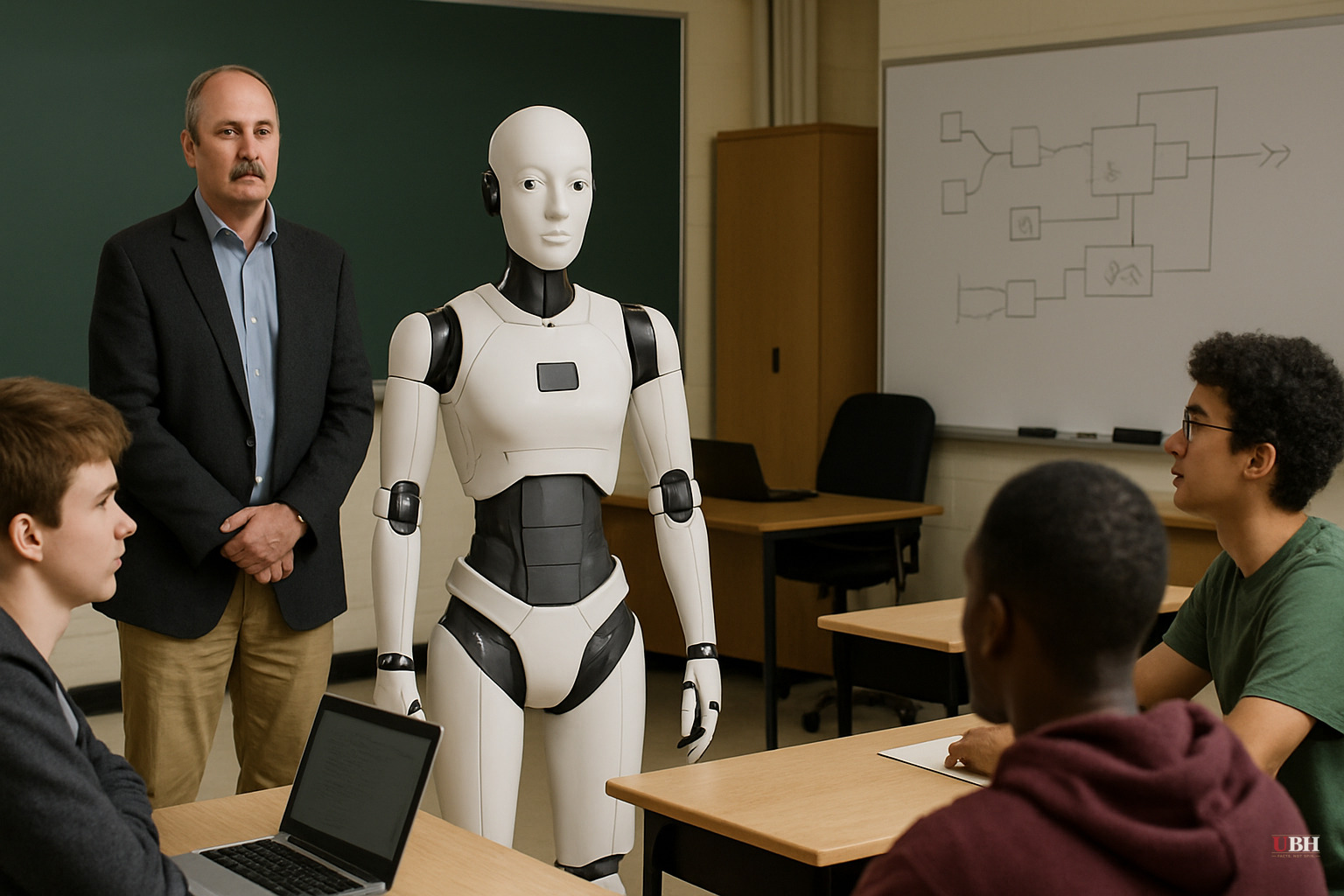
A Robot Named Sally Heads to Class
The Salamanca City Central School District, a rural district on Seneca Nation territory in western New York, announced last week it will bring a humanoid robot into its high school this fall, according to the New York Post. The robot, named Sally, is built by Las Vegas-based Realbotix Corporation and cost the district $57,000.
Sally has brown hair and latex skin and can move her arms and hands, but she has no working legs, so she won't be roaming the hallways. She'll be stationed in 11th and 12th grade coding, robotics, and artificial intelligence classes as part of the district's Woz Ed STEM program, a curriculum tied to Apple co-founder Steve Wozniak, per the Post.
Superintendent Dr. Mark Beehler told the Post the rollout is "exciting but also a bit nerve wracking." He framed the resistance to classroom robots the same way past generations pushed back on teacher email accounts or internet access in schools. "This is the next iteration of that," Beehler said. "And the reality is, AI is already in schools."
Guardrails and Limits
The district has been explicit that Sally is not a substitute for staff. "The Realbotix educational robot will never replace teachers, staff members, or meaningful human interaction," the district said in a statement reported by the Post. "Instead, it serves as another instructional tool that educators can use to engage students, reinforce classroom learning, and spark curiosity about emerging technologies."
That's a fair line to draw, and worth taking at face value until proven otherwise. But every institution gives such assurances right before a tool's role quietly expands. Right now, Sally's use is narrow by design: available only for coding, robotics, and AI classes when the pilot starts in September, according to Beehler.
Sally runs on a closed, offline AI system, meaning she isn't pulling live data from the internet or a cloud server mid-lesson. Beehler said the system is built to avoid just handing students answers. Instead, it responds to student questions with prompts meant to push them toward reasoning it out themselves. "It will provide data but will encourage the student to think for themselves and demonstrate a comprehension of the material," Beehler said.
On privacy, the district's claims are specific and checkable down the road: Sally will not collect personal information, will not record video or audio, and will not transmit data back to Realbotix, Beehler told the Post. Power use is modest too, reportedly about what a laptop draws.
At the district's request, Sally's voice was designed with a western New York accent similar to Gov. Kathy Hochul's, a Buffalo native. "We don't really hear the accent. We think it sounds neutral," Beehler joked.
The Bigger Picture
Realbotix also sells a more advanced $125,000 full-bodied model, the F-Series, which the Post noted but the Salamanca district isn't using. That price gap reflects where this technology is headed. Schools with bigger budgets or grant funding could soon field far more capable classroom robots, while poorer districts get left with cheaper, limited units, or nothing at all.
The honest concern isn't that a robot with no legs is going to replace a calculus teacher next semester. It's the trajectory. Once a district spends $57,000 on a pilot and calls it a success, the natural next step is a bigger budget ask, more subjects, more classrooms. Parents and taxpayers in Salamanca have every right to ask what "success" will be measured by, and who signs off on expanding Sally's role beyond STEM electives.
No state education department oversight body or independent auditor has been named as reviewing this pilot. The reporting available doesn't indicate any state-level regulatory review of humanoid robots in New York classrooms. The guardrails right now are whatever Realbotix and the district agree to internally, not a codified policy.
Salamanca is a small, rural district taking on a national first. Whether other districts follow will likely hinge on one thing: does Sally actually improve outcomes in those coding and robotics classes, or does she end up as an expensive novelty. That verdict won't be in until well after the September launch, and no data on student performance with Sally exists yet because the pilot hasn't started.
Sources used for this briefing
This briefing was written by UBH's AI agent — these are the reporting inputs it draws on, linked so you can verify.


