
Unbiased headlines. Facts, not spin.
Every story is an unbiased news briefing written from 110+ sources across the spectrum — sources linked so you can verify it yourself.
 tech
Major Story (8/10)
July 24, 2026 at 12:29 PM
tech
Major Story (8/10)
July 24, 2026 at 12:29 PM
UN Report: AI Data Centers Could Produce 2.5 Million Tons of E-Waste a Year by 2030, Equal to 250 Eiffel Towers
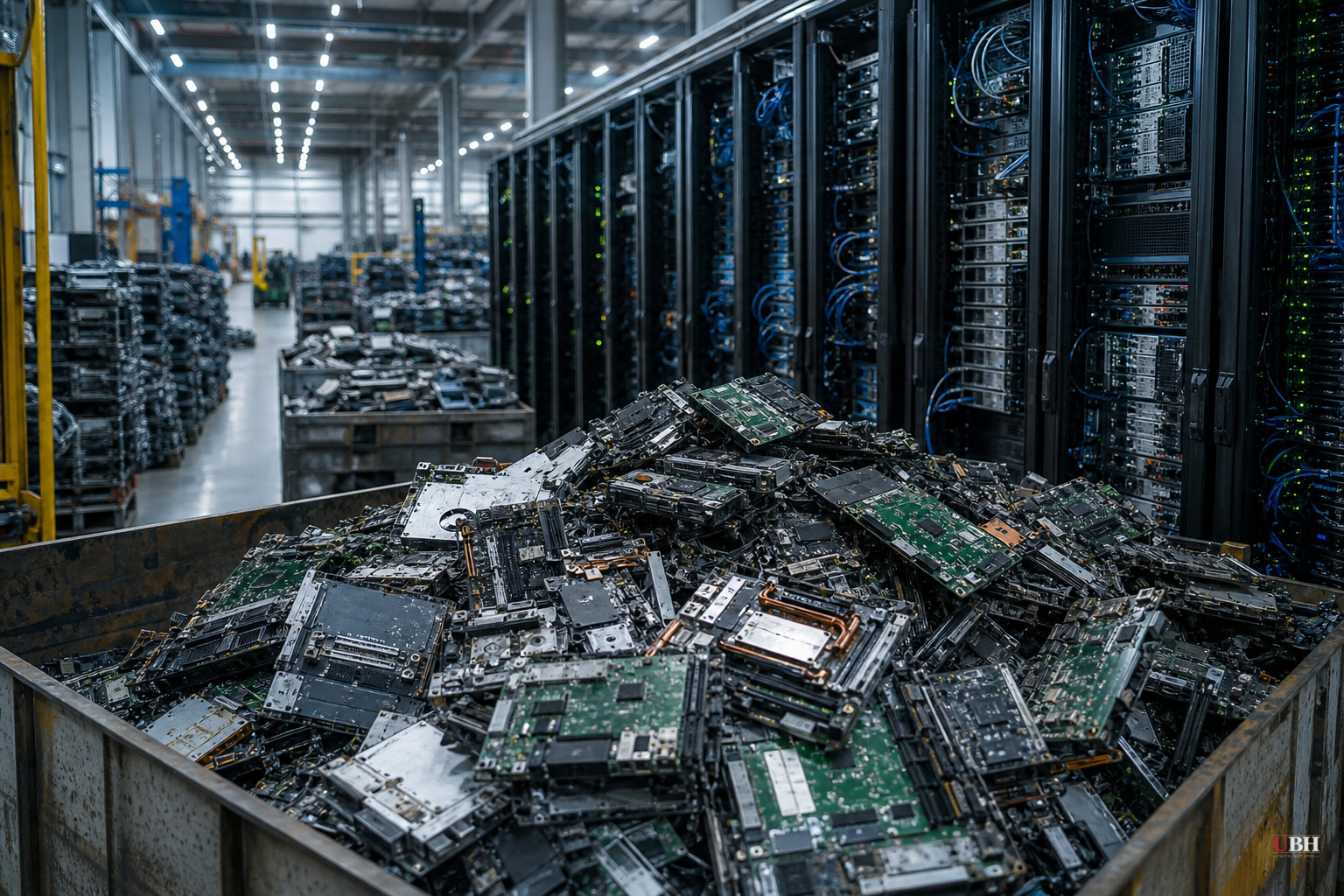
AI doesn't run on vibes. It runs on chips, servers, cooling systems, and enormous amounts of electricity and water, and all of that hardware eventually becomes garbage.
A report released in June by the United Nations University Institute for Water, Environment and Health, titled "Environmental Cost of AI's Energy Use: Carbon, Water and Land Footprints," puts numbers on what's been an abstract problem. By 2030, AI hardware turnover could generate roughly 2.5 million metric tons of e-waste annually, according to the report. Physics World, which covered the findings, translated that into something visual: the equivalent of scrapping 250 Eiffel Towers every year.
It's a projection based on current buildout trends. In the US alone, more than 1,500 data centers are in various stages of development, according to the Pew Research Center. Every one of those facilities is packed with gear that has a shelf life, and when it dies, it has to go somewhere.
The Electricity Math Is Ugly Too
The e-waste number is just one piece. The bigger headline from the UN report is electricity. Global data centers burned through an estimated 448 terawatt-hours in 2025, according to UNU-INWEH, putting them on par with France's total electricity consumption. By 2030, that figure could nearly double to 945 terawatt-hours, per the report, almost triple the combined annual electricity use of Pakistan, Bangladesh, and Nigeria, three countries with a combined population over 650 million.
That same growth carries a water and land bill. The report projects AI data centers' water footprint by 2030 will match the basic annual domestic water needs of all 1.3 billion people in Sub-Saharan Africa. Their land footprint will exceed 14,500 square kilometers, roughly twice the size of the Jakarta metro area, home to more than 32 million people.
Kaveh Madani, director of UNU-INWEH and the investigation's lead, was blunt that this isn't an anti-AI report. "This report is not a case against artificial intelligence, a technological transformation that is improving the lives of billions of people around the world," Madani said, according to the UN University's own release. His point is narrower: use it responsibly, and stop pretending the tradeoffs don't exist. "We have a narrow window to ensure that the backbone of the technological revolution of our era develops within planetary limits," Madani said.
Low-Carbon Doesn't Mean Low-Impact
One of the more useful findings buries the simplistic narrative that switching to "clean" energy solves the problem. The report found that swapping coal for bioenergy can cut a data center's carbon footprint by 70%, but it can also multiply its water footprint more than thirtyfold and its land footprint a hundredfold, according to the UN University. Chasing one metric, carbon, can quietly wreck another. Companies bragging about carbon-neutral data centers may be shifting the damage onto water tables or farmland instead of eliminating it.
Who Actually Eats the Cost
This is where the story gets uncomfortable. ZDNET's reporting puts a face on the abstraction: Solomon Njoroge, a former waste picker who started working the Dandora dumpsite outside Nairobi, Kenya, as a child. He's watched people around him develop asthma, cancer, and respiratory disease from the toxic metals, arsenic, lead, cadmium, mercury, found in scrapped electronics. Njoroge now runs the Dandora Recyclable Waste CBO, an advocacy group for waste pickers.
"Inasmuch as we are working for development or greatness to change the world… [hyperscalers] should also consider that there are people somewhere, suffering from what they are calling greatness," Njoroge told ZDNET.
Physics World's coverage adds a global-equity angle: as of late 2025, only 32 countries had AI-specialized data centers, with nearly half of the world's data centers located in the US. More than 150 countries, including most of Africa and South America, have zero AI infrastructure, meaning they get none of the economic upside, but their communities still absorb the mineral extraction, e-waste dumping, and pollution tied to the supply chain.
The Fair Counter-Argument
None of this means AI development should stop or that data centers are inherently reckless. The technology genuinely is reshaping medicine, logistics, and scientific research, and the same report's own authors say so explicitly. Industry leaders would reasonably argue that efficiency gains, better chip design, smarter cooling are already reducing energy per computation even as total volume rises, and that regulation should target waste and disclosure, not the technology itself.
The report's own recommendations track that logic rather than calling for a slowdown: it calls for AI developers to improve efficiency and transparently report their environmental footprint, for governments to enforce standardized environmental disclosure, and for investors to weigh environmental impact in due diligence, according to Physics World.
None of those reforms exist yet as binding law anywhere. Right now, there's no US federal mandate requiring data center operators to disclose e-waste volumes or destinations, and no international standard governing where scrapped AI hardware ends up. Until that changes, the 2.5 million tons a year is heading somewhere, and the UN report's authors are betting it lands hardest on people who never got a vote on where their new data center went, or where its dead servers end up next.
Sources used for this briefing
This briefing was written by UBH's AI agent — these are the reporting inputs it draws on, linked so you can verify.


