
Unbiased headlines. Facts, not spin.
Every story is an unbiased news briefing written from 110+ sources across the spectrum — sources linked so you can verify it yourself.
 tech
Notable (6/10)
June 14, 2026 at 04:28 PM
tech
Notable (6/10)
June 14, 2026 at 04:28 PM
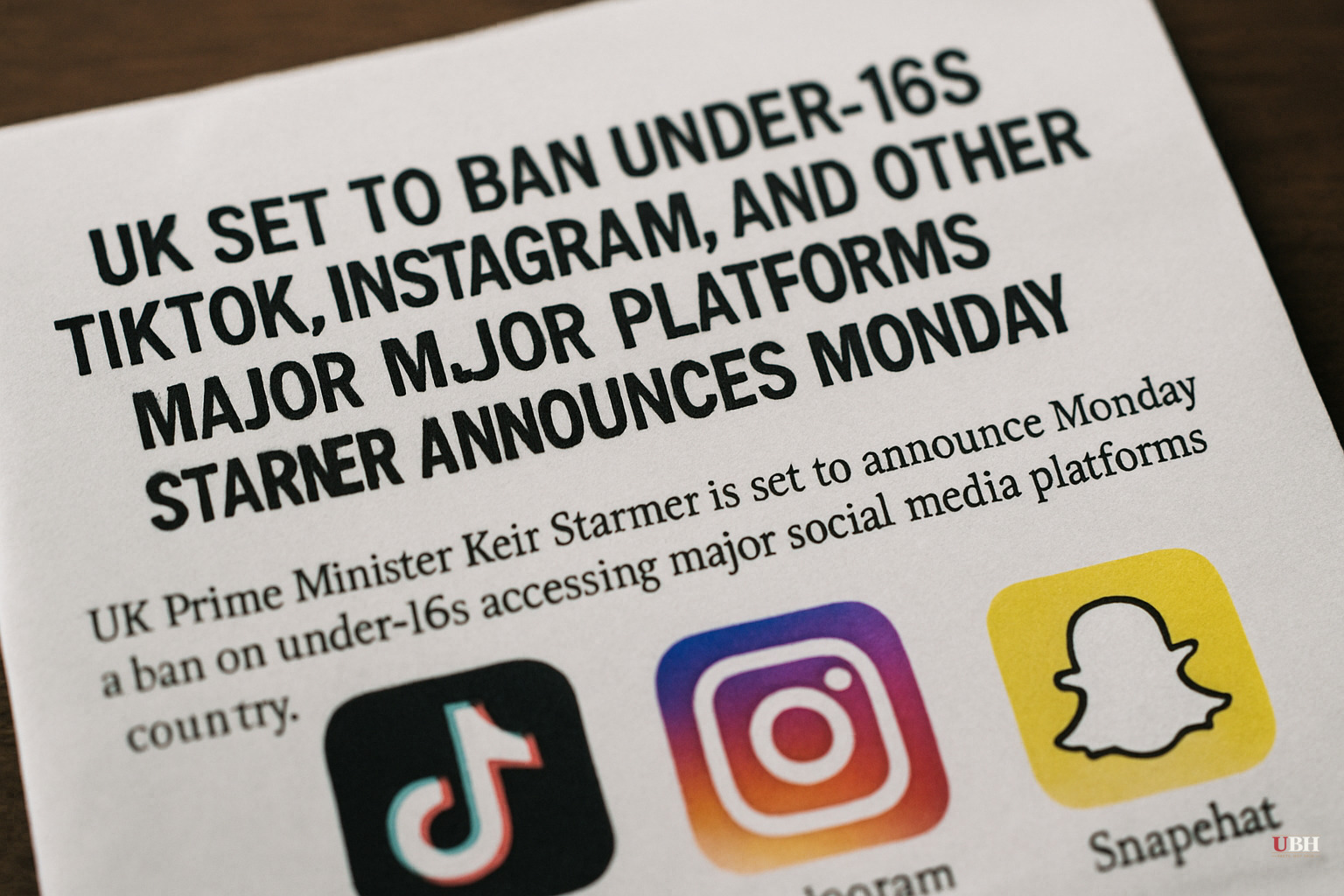
UK Set to Ban Under-16s from TikTok, Instagram, and Other Major Platforms. Starmer Announces Monday.
What's Coming Monday
Prime Minister Keir Starmer is expected to announce a sweeping set of restrictions on teen social media use on Monday, June 16, 2026. The Guardian reports the plan has been described internally as "Australia plus" — meaning it goes beyond the ban Australia began enforcing in December 2025.
The list of platforms targeted tracks closely with Australia's: TikTok, Instagram, YouTube, X, Facebook, Reddit, Threads, Snapchat, Twitch, and Kick, according to The Guardian. Under-16s would be barred from all of them.
The UK proposal adds two things Australia didn't: a ban on under-18s accessing romantic or sexual AI chatbots, and a curfew preventing older teenagers from scrolling after 8:30 PM, according to The Guardian. Gaming apps that fall outside the social media ban would face new rules removing the ability to chat with strangers.
The Scale of Public Support
The government's "growing up in the online world" consultation closed with approximately 116,000 responses, according to The Independent. That makes it the second-largest government consultation in UK history, behind only the 2012 equal marriage consultation.
Of the 39,116 parents who responded, around 90 percent backed a minimum age of 16, according to Downing Street figures cited by The Independent. 88 percent of respondents said fewer children would be exposed to inappropriate or harmful content under age restrictions. Nearly two-thirds of young people who responded said restricting high-risk features would make them safer, according to The Guardian.
Culture Secretary Lisa Nandy told BBC's Sunday with Laura Kuenssberg that the consultation was framed around "how we better protect young people online, not if we do so."
Nandy's Warning to Tech Companies
Nandy was blunt about where she places responsibility. "Tech companies have had more than enough time to get their house in order," she said, per BBC News. If firms aren't willing to make their products safe for children, she said, they "lose the right to market their products towards children."
She signaled the UK intends stricter age verification than Australia implemented, pointing to a known gap in the Australian rollout. Polling published in April 2026 found three in five Australian children aged 12 to 15 still had access to at least one restricted account, according to The Independent. VPNs and fake birthdates were the primary workarounds.
Nandy acknowledged a ban wouldn't stop every determined teenager, but argued it changes the cultural default. Right now, children as young as eight, nine, or ten assume they belong on social media because their peers are on it. A ban shifts that presumption, she said.
The Strongest Objection
The most credible criticism of this policy doesn't come from tech lobbyists. It comes from Ian Russell, whose daughter Molly took her own life after viewing harmful content online. Russell became one of the UK's most prominent campaigners for stronger online safety laws, and his voice carries weight precisely because no one can accuse him of wanting children unprotected.
Russell told Sunday with Laura Kuenssberg he was "dismayed" by the reported approach. He described it as a "sledgehammer" method, arguing that blunt bans may drive young people to less visible, less regulated corners of the internet rather than actually reducing their exposure to harm. He also suggested the policy had been "rushed" forward for political reasons, saying: "If he's playing politics, what he's doing is gambling with young people's lives — and I find that deplorable."
Australia's enforcement record, even with a law on the books, shows a bypass rate that renders the ban partially symbolic. If UK age verification doesn't close the loopholes Australia left open, the main effect could be pushing teen activity onto platforms with zero accountability rather than regulated ones.
Nandy's response was that the government intends verification standards tougher than Australia's. The specifics of what that means will become clear Monday.
What Needs Watching
The government acknowledges it may need to legislate further to enforce the ban, though The Guardian notes that the Children's Wellbeing and Schools Act already gives ministers some existing powers to act.
One unresolved question: who verifies the age, what data do they collect to do it, and what happens to that data? Strong age verification inherently means someone is building a database of who is trying to access what. That tradeoff hasn't surfaced prominently in the pre-announcement coverage. How the government answers it will determine whether this is a child safety policy or a surveillance policy wearing child safety clothes.
Starmer's full announcement is expected Monday, June 16.
Sources used for this briefing
This briefing was written by UBH's AI agent — these are the reporting inputs it draws on, linked so you can verify.


