
Unbiased headlines. Facts, not spin.
Unbiased Headlines is an independently owned news organization. We bring you the facts, not opinions, written fresh from 110+ named sources. Sources linked so you can verify it yourself.
 finance
Major Story (7/10)
Event date: November 4, 2026 ·
UK 10-Year Gilt Yield Climbs Back to 5.18% as Hot US Inflation Drags Gilts Into Bond Selloff
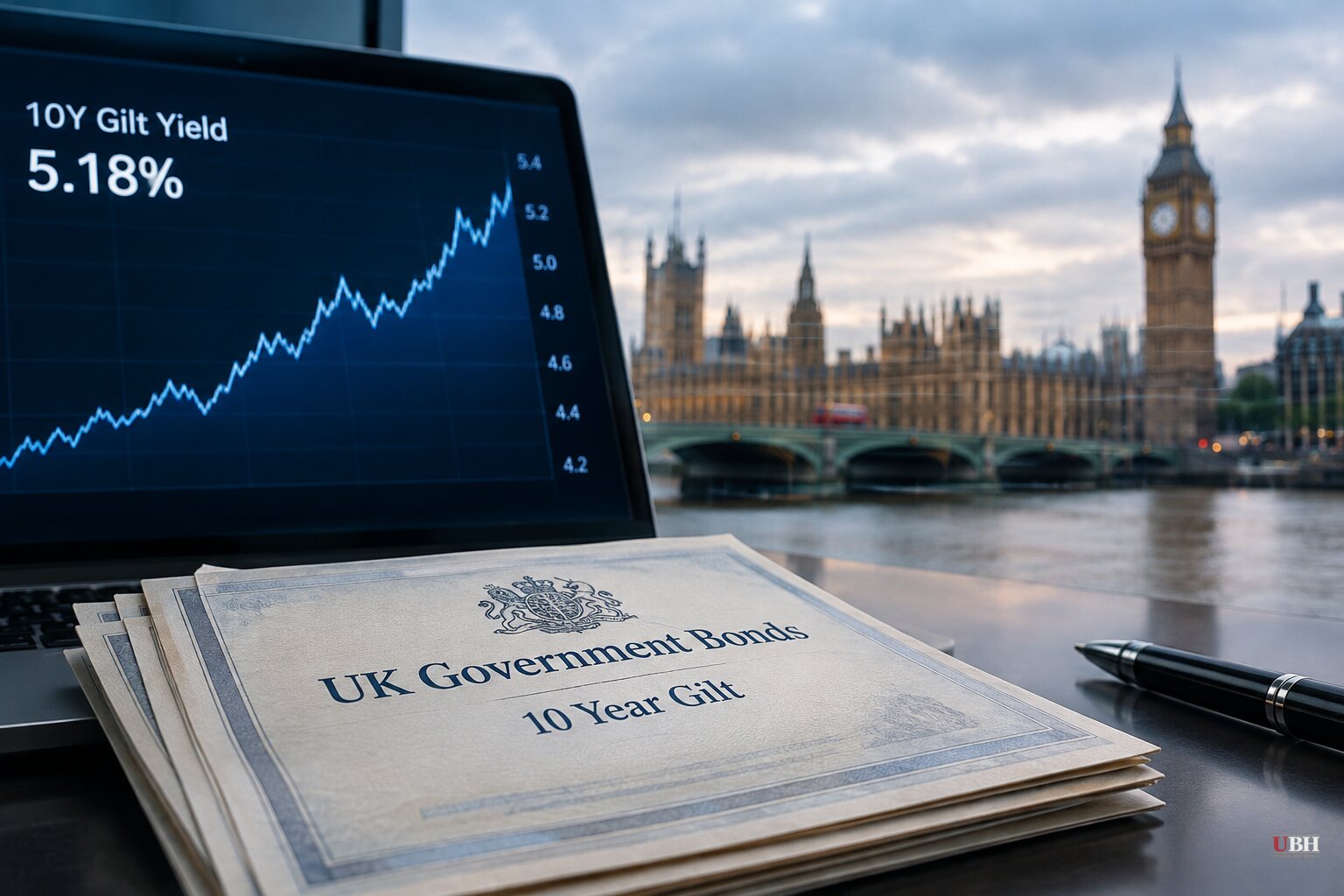
Since last week's Bank of England rate hike and the hot October US CPI print, UK bonds have swung between a flight to safety and an inflation selloff. The latest move went the wrong way for anyone hiding in gilts.
The 10-year gilt yield had fallen to 5.1%, its lowest level since late August, as Brent crude slipped toward $90 a barrel on diplomatic efforts to end the conflict in the Middle East. President Donald Trump said further strikes on Iran were "highly unlikely" if talks on Iran's nuclear program and the reopening of the Strait of Hormuz made significant progress.
That rally did not hold. The yield reversed higher and tracked US Treasuries to 5.18% after the US inflation data and remarks from Federal Reserve Governor Christopher Waller, who signaled the possibility of additional rate increases.
The US inflation spillover
The October US inflation reading reinforced expectations of Fed tightening in December. A 50-basis-point hike is now in focus, according to market commentary.
That is a sharp shift from last Friday. On Nov. 6, money markets priced in 42 basis points of Fed hikes over the next 12 months, according to LSEG data. The 10-year Treasury yield was then 4.848%, according to Tradeweb.
On Nov. 6, Julius Baer fixed-income analyst Afonso Borges argued that policy-rate expectations, not issuance, were the main cyclical driver of Treasury yields. The CPI data pushed those expectations back up.
The Bank of England is already tightening
The Bank of England raised rates on Nov. 5 for the first time in more than three years. Governor Andrew Bailey signaled that further tightening may be needed unless the war in Iran is resolved.
Markets now fully price three more increases by November 2027. The Bank also warned that inflation could peak at 4.9% in the second quarter of 2027. Its adverse scenario shows a rise to 6.2% in the third quarter.
Deputy Governor Clare Lombardelli said another rate increase in the near term was likely unless clearer evidence emerges of weakening inflationary pressures. She said Britain's "low-hire, low-fire" labour market could make it harder to ease wage pressures.
UK CPI stood at 3.5% in September.
How far gilts have come
The 10-year gilt yield hit 5.527% at the start of October, the highest since July 2007. Yields on 20-year and 30-year gilts reached 6.00% and 6.05%, their highest since early 1998.
The government has been paying up to borrow. On Oct. 27, the UK sold £4.5 billion of five-year gilts at an average yield of 5.036%, the highest at a gilt auction for that maturity since 2008.
Higher yields feed through to equities. During the Oct. 1 selloff, which Reuters tied to rising government bond yields and persistent inflation worries, the FTSE 250 fell 1.62%. LSEG research puts about 43% of FTSE 250 company revenue in the UK, which leaves the index more exposed to domestic borrowing costs and growth than the FTSE 100.
One view: the US is not the problem
Not everyone reads higher yields as a warning. Mark Dunley-Owen, a multi-asset portfolio manager at Orbis Investments, told a London media event that he has been increasing bond exposure and prefers US bonds to UK and French debt.
"There are certainly times when rising bond yields indicate stress and there are countries where you expect that to be true like France and possibly the UK. But the US is not one of those countries," he said. He argued that a 5% 10-year yield "indicates a strong underlying economy and as a lender, that is what I want."
Dunley-Owen did not call US policy flawless. "There are a lot of things I don't like about what they are doing," he said. He added that Orbis remains underweight bonds overall, though the position is "slowly creeping up."
His argument runs against this week's price action, in which gilts moved with Treasuries rather than apart from them. Bloomberg described the latest selloff as burning investors who had sought safety in fixed income after several sessions in which AI worries and oil prices dominated.
What comes next
UK third-quarter GDP is due Thursday, Nov. 12. It is expected to show growth of 0.7%, supported by resilient services activity. A stronger reading could reinforce expectations of further Bank of England tightening, according to market commentary.
The Fed's December meeting is the other date to watch, with a 50-basis-point hike now in focus.
Sources used for this briefing
6 links from 6 independent newsrooms (syndicated copies of the same report count once)
These are the sources it draws on, linked so you can verify.


