
Unbiased headlines. Facts, not spin.
Unbiased Headlines is an independently owned news organization. We bring you the facts, not opinions, written fresh from 110+ named sources. Sources linked so you can verify it yourself.
 tech
Major Story (8/10)
UEFI Flaw CVE-2026-97631 in TianoCore EDK II Rated 9.5 of 10, With Fix Code Already Public Ahead of January Disclosure
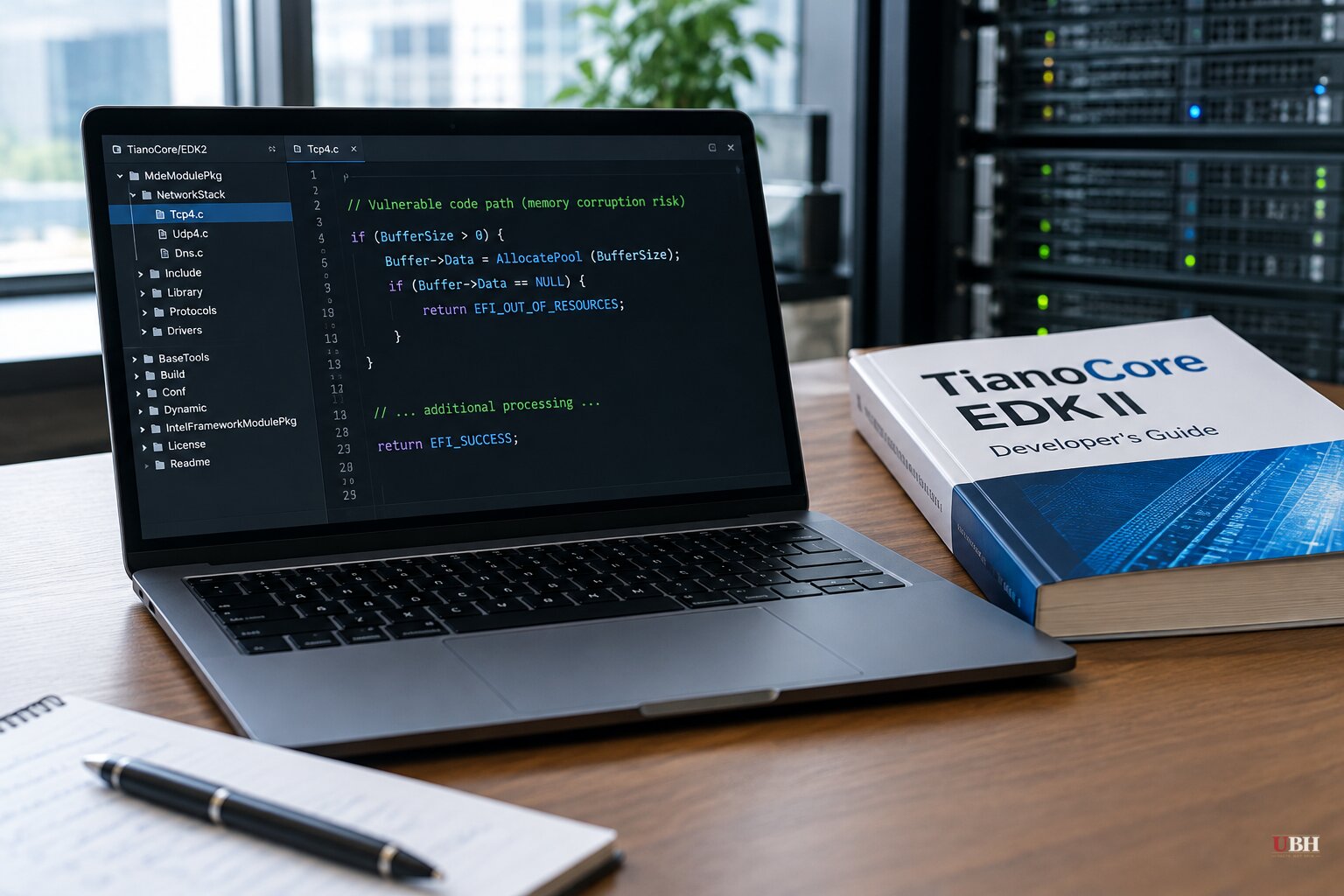
Six days after another botched disclosure involving a critical code-execution vulnerability in the PHP programming language, defenders have a second bug with a messy disclosure: a critical flaw in the firmware code that runs before a server's operating system even loads.
The vulnerability is tracked as CVE-2026-97631 and carries a severity rating of 9.5 out of 10. It sits in TianoCore EDK II, the open source codebase that hardware makers and cloud providers use to build UEFI firmware. AMI, Insyde and Phoenix, the major independent BIOS vendors, use the reference code extensively. Microsoft's hardened fork, Project Mu, used the code containing the vulnerable component too.
What the bug does
The flaw is a memory-corruption error in an ICMP component inside the EDK2 network stack. An attacker who triggers it can execute malicious code during boot, before the operating system and firmware load defenses such as Secure Boot. Secure Boot establishes a chain of trust for the code loaded at startup, including the Trusted Platform Module (TPM).
The payloads this flaw delivers do not persist. They run once. But they can open the door to installing other payloads that execute early in every boot.
HD Moore, creator of Metasploit and chief research officer at security firm Dragos, described the exposure. "An attacker intent on compromising a nearby endpoint or server could use this bug to hijack program flow at a point where the boot process still has access to sensitive components, like the endpoint's TPM," he said. That could break disk encryption where an attacker has short-term network access, he added, and "it would be even easier in a theft scenario."
A disclosure that did not go to plan
The flaw was found by Alex Matrosov of Anthropic and Dan Holmes of Google. They had arranged a coordinated disclosure for January.
According to Ars Technica's reporting, AMI then published a pull request last month that detailed the vulnerability and included a code fix. After the discovering parties noticed it, TianoCore Project members published a public advisory last week.
That leaves publicly available patch code for a bug that is not yet fixed in the field. Ars Technica reports it will be trivial for advanced attackers to work out how the flaw is triggered and build working exploits.
Inquiries to AMD, Phoenix Technologies, AMI, Microsoft and Amazon about their use of EDK2 went unanswered by the time of publication, according to a report from Archynewsy.
Patching is the slow part. UEFI fixes have to reach millions of end devices sold and used by thousands of hardware makers and cloud providers, a process Ars Technica calls cumbersome and time-consuming.
Not every machine is exposed
The scope is contested. Ars Technica's headline says the flaw threatens most servers on Earth. Archynewsy takes a narrower view: it says the exposure is organization-owned machines that boot from local networks or internet resources, using EDK2 firmware with Preboot Execution Environment (PXE) functionality enabled by default. In that account, home users, small offices and anyone who boots only from a local disk are unaffected.
Vendors are splitting on their own exposure. Intel said in an email that none of its commercial products under security support are known to be affected. It said it does not include the affected EDK2 functionality in its base reference code, though OEM board vendors may integrate it on their own.
Publicly available Intel reference code does contain mentions of EDK2. TianoCore maintains that each Intel-supplied UEFI development kit is a fully validated implementation for specific revisions of the EDK II source.
Arm said the CVE is not directly applicable to its core product portfolio. TianoCore documentation, however, acknowledges that firmware provided by Arm borrows heavily from EDK2.
The practical guidance in the Archynewsy account is for administrators to check whether their platform firmware incorporates EDK2 code and to ask their system manufacturers for patches.
Why pre-boot bugs draw attackers
A separate Kaspersky report, dated Oct. 22, shows what attackers do with control at this layer. Kaspersky's GReAT team described a UEFI bootkit it calls BlackX, found in early 2026 in an APT campaign against diplomatic agencies in Tajikistan, Uzbekistan and Turkmenistan.
BlackX exploits a different flaw, Baton Drop (CVE-2022-21894), the same Secure Boot bypass used by the BlackLotus bootkit that ESET confirmed in March 2023. Kaspersky says the BlackX exploit chain is remarkably similar to BlackLotus's, even though BlackLotus source code was never published. It says that could mean the attackers reverse-engineered BlackLotus or bought its source code from cybercriminals.
No source ties BlackX to CVE-2026-97631. It is a reminder that code running before the operating system is attractive enough that state-linked actors have already built tooling around earlier Secure Boot bypasses.
What comes next
The coordinated disclosure had been set for January, and that timeline has been overtaken by the public fix. Whether board vendors can ship patches before someone turns the public code into a working exploit is the open question. AMD, Phoenix Technologies, AMI, Microsoft and Amazon have not said whether their firmware includes the vulnerable component.
Sources used for this briefing
3 links from 3 independent newsrooms (syndicated copies of the same report count once)
These are the sources it draws on, linked so you can verify.


