
Unbiased headlines. Facts, not spin.
Unbiased Headlines is an independently owned news organization. We bring you the facts, not opinions, written fresh from 110+ named sources. Sources linked so you can verify it yourself.
 finance
Notable (6/10)
UBS Sets 8,200 S&P 500 Target for 2027 After Four-Day Slide as Forecasters See Earnings Growth Slowing
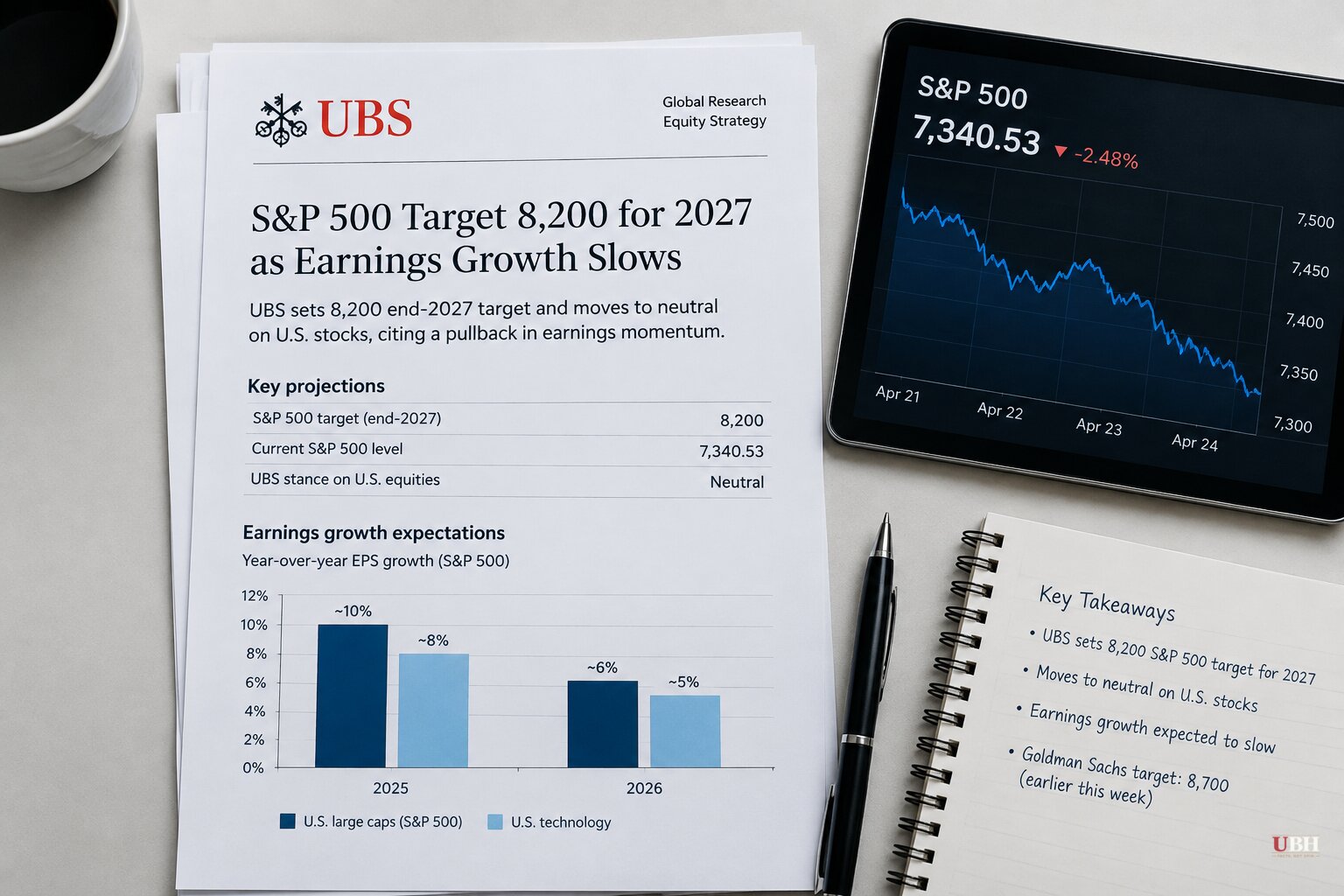
A day after Goldman Sachs put its end-2027 S&P 500 target at 8,700, UBS on Wednesday, Nov. 18, published a lower number: 8,200. That is about 12% above the index's Tuesday close of 7,340.53.
UBS also moved to a neutral stance on U.S. equities. In its Year Ahead 2027 report, the bank said elevated expectations and market concentration warrant more caution, even as it calls the broader outlook constructive.
The earnings cliff
Every major forecast now shares one shape: strong 2026 profits, then a much slower 2027.
UBS expects S&P 500 earnings growth of 29% this year and 15% next year. Goldman sees U.S. earnings growth slowing from 36% to 11%, with EPS rising from $375 to $415. LSEG IBES analysts expect 35% in 2026 and 15% in 2027.
Raymond James is the outlier on the mild side. Its numbers show EPS growth easing from 28% to 23%. Strategist Tavis McCourt wrote that material slowing is "likely more of a 2028 vs. 2027 theme."
Goldman estimates AI capital spending accounts for about half of S&P 500 earnings growth. A team led by Peter Oppenheimer wrote: "As we enter 2027, earnings growth is on course to slow sharply across all major regions, growth in AI capex spending is likely to peak and the cost of capital remains elevated." The bank still says it expects equities to rise, "but with volatility."
Amazon, Alphabet, Meta, Microsoft and SpaceX are expected to spend more than $800 billion on capex in 2026, a record. UBS projects global AI-related investment rising from $1 trillion this year to $1.4 trillion in 2027 and $1.5 trillion in 2028.
The tape: four down days
The S&P 500 fell 1.03% on Tuesday, Nov. 17, to 7,340.53, its fourth straight decline. The Dow dropped 848.75 points to 50,759.42. Both the S&P 500 and the Nasdaq had not strung together four losing sessions since September.
The index closed last Friday at 7,561, after its best week since August. Salesforce shed about 9% on Tuesday amid AI and tech pressure.
Rates are the other squeeze. The 10-year Treasury yield hit 5.15% on Friday, up from about 4.88% at the start of that week, after a hotter-than-expected CPI report. Skyler Weinand, chief investment officer at Regan Capital, said the data "sets the stage for another rate hike in December." He added that voters voiced frustration with inflation in the midterms, leaving the Fed little room to hold off.
Nvidia beat, and it did not settle the question
Nvidia reported October-quarter revenue of $115.8 billion and profit of $65.3 billion on Tuesday, both above Wall Street's expectations. It guided to about $130 billion for the current quarter, and shares rose in after-hours trading.
The call carried other news. Chair Harvey C. Jones said Jensen Huang voluntarily resigned as CEO over "personal behavior inconsistent with its code of conduct" and that the board has no plan to reinstate him. Huang had said earlier Tuesday he would return if asked. Interim CEO Colette Kress told investors, "Our demand is accelerating. Our supply is growing."
Nvidia also said it will stop shipping chips to China. It sold about $2.4 billion there last quarter, a sliver of total revenue. The company shed 12.75% last week as Huang's exit hit the stock.
A record quarter shows demand today. The 2027 forecasts are about whether customers keep raising spending at the same pace.
The case that slower is not broken
Not everyone reads the slowdown as a threat. Maya Bhandari, co-chief investment officer of multi-asset strategies at Neuberger, notes that the implied growth rates, high teens in the U.S. and high single digits in Europe, are "far from poor." She expects earnings growth, nominal growth and policy rates all to peak by early 2027, with earnings the most likely and rates the most contentious.
She also says prices have already adjusted. The global price/earnings ratio is down 20%. The top five S&P 500 stocks trade on almost the same forward P/E as the other 495, the narrowest gap since 2017. Global tech sits at 14.3x forward earnings, in the lowest decile of its 20-year range.
Bhandari adds that investors have not bought the cheapness, because it is hard to see where the upside surprises come from.
Ned Davis Research calls the earnings outlook for next year "questionable." The share of S&P 500 companies beating EPS estimates has slipped to 84% from 86% last quarter, according to FactSet, which Ned Davis reads as a sign optimism "has been overdone."
What UBS says to watch
UBS names the triggers that would worry it: capacity expansion outstripping demand, AI lab revenue growth slowing meaningfully, weaker cloud utilization, or falling AI costs failing to produce enough new usage. It also flags neocloud borrowing costs, power shortages and data center permitting delays.
It advises staying exposed to AI but favoring financially strong hyperscalers that fund their own investment.
The next concrete tests are the Fed's December meeting, where Weinand expects a hike, and the 2027 capex plans from the big cloud companies.
Sources used for this briefing
6 links from 6 independent newsrooms (syndicated copies of the same report count once)
These are the sources it draws on, linked so you can verify.


