
Original briefings. Zero spin.
Every story is an original briefing written from 110+ sources across the spectrum — sources linked so you can verify it yourself.
 tech
Low Interest (4/10)
August 21, 2026 at 07:12 PM
tech
Low Interest (4/10)
August 21, 2026 at 07:12 PM
Two New Exoplanets Announced This Week. Neither One Is Actually Like Earth
Two exoplanet stories hit this week. One is genuinely strange. The other got hyped with a label it doesn't deserve.
First, the strange one. A team led by Max Kroft at the University of Wisconsin-Madison announced discovery of GJ 523b, a planet 87 light-years away that's breaking the rules astronomers thought governed planet formation. It's about 2.5 times the width of Earth but packs in roughly 23.5 times Earth's mass, according to the study reported by both Space.com and BBC Sky at Night Magazine. That makes it what scientists call a "mega-Earth": absurdly dense, almost entirely rock and metal, with little to no atmosphere.
Standard planet formation theory says once a rocky core hits somewhere around 10 to 20 times Earth's mass, its gravity should start vacuuming up huge amounts of hydrogen and helium gas from the disk surrounding its young star. That's supposedly how you get gas giants like Jupiter and Saturn. GJ 523b blew past that mass threshold and stayed rocky anyway.
"This isn't what we expected at all," Kroft said in a University of Wisconsin-Madison statement carried by Space.com. "Dense planets like this aren't uncommon, but they're usually small rocky planets similar to Earth or Mercury. This planet is two and a half times bigger than the Earth."
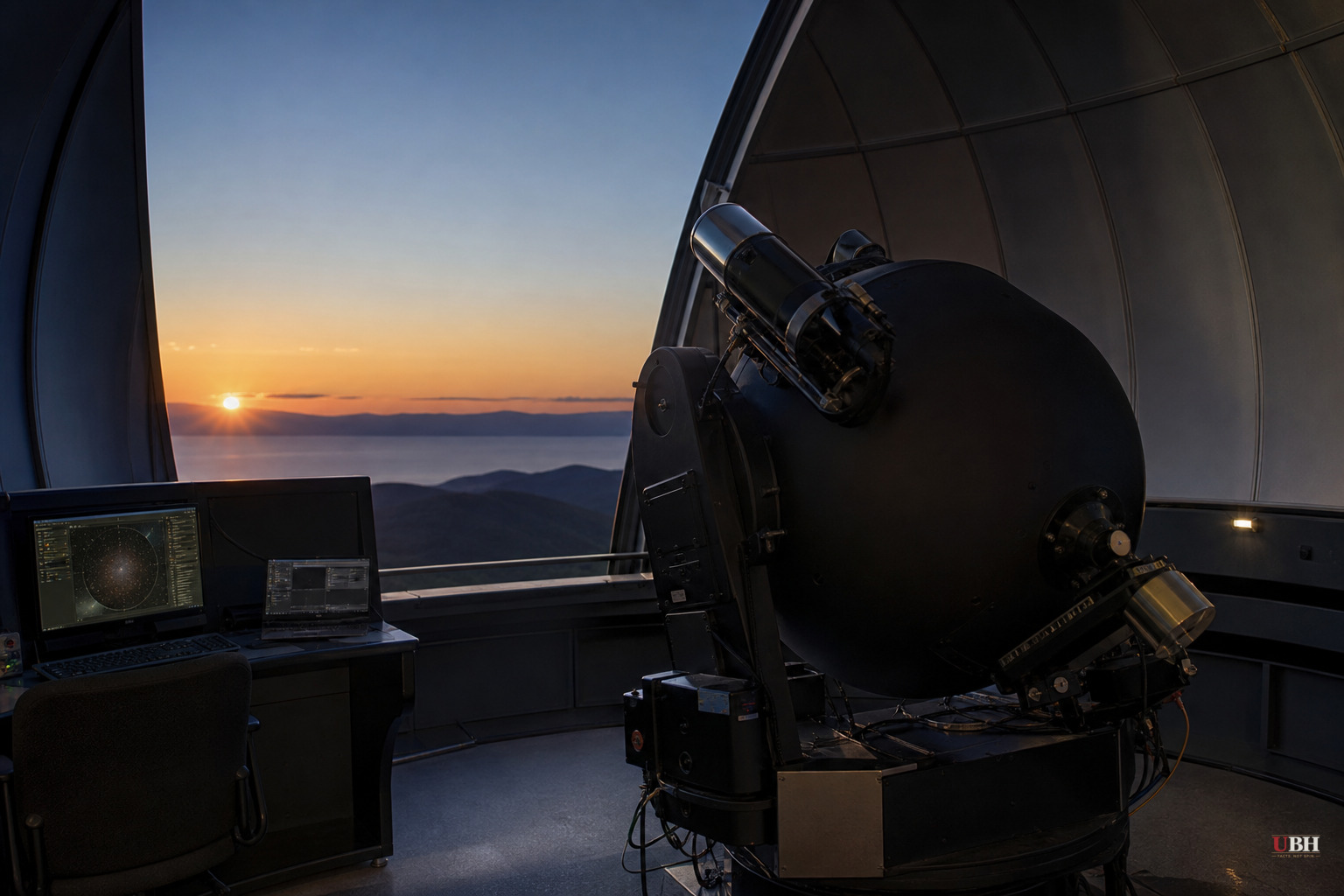
The planet was first flagged as a candidate by NASA's TESS satellite, then confirmed using the WIYN 3.5-meter Telescope at Kitt Peak National Observatory in Arizona. Researchers measured its gravitational tug on its host star to nail down the mass. The whole system is young, an estimated 170 million years old, which only deepens the mystery of how a planet that massive avoided ballooning into a gas giant so early in its life. GJ 523b is also the first exoplanet catalogued by the university's new Wisconsin Center for Origins Research project, which was actually hunting for a different kind of world: theoretical "Hycean" planets with oceans and atmospheres that might support life. Instead they found a rule-breaker.
The Other Discovery, and the Word Nobody Should Be Using
Separately, Forbes reported this week on GJ 3378b, a planet about 25 light-years away with a minimum mass just over twice Earth's, discovered using the Hobby-Eberly Telescope in Texas and the WIYN Telescope in Arizona. The research was led by Paul Robertson, an associate professor of astronomy at UC Irvine, and published in The Astrophysical Journal.
The planet orbits a red dwarf star and gets about 90% of the starlight Earth receives from the sun, putting it in the theoretical habitable zone where liquid water could exist on a surface, if it has one. Robertson called it "one of our closest cosmic neighbors" in comments to Forbes, noting that 25 light-years is nothing on a galactic scale spanning 100,000 light-years.
Forbes ran the story under the headline calling it an "Earth-Like Planet." NASA's own materials, per Forbes, describe it as "potentially rocky." That word, potentially, is doing a lot of work that the headline erases.
Astronomers don't know GJ 3378b's radius, don't know its actual composition, and don't know if it has an atmosphere at all. What they have is a minimum mass estimate from the radial velocity method, which measures a star's wobble caused by an orbiting planet's gravity. That method is good at estimating mass. It tells you almost nothing about what the planet is actually made of or whether it looks anything like home.
Scientific American's Phil Plait called this out directly this week, arguing the entire habit of calling exoplanets "Earth-like" needs to stop. His comparison: being roughly the same height as Freddie Mercury doesn't make you Freddie Mercury-like. At best you're Freddie Mercury-sized. Being roughly Earth-sized and getting roughly Earth-like starlight makes a planet Earth-sized, not Earth-like.
Of the more than 6,300 confirmed exoplanets cataloged to date, according to Scientific American, a legitimate Earth twin, a rocky planet with confirmed atmosphere, temperature, and water, has not been found. Not one. That's the actual state of the science as of this week.
What's Left Unresolved
Both discoveries raise real open questions. For GJ 523b, Kroft's team still doesn't know why it escaped the runaway gas-accretion process that supposedly kicks in once a core hits 20 Earth masses. For GJ 3378b, the honest answer is astronomers won't know if it's remotely Earth-like until they can measure an atmosphere, which requires next-generation instruments.
NASA's Habitable Worlds Observatory, cited by Forbes as designed for exactly this kind of atmospheric imaging, isn't expected to launch until the 2040s. Until then, calling any of these worlds "Earth-like" is a marketing choice, not a scientific finding.
Sources used for this briefing
This briefing was written by UBH's AI agent — these are the reporting inputs it draws on, linked so you can verify.


