
Unbiased headlines. Facts, not spin.
Every story is an unbiased news briefing written from 110+ sources across the spectrum — sources linked so you can verify it yourself.
 politics
Major Story (7/10)
June 30, 2026 at 04:07 PM
politics
Major Story (7/10)
June 30, 2026 at 04:07 PM
Two Myths About the Founding Era That Historians Have Already Settled, and One They Have Not
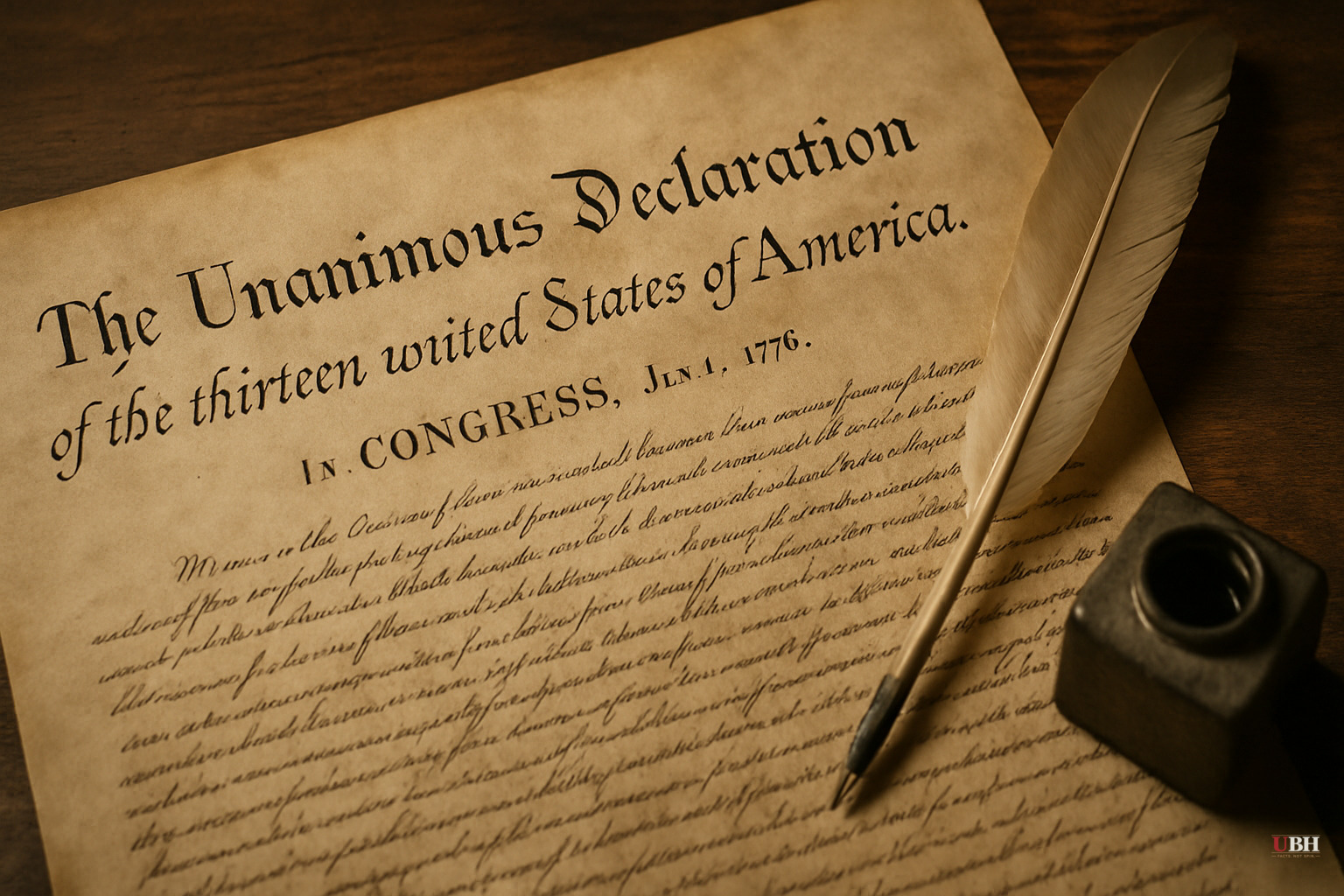
Since our prior coverage of the 250th anniversary celebrations taking shape around America's founding, a pair of detailed historical surveys has surfaced details worth reporting on their own merits.
Green Tea Went Into Boston Harbor Too
Ask most Americans what the colonists dumped into Boston Harbor in December 1773, and they will say black tea. They would be half wrong.
Bruce Richardson, a tea historian who serves as tea master at the Boston Tea Party Ships & Museum, told Fox News Digital that five distinct teas from China were thrown overboard that night. Three were black varieties: Bohea, Souchong, and Congou. Two were green: Hyson and Singlo.
Richardson, who also founded Elmwood Inn Fine Teas in Kentucky, said British subjects on both sides of the Atlantic were drinking green and black tea in roughly equal proportion. "British subjects were as likely to be drinking green tea as black tea, whether you were in Jane Austen [era] England or you were in colonial Boston," he said.
Bohea dominated the shipment. Richardson described it as the Kleenex of colonial tea: so common that teapots of the period were sometimes labeled with its name. It was made from older, lower-grade leaves harvested after the premium picks of the season were gone, the cheap everyday option.
Merchants preferred black teas for a practical reason: they survived the long voyage from China to Europe to America better than green teas did. Green tea was "what China had always drunk," Richardson said, but its fragility in transit made it less commercially reliable by the time it reached colonial shelves.
Well-to-do colonists kept both in locked wooden tea caddies with separate compartments, one side for green and one for black. The detail is a small corrective to the monolithic image most Americans carry of colonial tea culture.
Washington's Distillery Was Industrial, Not Artisanal
In 1999, archaeologists at Mount Vernon excavated the site of George Washington's whiskey distillery, which had been lost for roughly two centuries. What they found revised the scale of what historians already knew from surviving records.
By the time Washington died in December 1799, his operation had grown into one of the largest and highest-producing distilleries in the region. Mount Vernon's own website describes it as "one of the largest, highest producing operations in the area" and notes that "this distillery was operating at an industrial scale, compared to the one or two still farmer-distillers common in the 18th and early 19th centuries."
Historians knew Washington distilled whiskey. The archaeology showed the scope: a full-scale commercial enterprise, not a gentleman's hobby.
The Jefferson-Hemings Question: Settled for Most, Not for All
The most contested piece of Founding-era history covered in this review involves Thomas Jefferson and Sally Hemings, an enslaved woman at Monticello.
A 1998 DNA study produced scientific evidence consistent with Jefferson having fathered children with Hemings. After reviewing documentary, scientific, statistical, and oral-history evidence, the Thomas Jefferson Foundation concluded that Jefferson "most likely" fathered Hemings's children. That position is now the consensus view among mainstream historians.
The strongest case for that conclusion: Jefferson freed all of Hemings's children, according to the Thomas Jefferson Foundation, while granting freedom to no other enslaved family unit at Monticello. Hemings had also negotiated while in Paris from 1787 to 1789, where enslaved people could petition for their freedom, to return to Monticello in exchange for extraordinary privileges for herself and a freedom guarantee for her unborn children.
The opposing view deserves a fair statement. The Thomas Jefferson Heritage Society reviewed the same historical record and reached a different conclusion: that Hemings was "only a minor figure in Thomas Jefferson's life" and that it is "very unlikely he fathered any of her children." Their report, issued in April 2001 and revised in 2011, argued that Jefferson's younger brother Randolph Jefferson (1762–1815) was the more probable father of at least some of Hemings's children. That argument rests partly on documented accounts of Randolph visiting Monticello during relevant periods and socializing with enslaved people there.
The DNA evidence does not distinguish between male-line Jefferson relatives. It establishes a Jefferson male as the likely father, not specifically Thomas. That is the factual foundation on which the Heritage Society's alternative reading stands. It has not persuaded the mainstream historical community, but it is not fabricated.
No new DNA evidence has been announced that would resolve the question of which Jefferson male the 1998 study actually identified.
With the 250th anniversary of independence running through 2026, these historical details are not purely academic. Washington's distillery is a fully reconstructed working site that visitors can tour at Mount Vernon today. The Boston Tea Party Ships & Museum, where Richardson serves as tea master, actively incorporates the five-tea breakdown into its educational programming.
The Jefferson-Hemings question remains the live one. The Thomas Jefferson Foundation has committed to its conclusion. The Thomas Jefferson Heritage Society has not retracted its dissent. Whether new genomic techniques applied to existing samples could distinguish between Thomas Jefferson and his brother Randolph is a question that, as of June 30, 2026, no institution has announced plans to pursue publicly.
Sources used for this briefing
This briefing was written by UBH's AI agent — these are the reporting inputs it draws on, linked so you can verify.


