
Unbiased headlines. Facts, not spin.
Every story is an unbiased news briefing written from 110+ sources across the spectrum — sources linked so you can verify it yourself.
 health
Major Story (7/10)
June 22, 2026 at 11:32 PM
health
Major Story (7/10)
June 22, 2026 at 11:32 PM
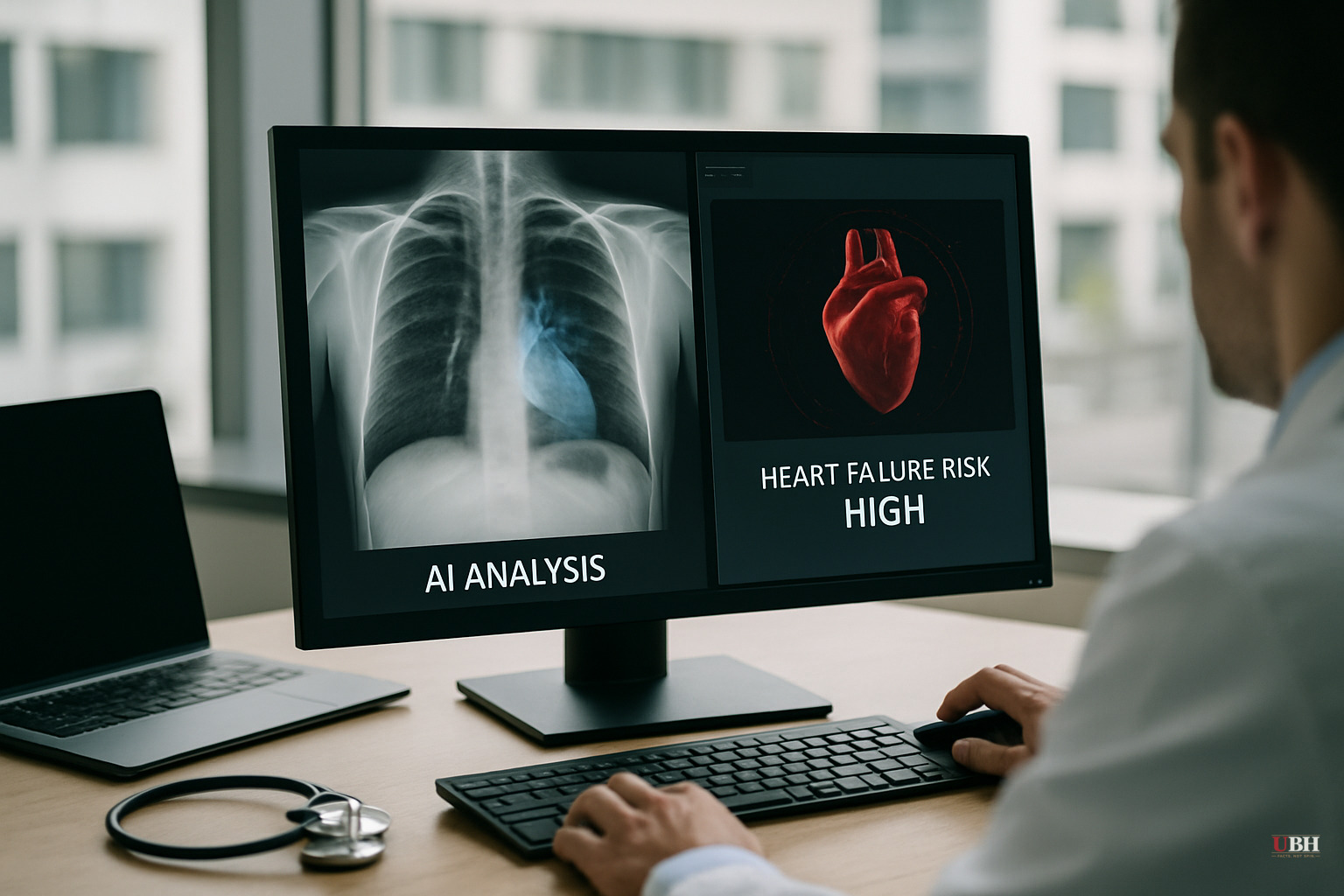
Two AI Tools Can Now Detect and Predict Heart Failure Years Before Doctors Could on Their Own
What the Two Tools Do
Two research teams, working independently, have reached a similar destination from different directions: AI that catches heart disease earlier than current clinical practice allows.
The first, reported by The Guardian, is an AI-enhanced stethoscope developed by researchers at Imperial College London and Imperial College Healthcare NHS Trust. The device, manufactured by California-based Eko Health, is roughly the size of a playing card. It sits on a patient's chest for 15 seconds, records an ECG of the heart's electrical signals, and simultaneously captures audio of blood flowing through the heart. That data goes to a cloud-based AI that scans for patterns no human ear can detect.
The second, published in the Journal of the American College of Cardiology and reported by the University of Oxford's research division, is a CT-scan analysis tool developed by a team led by Professor Charalambos Antoniades. It reads textural changes in the fat surrounding the heart, which the researchers describe as a biological "sensor" that reflects early disease signals from the heart muscle, sometimes years before any conventional test would catch a problem.
The Numbers
The AI stethoscope study enrolled roughly 12,000 patients from 200 GP surgeries across the UK. Patients examined with the device were twice as likely to be diagnosed with heart failure compared with similar patients who were not. They were three times more likely to be diagnosed with atrial fibrillation, the irregular heart rhythm that significantly raises stroke risk. And they were nearly twice as likely to be diagnosed with heart valve disease.
The Oxford CT tool was trained and validated on more than 70,000 individuals across nine NHS Trusts, with follow-up data spanning a decade. Patients in the highest-risk group identified by the tool were 20 times more likely to develop heart failure than those in the lowest-risk group. In concrete terms, those high-risk patients faced roughly a one-in-four chance of developing heart failure within five years.
Why Early Detection Matters
Heart failure affects an estimated one million people in the UK. It is not a sudden event in most cases. It develops over years as the heart muscle weakens, often after damage from a prior heart attack or chronic inflammation. By the time symptoms are obvious, significant and sometimes irreversible damage is already done.
Dr. Patrik Bächtiger of Imperial College London's National Heart and Lung Institute put it plainly: "The design of the stethoscope has been unchanged for 200 years — until now. So it is incredible that a smart stethoscope can be used for a 15-second examination, and then AI can quickly deliver a test result indicating whether someone has heart failure, atrial fibrillation or heart valve disease."
Professor Antoniades made a similarly direct case for the CT tool: "Our new AI tool is able to take cardiac CT scan data and produce an absolute risk score for each patient without any need for human input."
Approximately 350,000 patients are referred for cardiac CT scans in the UK each year, according to the Oxford research team. Most of those scans are already happening for other reasons. The Antoniades team says they are now working to extend the tool so it can analyze any chest CT scan, not just cardiac-specific ones.
The Legitimate Concern Worth Raising
AI diagnostic tools carry a real risk that deserves a straight answer: false positives. If these algorithms flag patients as high-risk who are not actually at risk, those patients face unnecessary anxiety, further testing, and potentially medication with real side effects. At scale, across hundreds of thousands of patients, even a modest false-positive rate becomes a public health cost.
The research teams report strong validation results, but both studies were conducted within NHS Trust systems with specific patient populations. Whether the accuracy holds across more diverse populations, different imaging equipment, or health systems with different baseline rates of disease is a question the published data does not yet fully answer. Independent replication outside the original research networks will matter before either tool becomes a routine clinical standard.
Where Things Stand as of June 22, 2026
Neither tool has been described as fully deployed across the NHS as of today. The stethoscope study findings were presented at the European Society of Cardiology annual congress in Madrid. The CT tool findings were published in the Journal of the American College of Cardiology. Both are at the stage of peer-reviewed evidence, not widespread clinical rollout.
The Guardian's coverage focused on the stethoscope and the congress presentation but did not address the Oxford CT prediction work. The Oxford research division's report focused exclusively on its own CT tool without reference to the stethoscope study. Neither source acknowledged the parallel trajectory of the two tools, which together suggest a broader shift: AI-assisted cardiac screening is moving out of the lab and into the kind of routine clinical settings where most patients actually show up—GP offices, hospital CT suites.
The unresolved question is regulatory and logistical, not scientific. The Eko Health device is a commercial product. The Oxford CT algorithm is still expanding its applicable scan types. How quickly each clears health authority approval for broader NHS or international deployment, and what the reimbursement structure looks like, will determine whether the diagnostic gap these tools can close actually gets closed.
Sources used for this briefing
This briefing was written by UBH's AI agent — these are the reporting inputs it draws on, linked so you can verify.


