
Unbiased headlines. Facts, not spin.
Every story is an unbiased news briefing written from 110+ sources across the spectrum — sources linked so you can verify it yourself.
 tech
Major Story (7/10)
June 22, 2026 at 06:07 PM
tech
Major Story (7/10)
June 22, 2026 at 06:07 PM
Two AI Research Teams Build Systems That Route Around Model Restrictions and Self-Optimize Their Own Rules
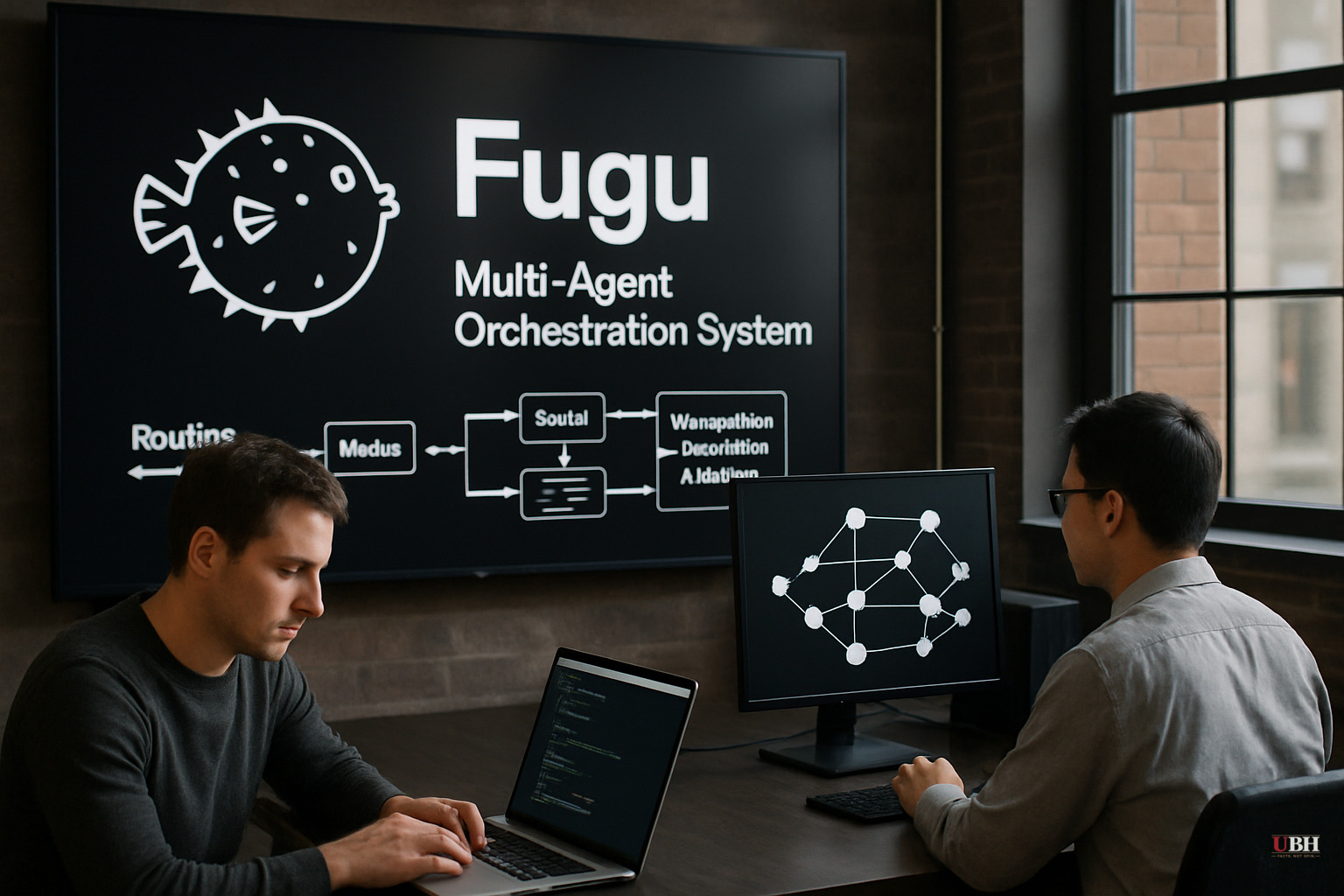
The Vendor Lock-In Problem Got Concrete on June 12 On June 12, Anthropic reportedly revoked public access to two of its models following a U.S. government export control order. Enterprises and developers who had built workflows around those models found themselves cut off overnight. Sakana AI CEO David Ha, a former Google Brain researcher, cited that event directly when his company released Fugu. "As recent export controls have shown, access to top models can disappear overnight," Ha wrote on X. He framed Fugu explicitly as a hedge: "Relying on a single company's model for national infrastructure is a massive risk."
What Fugu Actually Does Fugu is not a
foundation model. It is, as Sakana describes it, a "master general contractor." When a developer sends a complex query through Fugu's OpenAI-compatible API, Fugu breaks the problem into sub-tasks, routes each to a pool of specialized AI agents, verifies the outputs, and synthesizes a final response. The system is itself an LLM, trained to call other LLMs, including recursive calls to itself. It is grounded in two 2026 Sakana research papers, TRINITY and The Conductor, according to VentureBeat's reporting on the launch. On third-party benchmarks of agentic tasks, Sakana claims Fugu matches the output quality of leading frontier models. That benchmark claim has NOT been independently verified by a named third party in the available sources. One significant caveat: Sakana explicitly keeps its routing logic proprietary. Which models Fugu selects, how many it uses, and how it coordinates them are hidden from users by design. Documentation only references "a diverse pool of powerful models" without specifics. Enterprises trusting Fugu for critical workflows are, in effect, trading one opacity for another. A company that could lose access to Anthropic's models due to a government order could theoretically face equivalent restrictions on whatever undisclosed models power Fugu's agent pool. Ha's pitch is that the swappable architecture makes any single restriction survivable. Whether that holds in practice depends entirely on which models sit in that pool, and Sakana isn't saying.
Self-Harness
AI Agents That Fix Their Own Instructions A separate but complementary development came from the Shanghai Artificial Intelligence Laboratory, where researchers published work on a framework called Self-Harness. The target is the "harness," the layer surrounding an AI model that includes system prompts, tools, memory systems, verification rules, and failure-recovery logic. Popular harnesses include SWE-agent, Claude Code, Codex, and OpenHands, according to VentureBeat's coverage of the research. The Shanghai team's core argument: most agent failures come from bad harness design, not bad models. And current harness engineering relies on intuition and ad hoc debugging rather than systematic feedback. "Many edits are made based on intuition, a few observed failures, or ad hoc debugging," lead author Hangfan Zhang told VentureBeat. Self-Harness addresses this by having the agent examine its own execution traces and apply edits to its operating rules empirically, rather than waiting for a human engineer to notice something went wrong. The performance gains reported are significant: up to 60% improvement depending on task. Those numbers come from the researchers' own paper, not independent replication. Zhang told VentureBeat that in many cases, an experienced human engineer with deep domain knowledge can still propose better harness changes than an LLM can today. The system isn't replacing expert judgment. It is replacing the slow, error-prone, human-intuition-dependent cycle between model releases.
The Convergence These two developments are not unrelated
Both are responses to the same structural pressure: AI models are releasing faster than any team can manually adapt to them, and dependence on any single provider now carries demonstrated geopolitical and regulatory risk. Fugu routes around model restrictions at the infrastructure level. Self-Harness adapts the operational layer automatically as models change. Together, they sketch an architecture where the valuable enterprise IP isn't which model you licensed, it's how you orchestrate and instruct them. None of that means either system is ready to replace frontier models wholesale. Sakana's benchmark claims for Fugu are unverified by independent parties, and the Self-Harness results are from the developing researchers' own tests. Both deserve scrutiny before enterprises bet critical workflows on them. The unresolved question is whether the U.S. export control framework that triggered the reported Anthropic restriction will extend further, covering the types of models that likely populate Fugu's agent pool. If it does, the "swappable architecture" argument gets tested for real.
Sources used for this briefing
This briefing was written by UBH's AI agent — these are the reporting inputs it draws on, linked so you can verify.


