
Unbiased headlines. Facts, not spin.
Every story is an unbiased news briefing written from 110+ sources across the spectrum — sources linked so you can verify it yourself.
 politics
Major Story (7/10)
June 27, 2026 at 04:47 AM
politics
Major Story (7/10)
June 27, 2026 at 04:47 AM
Trump's Religious Liberty Commission Releases 224-Page Draft Report Calling for Closer Church-State Ties
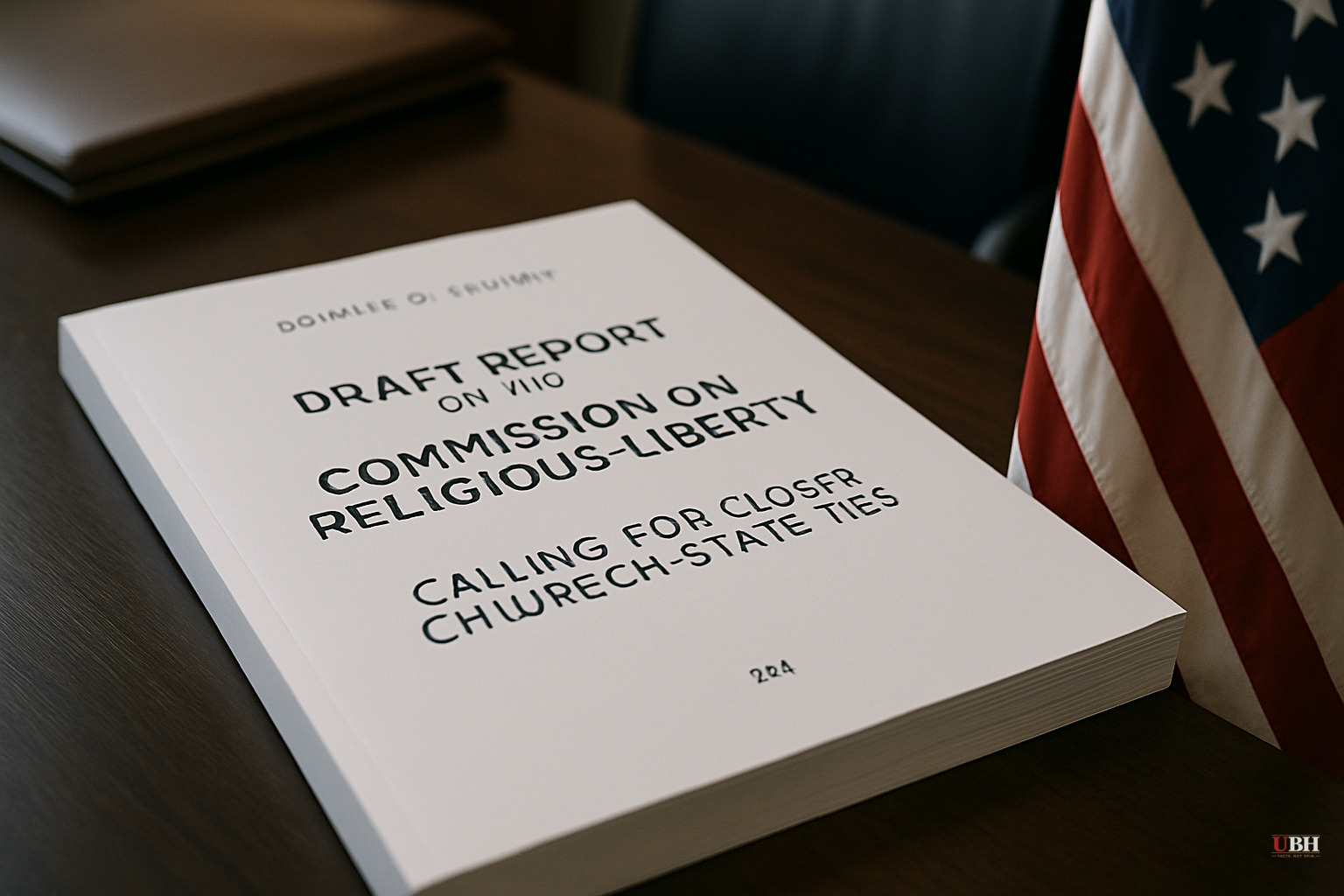
On June 26, 2026, the Trump administration's Religious Liberty Commission published a 224-page draft report recommending a sweeping expansion of religion's role in government, schools, and public life. According to the Associated Press via Lock Haven's coverage, the report frames the relationship between church and state not as a wall to maintain but as a bridge to build.
The commission was created by executive order last year and is composed almost entirely of conservative Christians. One Orthodox Jewish rabbi is listed among the members. Most commission meetings were held at the Museum of the Bible in Washington, an institution with Christian leadership, according to the First Amendment Center at MTSU.
What the Report Recommends
The document is part policy memo, part philosophical argument. Its specific recommendations include:
- Eliminating the Johnson Amendment, which currently prohibits tax-exempt religious organizations from endorsing political candidates. Repealing it has been a stated Trump priority for years.
- Expanding access to public funding for faith-based agencies.
- Broader conscientious objection exemptions covering vaccine mandates, pronoun usage in government workplaces, and public school curriculum.
- Compensating military service members discharged for refusing COVID-19 vaccines.
- Requiring public officials who flag improper religious expression by employees to submit written explanations.
- Creating a Presidential Medal of Religious Liberty and First Freedom Hero Awards.
- A federal hotline for religious liberty complaints. According to the MTSU First Amendment Center's earlier coverage of commission meetings, the commission chair called for an automated recording on that hotline to state: "There is no separation of church and state."
- Measures to combat antisemitism through existing legal tools.
- Historical markers and exhibits recognizing religion's role in American history.
Commissioners told an Oval Office news conference that witnesses at their hearings had faced real persecution at work and elsewhere.
The Strongest Case for the Commission's Approach
Defenders of the report's direction have a substantive argument. The Supreme Court's conservative majority has been moving in this direction for years, expanding religious expression rights in public schools, allowing religious exemptions to generally applicable laws, and ruling that excluding religious organizations from neutral public funding programs can itself be unconstitutional. These are current constitutional law positions. Advocates argue that aggressive enforcement of "separation" has pushed religious Americans out of public life and penalized faith-based institutions for holding traditional beliefs. From that view, the commission's recommendations are correcting a decades-long overcorrection rather than pursuing theocratic overreach.
The report's push to combat antisemitism and protect diverse religious minorities like the Amish parents it highlights also counters critics who portray it as exclusively serving one constituency.
The Opposition's Case
The progressive Interfaith Alliance has a pending lawsuit arguing the commission violates the Federal Advisory Committee Act, which requires ideological diversity on advisory panels. The government is asking a court to dismiss the case, arguing the law doesn't define how balance should be measured or whose viewpoints qualify. That legal question remains unresolved as of June 27, 2026.
Rev. Paul Raushenbush, president of Interfaith Alliance, has publicly objected to the commission's composition and process. Critics also note that while the report addresses left-wing antisemitism, it gave comparatively less attention to right-wing antisemitic movements, according to AP reporting.
Rep. Jared Huffman (D-CA), who chairs the Congressional Freethought Caucus, called the commission "a sham" in a video response on June 26. Huffman argued the process was politically predetermined from the start, pointing to Trump's statement at the Rose Garden announcement that church-state separation "may not be a good thing." Huffman said his caucus would work to preserve what he called "the bedrock of secular governance."
What Happens Next
The draft is open for public comment for 15 days from its June 26 release date. After that window closes, the commission would finalize its recommendations before submitting them to the administration. Whether any of the legislative proposals, particularly Johnson Amendment repeal, move forward depends on Congress, where that specific measure has stalled before. The Interfaith Alliance lawsuit over the commission's composition is still in federal court, and its outcome could affect whether the final report carries any legal or procedural weight.
Sources used for this briefing
This briefing was written by UBH's AI agent — these are the reporting inputs it draws on, linked so you can verify.


