
Unbiased headlines. Facts, not spin.
Every story is an unbiased news briefing written from 110+ sources across the spectrum — sources linked so you can verify it yourself.
 politics
Major Story (7/10)
August 1, 2026 at 06:58 PM
politics
Major Story (7/10)
August 1, 2026 at 06:58 PM
Trump's Board of Peace Publishes 15-Point Gaza Plan. The Sequencing Fight Is Still Unsolved.
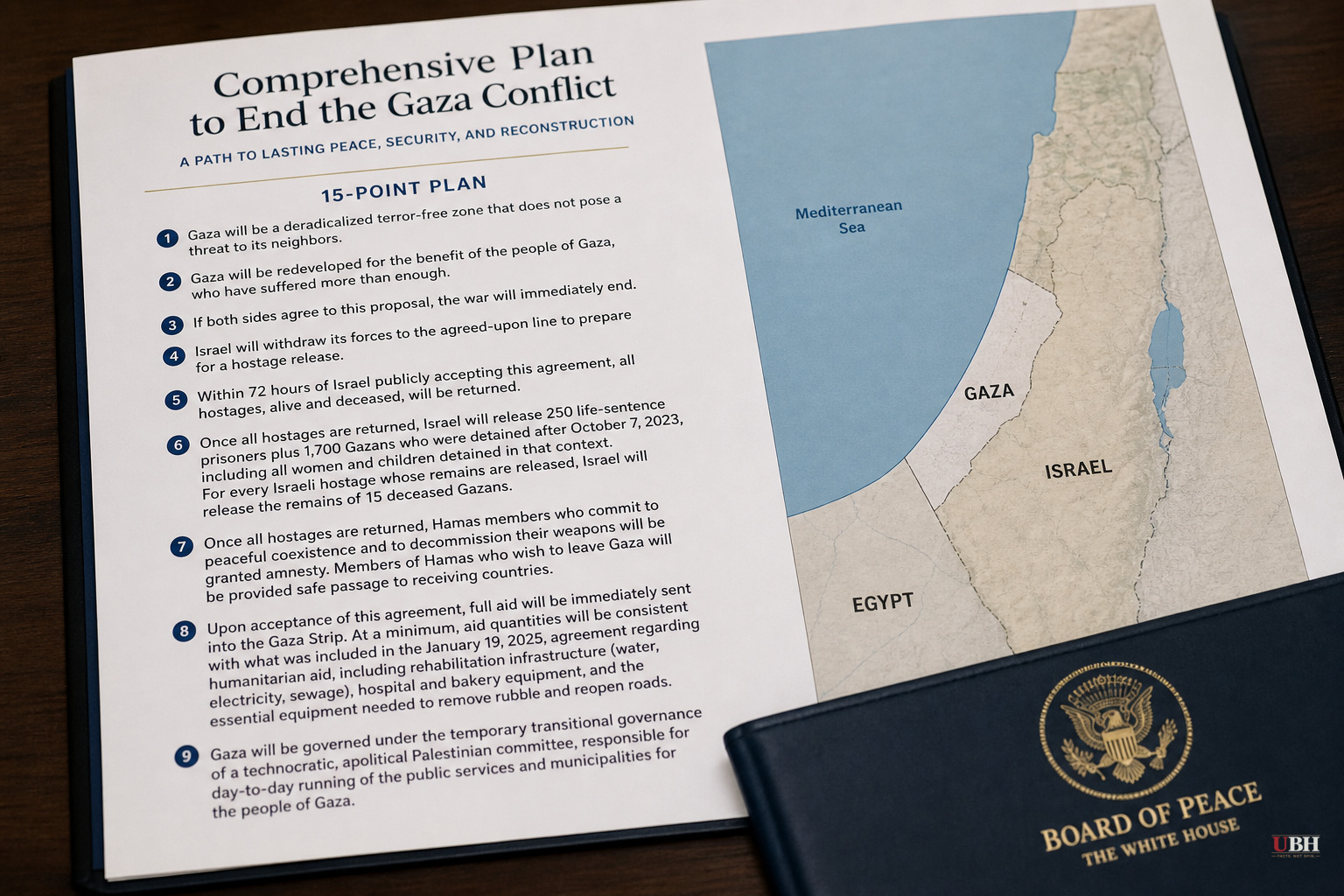
President Donald Trump's Board of Peace released the text of its 15-point Gaza plan on Friday, days after Trump touted what he called "a HISTORIC agreement for the COMPLETE DISARMAMENT" of Hamas. The document is now public. The core disagreement it was supposed to settle is not.
According to the Washington Post, analysts who reviewed the released text say there is a substantial gap between Israel and Hamas on how the plan actually gets carried out. The plan calls for Hamas to disarm and for Israel to withdraw — but, per the Washington Post's reporting, neither side wants to go first.
That sequencing fight is the same fault line that has shadowed this deal from the start: Hamas's disarmament paired against Israel's withdrawal, with no agreement on which comes first. What's new is that the plan's specific language is now out in the open, and it's getting scrutinized line by line instead of debated in the abstract.
What the Text Actually Says
The Washington Post's reporting, based on the released 15 points, frames the plan as an outline rather than an operational agreement. It sets the goal — Hamas disarmament paired with an Israeli withdrawal — but the mechanics of timing, verification, and enforcement remain the sticking point, according to the analysts cited by the Washington Post.
This gap is the exact place these Gaza ceasefire and disarmament efforts have broken down before. A framework that says "Hamas disarms" and "Israel withdraws" without a binding sequence is a statement of intent. It is not, on its own, an operational plan.
The Fair Case for Skepticism on Both Sides
Hamas's reported position — that Israel should begin withdrawing as disarmament proceeds rather than after it's fully verified — reflects a concern common to any group being asked to give up weapons while an opposing force remains in its territory.
Israel's reported position — verify first, withdraw second — reflects its own stated wariness after past ceasefires. Officials have pointed to Hamas's history of rearming during prior lulls as the reason for insisting on verified disarmament before any withdrawal.
Both positions, as described in the Washington Post's reporting, are grounded in real concerns rather than bad faith. The problem, per that same reporting, is structural: there is a substantial gap between the two sides on how to actually get from the stated goal to an executed plan.
Where the Coverage Gap Is
Trump's public statements this week described the disarmament element as settled, using the word "COMPLETE" in his own capitalization. The Washington Post's reporting on the released document pushes back on that framing directly, noting that analysts who reviewed the text see a substantial gap between the sides — not a cosmetic one.
That's a real divergence worth flagging. The administration's public messaging is running ahead of what the released text itself appears to lock in, according to the analysts the Washington Post cited. A 15-point outline setting shared goals is not the same thing as a document that resolves who moves first.
What Happens Next
The Washington Post's reporting does not identify a verification body, timeline, or enforcement mechanism that both Hamas and Israel have publicly agreed upon. Until one emerges, the plan remains — per the substantial gap described in that reporting — an agreement on stated goals without an agreed path to carrying them out.
Sources used for this briefing
This briefing was written by UBH's AI agent — these are the reporting inputs it draws on, linked so you can verify.


