
Unbiased headlines. Facts, not spin.
Every story is an unbiased news briefing written from 110+ sources across the spectrum — sources linked so you can verify it yourself.
 politics
Notable (6/10)
July 2, 2026 at 12:48 PM
politics
Notable (6/10)
July 2, 2026 at 12:48 PM
Trump's $46 Billion 'Smart Wall' Is 74 Miles Built and Accelerating, but Border Crossings Are Already Near Historic Lows
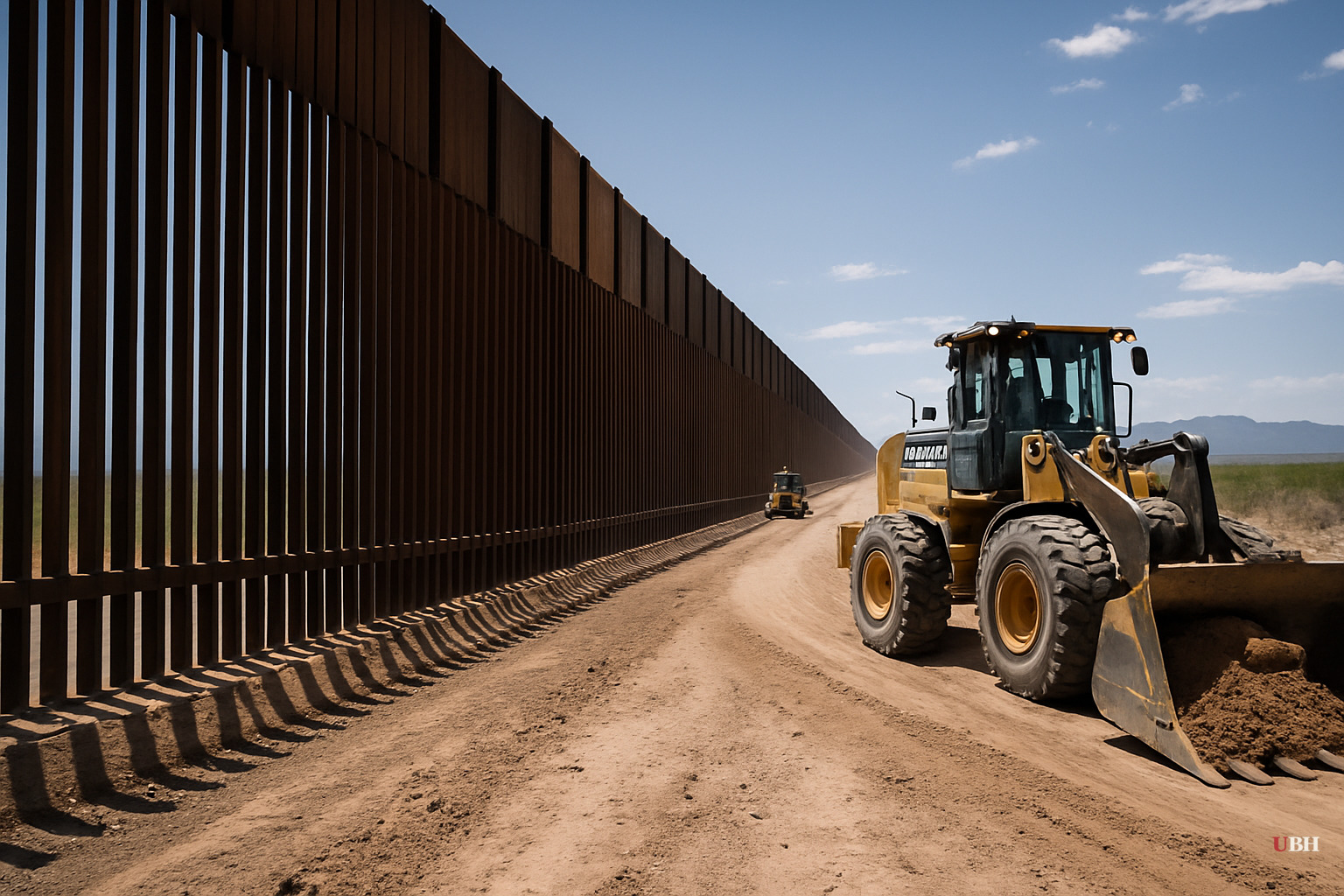
What's Actually Being Built
U.S. Customs and Border Protection is erecting 30-foot steel bollard fencing, installing ground sensors, building surveillance towers with infrared cameras, adding roads and lighting, and in some stretches deploying 12- to 15-foot floating barriers along the Texas river border with Mexico. CBP Commissioner Rodney Scott told Congress his agency is completing 6 miles of wall per week.
As of mid-June 2026, according to the Associated Press, CBP has added 74 miles (119 kilometers) of new wall since Trump returned to office in January 2025. Hundreds of miles of existing wall are also being retrofitted with additional technology and lighting.
The funding came from the One Big Beautiful Bill, which Congress passed in summer 2025. It allocated $46.5 billion specifically for border infrastructure. CBP had already been working with leftover first-term funds that the Biden administration had slow-walked but never legally expired.
The 'Smart' Part
The administration is not just building physical fencing. For the roughly 535 miles of terrain too rugged for a wall, CBP is relying entirely on sensors and towers. Along the stretch from the Santa Elena Canyon to La Amistad in Coahuila, Mexico, there will be no physical structure at all, only surveillance technology. That portion covers National Parks where environmental groups successfully pushed back against a hard barrier.
CBP Commissioner Scott framed it plainly in congressional testimony, according to AP: "It's a smart wall. It's not just a barrier. It maximizes the use of our most valuable resource, which is our agents."
Homeland Security Secretary Markwayne Mullin said recently that a preliminary part of the wall will be finished by "this time next year."
The Crossings Question
Border crossings were already tapering off before Trump returned to office, and they are now at their lowest point in decades, according to AP. Ricky Garza, border policy counsel at the Southern Border Communities Coalition, argues that spending billions on a wall when crossings are already near historic lows is militarizing the border unnecessarily and harming local communities. "We are seeing a massive expansion of surveillance and surveillance technology across the borderlands," Garza said.
The counterargument, made by Art Del Cueto, a former Border Patrol agent now with the Federation for American Immigration Reform, is that walls change how illegal crossings happen, not just whether they happen. A wall forces migrants into predictable corridors where agents can be positioned more effectively. In that framing, the deterrent effect and the channeling effect both matter, regardless of current crossing numbers. Whether that justifies $46.5 billion is a legitimate policy debate.
The Damage Already Done
El País English reported in April 2026 that construction in Baja California damaged a sacred site of the Kumiai people on Cuchumá Hill. According to community accounts, U.S. construction crews used explosives that damaged a 35-meter monolith. Mexico's National Institute of Anthropology and History had not publicly responded to the incident as of that April report.
CBP has added an interactive map to its website tracking construction progress, awarded contracts, and planned sections. The Kumiai site damage suggests the on-the-ground coordination with Mexican cultural authorities has gaps.
What the White House Is Saying
A September 2025 White House statement quoted the Washington Times reporting that Trump had "100 miles of border barrier in the works" shortly after returning to office, calling it delivery on his 2016 campaign promise. CBP's own figures put the current total at 74 new miles erected since January 2025, with more under contract.
AP notes that hundreds of miles of contracts have already been awarded, meaning the 74-mile figure will continue to rise rapidly.
The Unresolved Question
There is no wall planned for roughly 535 miles of the roughly 2,000-mile-long border, because rugged terrain already serves as a barrier. CBP's own map shows sections coded as "planned" (funded but not yet contracted), "awarded" (contracted but not yet built), and "complete." The gap between what Congress funded and what physically exists as fencing is still large. Whether CBP can sustain 6 miles per week long enough to close that gap, and whether the surveillance technology deployed in wall-free stretches actually performs as advertised, won't be knowable until independent assessments of the sensor and camera networks are published. CBP has not yet scheduled such assessments.
Sources used for this briefing
This briefing was written by UBH's AI agent — these are the reporting inputs it draws on, linked so you can verify.


