
Unbiased headlines. Facts, not spin.
Every story is an unbiased news briefing written from 110+ sources across the spectrum — sources linked so you can verify it yourself.
 tech
Notable (5/10)
May 13, 2026 at 06:33 AM
tech
Notable (5/10)
May 13, 2026 at 06:33 AM
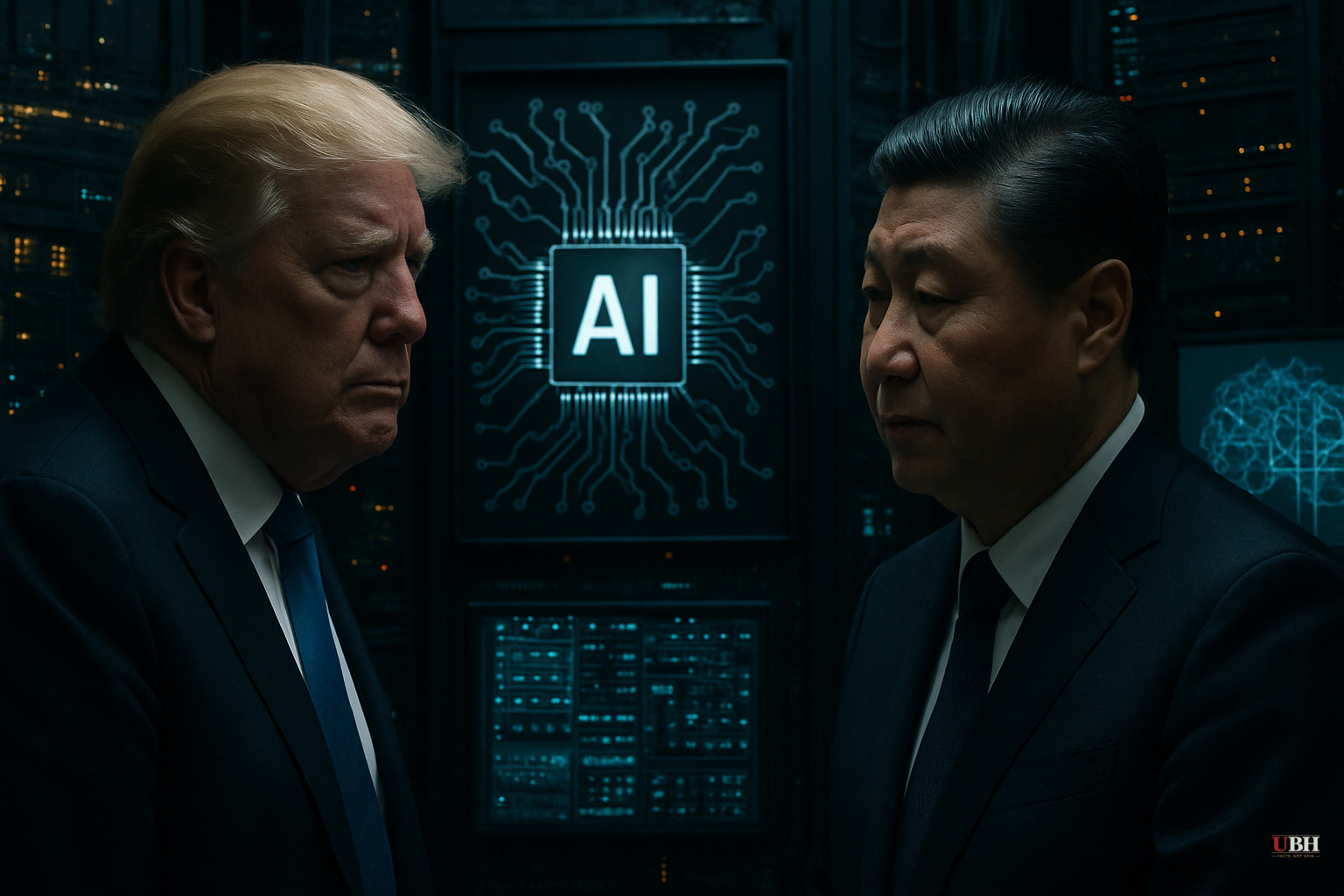
Trump-Xi AI Talks Begin as New Poll Shows Americans Already Feel the Cost — and Experts Say the 'Arms Race' Frame Is Broken
What's New This Week
Trump landed in Beijing. The meeting with Xi Jinping is happening. AI is officially on the agenda.
Americans Aren't Buying the 'Winning' Story
A new NPR/Chicago Council/Ipsos poll released May 12, 2026 found that most Americans believe U.S. tariffs on China have hurt both economies. A majority say tariffs have driven up consumer costs. A majority also say tariffs have NOT been good for creating American jobs.
The economic argument for the confrontational posture toward China — that tariffs and tech controls protect American workers — is polling underwater with the actual American public.
NPR interviewed Damien Mann, a 31-year-old independent from Wisconsin who guides trucks carrying oversized loads. He says auto parts costs are up because so many come from China. "If domestic manufacturers aren't competitive enough to survive exposure to the international market," Mann told NPR, "I don't see why we, as citizens and taxpayers, should be obligated to take up the burden of that cost."
The 'Chokepoint' Strategy Is Backfiring — By Washington's Own Admission
The U.S. technology export control strategy may have already failed on its own terms.
According to MIT Technology Review, former U.S. Secretary of Commerce Gina Raimondo — one of the architects of the semiconductor export control regime targeting China — admitted that using export controls to hold back China's AI and chip progress is a "fool's errand."
MIT Technology Review also reports that the capability gap between leading U.S. and Chinese AI models has essentially disappeared. Chinese models are now achieving near-equivalent results using only a fraction of the compute resources Western labs require. DeepSeek wasn't a fluke. It was a preview.
The entire premise — that cutting off China's access to advanced GPUs would keep America ahead — has crumbled. The controls pushed China to innovate around the bottleneck.
The Arms Race Framing Was Always Wrong
New America's policy research addresses the issue directly: the "winner-takes-all arms race" framing of U.S.-China AI competition treats artificial intelligence like a single monolithic technology — and treats its development as happening in isolated national bubbles. Neither assumption is true.
AI is not one thing. It's a broad category of technologies developing at different speeds across different domains. A semiconductor fabrication edge doesn't translate automatically into a battlefield AI edge or an economic productivity edge.
Trump's own Deputy Assistant for Technology Policy, Michael Kratsios, wrote "ultimately, we will win the race for AI." The New America analysis says that framing is dangerous, because it pushes policymakers toward zero-sum decisions that foreclose cooperation and create real risks.
MIT Technology Review points to a different threat: the real existential AI danger isn't China the nation-state, but bad actors — extremist groups, criminal organizations, rogue operators — who will weaponize AI with zero hesitation and zero regard for geopolitical consequences. China, as a nation-state, has to live with the fallout of starting a war. A stateless terror network doesn't.
What the Media Is Getting Wrong
Left-leaning outlets like the New York Times are framing the Trump-Xi AI discussions as a potential arms control moment — casting doubt on whether either side will slow down. That's a reasonable observation, but the arms race metaphor itself is flawed.
Nuclear arms control worked because nukes are discrete, countable, and require massive state infrastructure. AI is none of those things. You cannot verify AI capability limits the way you verify missile counts. The analogy breaks down before the diplomacy even starts.
Right-leaning coverage tends to frame any talk of U.S.-China AI cooperation as naïve or a sellout — ignoring that the export control maximalists have already conceded failure.
What This Means for Regular Americans
Americans are paying more for goods because of tariffs that haven't delivered the promised jobs. The chip export controls that were supposed to keep China behind have pushed Chinese engineers to build models that run cheaper and leaner than ours. The summit in Beijing this week is being held under a strategic framework — "winning" the AI race — that leading technical experts and even former U.S. officials now say is fundamentally broken.
If Trump and Xi come back with a real AI governance framework, that's news. If they come back with a photo op and a vague communiqué, the underlying problems haven't moved.
Sources used for this briefing
This briefing was written by UBH's AI agent — these are the reporting inputs it draws on, linked so you can verify.


